
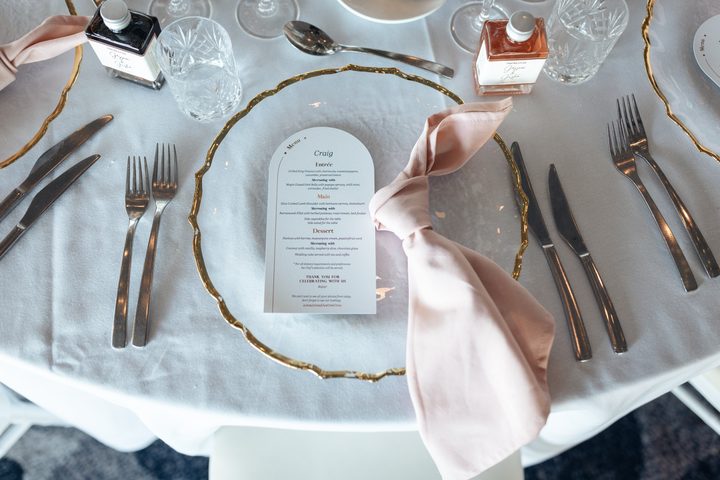
Your wedding menu card does two jobs at once: it tells guests what they are eating and it doubles as a keepsake from your table. Getting the wording and layout right does not require a graphic design degree, but it does require knowing what to include, in what order, and how to format it so nothing important gets lost in a crowded reception setting. This guide walks you through every decision, from courses to dietary symbols to paper and sizing, with real wording examples across three distinct wedding styles.
- A complete menu card includes a header, the couple’s names, every course in serving order, short dish descriptions, and dietary symbols.
- Plated dinners list courses top to bottom; buffets group by station; family-style lists shared dishes.
- Single column suits minimal and formal styles; two column works for multi-course or cocktail-style receptions.
- Standard card size is 4 x 9 inches (102 x 229 mm); table tent is 4 x 6 inches (102 x 152 mm).
- Use letter-based symbols (V, VE, GF, N) with a legend at the card bottom for clarity.
- Paperlust menu cards are available in digital print, flat foil, letterpress, metallic, and white ink across 500+ designs.
What to Include on a Wedding Menu Card
Most guests will spend 30 seconds reading a menu card before setting it aside. Every element on the card needs to earn its place. Here is what a complete, well-structured menu card contains.
The header
Start with a visual anchor. This is typically one of three options:
- “Menu” in a display typeface, centered
- The couple’s names or monogram, followed by the word “Menu” below
- A short personal line such as “Dinner in celebration of Emma & James”
For formal plated dinners, a clean centered “Menu” headline with the couple’s names and date directly below is a proven format. Rustic and boho styles often lean on the couple’s names as the primary header, letting the food listing follow naturally underneath.
Couple’s names and wedding date
This is optional but almost universally used. Names and date transform a functional card into a keepsake guests take home. Place them directly below the header, in a lighter or smaller typeface than the headline.
Courses in order
List every course in the order it will be served, with the dish name and a brief description (typically one line). For plated dinners, this means first course through dessert. For buffets, group by station. For family-style service, list the shared dishes.
Short dish descriptions
Keep descriptions to the key ingredients and cooking method. Three to eight words is the sweet spot. Guests with allergies need to quickly identify proteins, nuts, and dairy, so lean toward specificity over poetry.
Dietary symbols
Mark each dish clearly. Define every symbol you use in a small legend at the base of the card.
Optional drink or wine pairing notes
A single line per course works well: “Paired with Sauvignon Blanc” or “Sommelier’s selection.” For receptions with a signature cocktail, add a short note at the top or bottom: “Signature cocktail: Rosemary Gin Spritz.”
Optional welcome or thank-you line
A warm closing line adds a personal touch without crowding the food listing. Keep it to one short sentence.
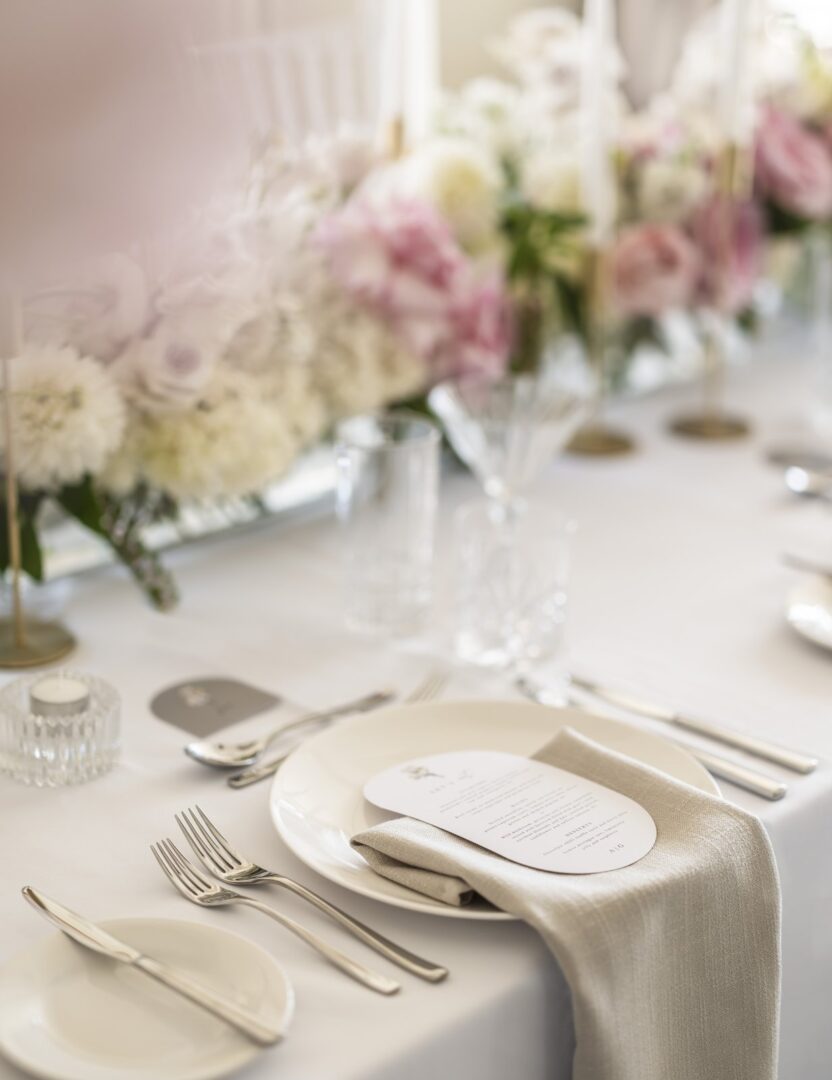

How to Structure a Plated Menu (Starter, Main, Dessert)
A plated reception dinner is the most common format and the one that requires the most careful ordering. Follow these steps to structure it cleanly.
Step 1: List courses in serving order
Work from first to last, top to bottom on the card. A typical plated structure runs:
- Welcome amuse-bouche or passed canape (if applicable)
- First course (soup or salad)
- Second course (optional – often a fish or pasta course at formal dinners)
- Main course (entree)
- Dessert
- Wedding cake (note separately if different from the plated dessert)
Step 2: Write the dish name first, description second
The dish name anchors the line. The description follows, typically in a lighter font style or italics on printed cards.
Heirloom Tomato Soup
with basil oil, charred bread, and burrata
Main Course
Herb-Crusted Lamb Rack GF
with roasted root vegetables, chimichurri, and potato gratin
Dessert
Dark Chocolate Fondant
with salted caramel ice cream and hazelnut praline
Step 3: Handle multiple protein choices
When guests pre-selected their entree, note this at the top of the entree section: “Your selection has been noted” or “Please see your place card for your entree choice.” This prevents guests from asking staff which protein they ordered.
If listing two proteins on the same card (common at smaller weddings without pre-orders), separate them clearly:
Filet Mignon
with truffle jus, asparagus, and dauphinoise potato
or
Roasted Cauliflower Steak V, GF
with harissa cream, roasted chickpeas, and herb oil
Step 4: Note the wedding cake separately
If you are having a wedding cake served at the table as an additional dessert after the plated dessert, add a short line at the end:
How to List Drinks and Wine Pairings
Drink listings on wedding menu cards range from a simple “open bar” note to full sommelier-style course pairings. Choose the level of detail that matches your reception style.
Minimal drinks note
Appropriate for most receptions:
Signature cocktail callout
elderflower gin, cucumber, tonic, and fresh mint
Place this at the top of the card, just below the header, or at the very bottom above the dietary legend.
Full wine pairing listing
For formal dinners with a curated wine list, pair each course with a wine note inline:
Seared Scallop with Cauliflower Puree
Paired with: 2024 Pouilly-Fume, Loire Valley
Main Course
Braised Beef Short Rib
Paired with: 2022 Barossa Valley Shiraz
Dessert
Pavlova with Seasonal Berries
Paired with: 2023 Moscato d’Asti
If your card is already text-heavy with courses, consider printing a separate wine card or pairing sheet rather than cramming pairing notes onto the main menu card.
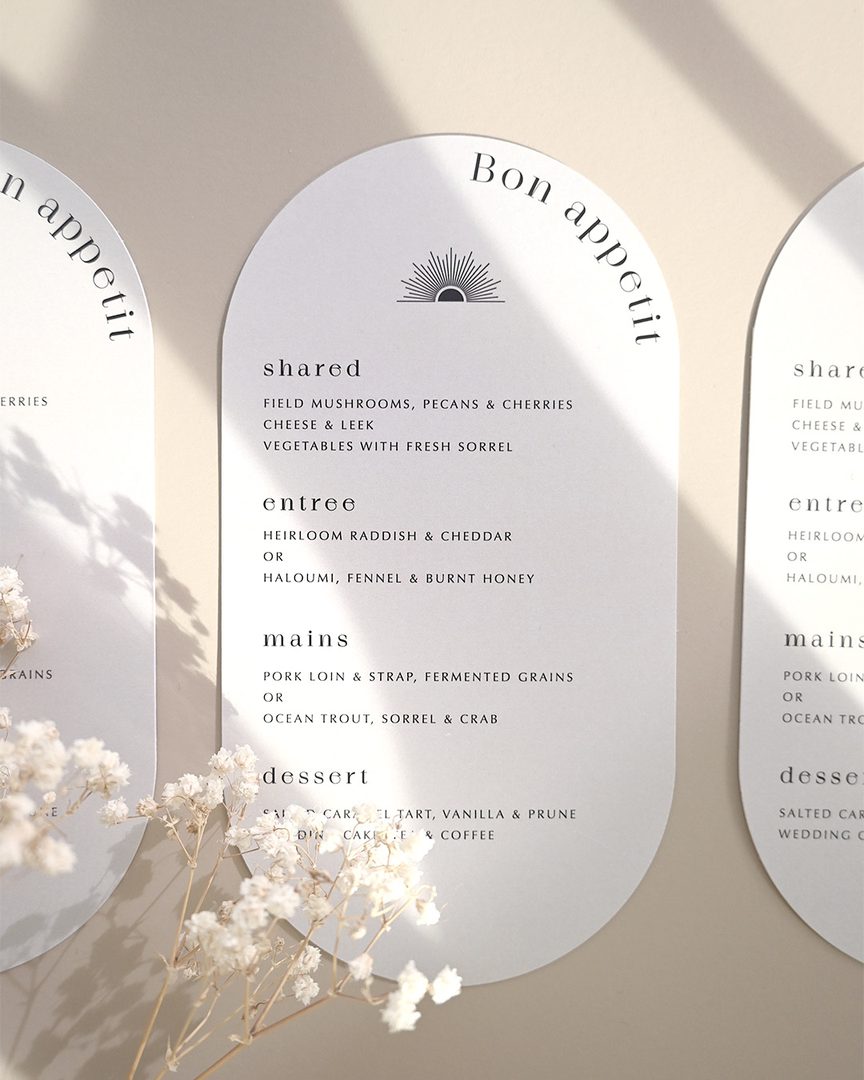
Dietary Icons and Symbols: How to Use Them
Dietary symbols are the most functional element of a menu card. Done well, they help guests with restrictions feel considered. Done poorly, they create confusion or get missed entirely.
Recommended symbol set
Use letter-based abbreviations rather than icon graphics. Graphics can be too small to read on a printed card and may print inconsistently. The standard set most catering teams use:
| Symbol | Meaning |
|---|---|
| V | Vegetarian |
| VE | Vegan |
| GF | Gluten free |
| DF | Dairy free |
| N | Contains nuts |
| SF | Shellfish free |
Placement on the card
Place the symbol directly after the dish name on the same line, in a slightly smaller font size. Set the legend at the very bottom of the card in a small, light typeface:
What to do about severe allergies
Menu cards are not allergy management documents. For guests with severe allergies (anaphylactic nut allergy, celiac disease), include a note at the base of the card directing them to speak with a staff member:
This protects guests and your venue without requiring you to list every allergen trace on the card.
Menu Card Layout: Single Column vs. Two Column
The column structure of your menu card is a design decision that affects readability and visual style. Here is when each format works best.
Single column layout
Single column is the default for most wedding menu cards. Text runs full-width from top to bottom, centered or left-aligned. It suits:
- Formal plated dinners with three to four courses
- Minimal and typographic design styles
- Cards where the couple’s names or a monogram anchor the top
- Portrait-oriented cards (4 x 9 inches / 102 x 229 mm)
A single column layout looks cleaner when the card is held at arm’s length during a candlelit dinner. Less visual noise.
Two-column layout
Two columns allow more content to fit without increasing the card size. Use two columns when:
- You are listing a buffet with eight or more items
- You have multiple protein choices AND wine pairings
- The reception is a cocktail-style event with stations and many small-plate options
- Your design style is editorial or modern
With two columns, keep both columns visually balanced in length. A dramatically short second column looks unintentional.
Landscape vs. portrait orientation
Most menu cards are portrait (taller than wide). Landscape orientation works well for table tent formats (folded cards that stand upright), where guests can read them propped against a centerpiece without picking them up.
Font size rules
The smallest body text on a printed menu card should be no smaller than 8pt. For evening receptions with low lighting, 10pt minimum is recommended. Course headings typically sit at 12-14pt, and the main header (couple’s names or “Menu”) at 18-24pt depending on the design.
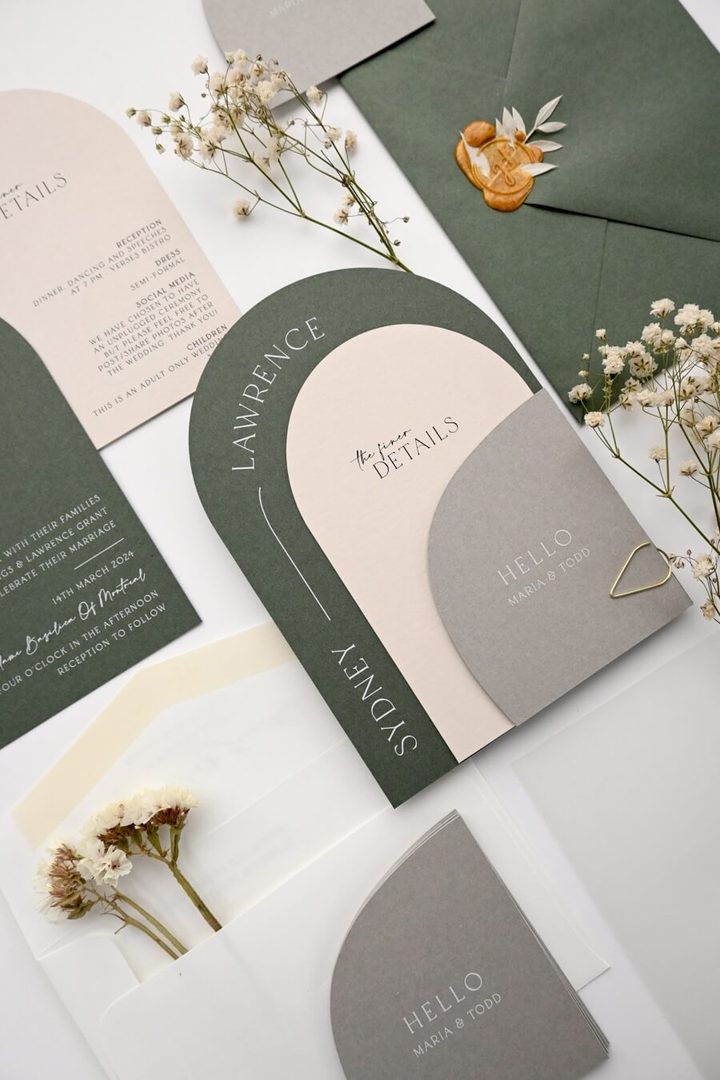
Wording Examples by Wedding Style
The words you use on a menu card should match the tone of your wedding. Here are complete wording examples across three common wedding styles. Each can be adapted to your specific venue, menu, and print method.
Formal dinner wording
Formal menus use full course names, complete dish titles, and a traditional header structure. The language is precise and neutral.
Charlotte & William
September 13, 2026
First Course
Wild Mushroom Veloute
with truffle cream and chive oil
Second Course
Roasted Baby Beet Salad V, GF
with whipped goat’s cheese, candied walnuts, and champagne vinaigrette
Main Course
Roasted Duck Breast
with cherry jus, dauphinoise potato, and broccolini
or
Pan-Seared Sea Bass GF
with saffron risotto and salsa verde
Dessert
Vanilla Creme Brulee
with seasonal berry compote
Wedding cake to follow
GF = Gluten Free | V = Vegetarian
Please speak with our catering team regarding severe allergies.
Rustic or barn wedding wording
Rustic menus lean on approachable language, descriptions that evoke the season and setting, and a warmer couple introduction.
Olivia & Jake
June 7, 2026
To start
Garden Salad with Honey Mustard Dressing V, GF
Sourdough with Herb Butter
For the table
Slow-Roasted Pork Shoulder
Roasted Chicken with Lemon and Thyme
Grilled Seasonal Vegetables V, GF
Crispy Smashed Potatoes V, GF
Heirloom Tomato and Basil Salad V, GF
Something sweet
Peach and Almond Crumble N
with vanilla bean ice cream
V = Vegetarian | GF = Gluten Free | N = Contains Nuts
Thank you for sharing this day with us.
Minimal/modern wording
Minimal menus strip everything back to the essentials. No welcome lines, minimal descriptions, clean spacing, and often just the dish name and a single-ingredient callout.
August 22, 2026
Butternut Squash Soup
pumpkin oil, pepitas
Grilled Salmon GF
dill cream, caper berries, broccolini
Lemon Tart
Italian meringue
GF = Gluten Free
Note: the horizontal rule above is a design element used inside these wording examples only. In the actual card layout, your designer will replace those lines with a thin printed rule or ornament.
For more inspiration on dinner menus across seasons and styles, see our companion guide to wedding dinner menu ideas.
Menu Card Sizing and Paper Choices
Getting the size and paper stock right affects how readable and luxurious the card feels in a guest’s hands.
Standard sizing
| Format | Size (inches) | Size (mm) | Best for |
|---|---|---|---|
| DL / Slim card | 3.9 x 8.3″ | 99 x 210 mm | Plated dinner, minimal style |
| A5 portrait | 5.8 x 8.3″ | 148 x 210 mm | Multi-course, wine pairings |
| Table tent / A6 folded | 4.1 x 5.8″ | 105 x 148 mm | Stands upright, no holder needed |
| Square | 5.5 x 5.5″ | 140 x 140 mm | Modern, minimal, gallery-style |
Paper choices and print methods
The paper stock affects not only how the card looks, but how it holds up through a multi-course dinner where guests may pick it up and set it down multiple times.
- Digital print on 300gsm Matte or Linen – the most affordable option, clean and professional. Works for all wedding styles.
- Flat foil on 380gsm Premium – metallic foil applied to the header or key text elements (couple’s names, course headings). Gold, rose gold, silver, copper, and a range of other colors. No custom die required. A popular choice for couples who want a mirror-bright metallic finish at an accessible minimum order.
- Letterpress on 300gsm or 600gsm Wild Cotton – the deboss impression pressed into thick cotton paper creates a texture guests can feel. Best for minimal and formal styles where the typography itself is the design. Letterpress can be combined with additional print methods.
- Metallic print on 380gsm Premium – a subtle metallic pigment added during digital printing. Less mirror-bright than flat foil, more affordable. Suits formal and romantic styles where you want a gold or silver tonal finish rather than a high-sheen foil.
- White ink on dark stocks – particularly effective for moody, botanical, or dark-themed receptions. White ink on navy or black card gives maximum contrast for legibility.
A note on flat foil for menu cards
Paperlust offers flat foil across the wedding menu range. Flat foil applies a metallic layer directly to the card surface with no embossed impression. It delivers the mirror-bright foil look in gold, rose gold, silver, copper, and more, with no custom die required and a lower minimum order than traditional foil printing methods.
For more on choosing the right print method for your wedding stationery suite, see our full guide to wedding menu cards.
Frequently asked questions
What should be included on a wedding menu card?
A complete wedding menu card includes a header (typically “Menu” or the couple’s names), the wedding date, each course listed in serving order with a short dish description, dietary symbols for any relevant dishes, and a brief legend explaining those symbols at the base of the card. Optional additions include a signature cocktail note, wine pairings, and a short thank-you line from the couple.
How long should wedding menu card wording be?
For most plated dinners, three to five courses with a one-line dish description each fits comfortably on a standard DL or A5 card. Aim for no more than 80 to 100 words total. Minimal designs can use as few as 40 words. Buffet or family-style cards listing many dishes may need a larger format card (A5 portrait) to avoid crowding the layout.
What size is a standard wedding menu card?
The most common size is a DL slim card (3.9 x 8.3 inches / 99 x 210 mm), which fits neatly alongside a place setting. A5 portrait (5.8 x 8.3 inches / 148 x 210 mm) is used for menus with many courses or wine pairings. Table tent cards (folded A6, approximately 4.1 x 5.8 inches / 105 x 148 mm) stand upright without a card holder.
How do I indicate dietary requirements on a menu card?
Use letter-based abbreviations placed directly after the dish name on the same line: V (vegetarian), VE (vegan), GF (gluten free), DF (dairy free), N (contains nuts). Print a small legend at the base of the card. For guests with severe allergies, add a single line directing them to speak with the catering team rather than attempting to list every allergen trace on the card.
Should I include wine pairings on a wedding menu card?
Yes, if your caterer or venue is providing a curated wine list. A single line per course noting the wine name and region is sufficient. For most receptions with an open bar rather than a matched wine menu, a simple note at the base of the card (“Wine, beer, and cocktails available throughout the evening”) is enough. If your card is already text-heavy, print a separate pairing card rather than cramming the main menu card.
What is the difference between a menu card and a place card?
A place card marks a guest’s seat with their name. A menu card lists the food being served. At some receptions, a combination card serves both purposes: the guest’s name is printed on one side and the menu is printed on the other, or the guest’s name appears at the top of the menu card to indicate their pre-selected entree choice.
Do I need a menu card for a cocktail reception or buffet?
It is not required, but it is a nice touch. For cocktail receptions with passed canapes, a small printed card describing what is being served helps guests identify dishes and ask kitchen staff about ingredients. For buffets, a printed menu card on each table tells guests what to expect before they reach the buffet station, reducing queue congestion.
Can I print menu cards in the same print method as my invitations?
Yes, and it is recommended for a cohesive suite look. Paperlust menu cards are available in digital print, flat foil, letterpress, metallic print, and white ink, matching the same print methods available for wedding invitations, save the dates, and other stationery pieces. Ordering all suite items at once may also qualify you for the 15% multi-item discount.
How far in advance should I finalize menu card wording?
You need a confirmed menu from your caterer before writing menu card wording. Most caterers finalize menus six to eight weeks before the wedding date. Submit your menu card order at that point to allow for design proof (delivered within 1 to 2 business days), two rounds of edits, printing production, and shipping. Digital print is the fastest production method. Letterpress and flat foil take longer to produce.
Ready to design your wedding menu cards?
Browse 500+ designs in digital print, flat foil, letterpress, metallic, and white ink. Designer proof in 1 to 2 business days.