
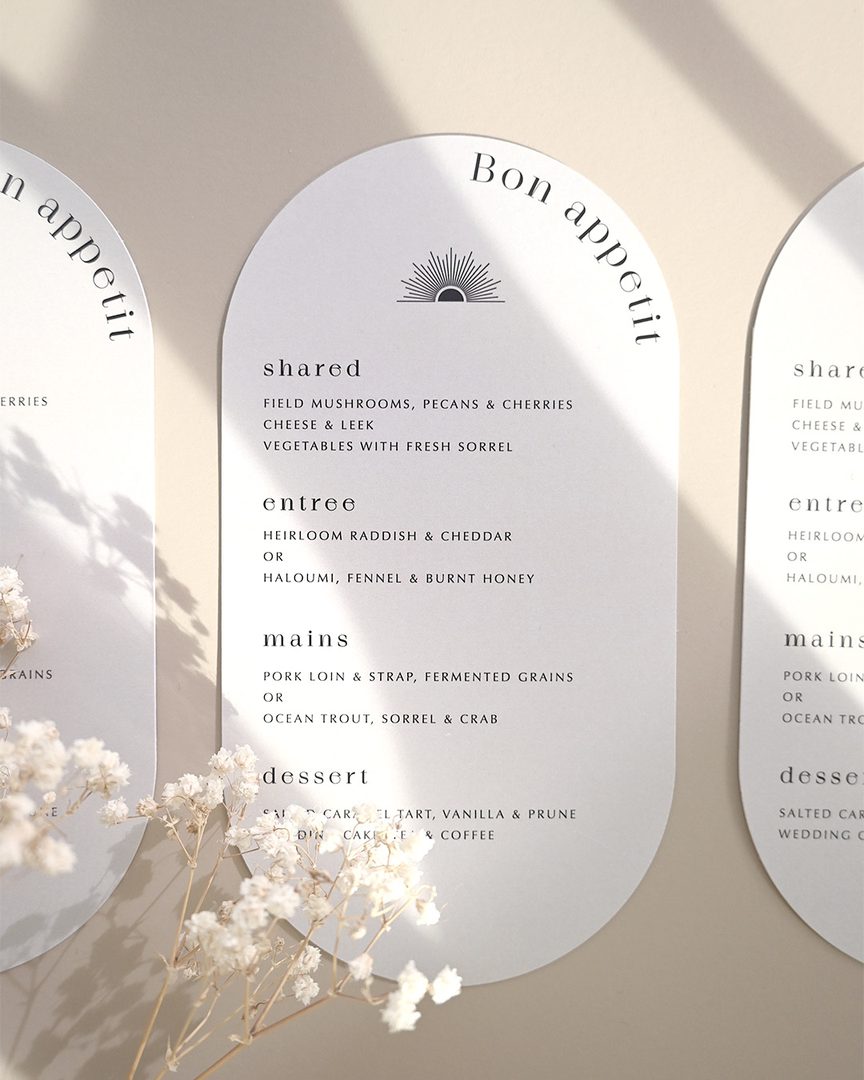
Putting together your wedding program and not sure what to include? You are not alone. Most couples know they want one but quickly discover how many sections are optional, how many are required, and how much real estate they actually have to work with. This checklist breaks down every section of a wedding program, tells you which ones guests genuinely expect and which you can skip, and gives you sample wording for the trickiest parts.
For the full design and printing guide, see Wedding Ceremony Programs: The Complete Guide.
- Must-have sections: cover (names, date, venue), order of ceremony events, and wedding party list.
- Strongly recommended: readings and songs with speaker credits, officiant and musician credits.
- Optional but appreciated: memorial acknowledgment, closing thank-you note, programs notes or quotes.
- Skip when space is tight: full bio paragraphs, lengthy family thank-yous, lengthy program notes about each reading.
- A standard single-fold program fits 6-8 sections comfortably on four panels.
- Order this checklist top to bottom and you have a complete, guest-ready ceremony program.
The Essential Sections of Every Wedding Program
Not every program needs every section. The right content depends on your ceremony length, religious or cultural traditions, and how much you want guests to follow along versus simply witness. That said, three sections appear on almost every wedding program because guests genuinely use them: the cover, the order of events, and the wedding party list.
Everything else is supplementary. If you are working with a single folded sheet, you have four panels. The cover takes one. The order of events and wedding party list comfortably fill two more. The final panel is where couples make different choices: a memorial section, a closing quote, a short thank-you, or simply white space.
Think of what follows as a menu. Take what fits your ceremony and leave the rest.
| Section | Must-Have | Optional | Skip When Tight |
|---|---|---|---|
| Cover (names, date, venue) | Yes | ||
| Order of ceremony events | Yes | ||
| Wedding party list | Yes | ||
| Reading and song credits | Yes | ||
| Officiant and vendor credits | Yes | ||
| Memorial acknowledgment | Yes | ||
| Closing thank-you or quote | Yes | ||
| Lengthy bio paragraphs | Yes | ||
| Extended family thank-yous | Yes |


The Cover: What It Must Include
The cover is the only section every program shares. Guests see it before the ceremony starts and carry it in their hands or lap throughout. It needs to communicate three things clearly:
Names
Use first names only, full names, or the combination you use everywhere else in your stationery. Whatever appears on your invitations is the right choice here. Consistency across the suite matters more than formality.
and
James Oliver Hartley
Date
Spell out the full date. Saturday, June 14, 2026 is preferable to 06/14/2026, which can read ambiguously depending on your guests’ country of origin.
two thousand and twenty-six
Venue Name and Location
Include the venue name and city. You do not need the full street address; guests already know where they are.
St. Helena, California
Some couples add a short tagline or quote below the venue line. Keep it brief, one line of 8-10 words is enough on a cover.
Order of Ceremony Events: How to List Them
The order of events is the section guests use most actively. It tells them how long the ceremony runs, when to expect the vows, and whether to ready a tissue when the readings start. List each event in sequence, with the name of each person participating where relevant.
Standard Sequence for a Civil Ceremony
- Prelude music (as guests are seated)
- Processional
- Welcome by the officiant
- Opening words or reading
- Exchange of vows
- Exchange of rings
- Pronouncement
- First kiss
- Recessional
Standard Sequence for a Religious Ceremony
Religious ceremonies vary significantly by faith tradition. A Catholic Mass has many additional components (Liturgy of the Word, homily, Liturgy of the Eucharist) that guests unfamiliar with the rite will appreciate seeing listed. Jewish ceremonies include specific blessings (Birkat Erusin, Sheva Brachot) that are worth naming. Consult with your officiant on the canonical order and exact names for each component.
Formatting Tips
- Bold the event name. Use regular weight for the participant name(s) on the same line or the line below.
- Keep event titles short, “Processional” not “Entrance of the Wedding Party and Bride.”
- You do not need timestamps. Guests appreciate knowing the sequence, not the schedule.
- For musical interludes, include the song title and artist in parentheses or italics below the event title.
Sample order of events block:
“Clair de Lune” by Debussy
Processional
“Canon in D” by Pachelbel
Welcome
Rev. Patricia Moore
Reading
1 Corinthians 13:4-7
Read by Sarah Reid, Sister of the Bride
Exchange of Vows
Exchange of Rings
Pronouncement and First Kiss
Recessional
“Married Life” by Michael Giacchino
Wedding Party List: Order, Titles, and Relationships
The wedding party section introduces the people standing up with you. Guests who do not know your closest friends appreciate the context; guests who do know them enjoy seeing names in print. List people in the order they walked in during the processional.
Order of Listing
- Officiant (first, with credentials if relevant: Reverend, Rabbi, etc.)
- Maid/Matron of Honor and Best Man
- Bridesmaids and Groomsmen (in processional order, or alphabetical if large party)
- Flower girls and ring bearers
- Readers (if not already listed in the order of events)
- Musicians and vocalists
- Parents of the couple (optional but appreciated)
Titles and Relationships
List each person’s name and their relationship to you. Keep titles brief and consistent. Examples:
Reverend Patricia Moore
Maid of Honor
Sarah Reid, Sister of the Bride
Best Man
Michael Hartley, Brother of the Groom
Bridesmaids
Claire Johnson, Friend of the Bride
Priya Sharma, College Roommate
Nicole Davis, Cousin of the Bride
Groomsmen
Daniel Park, Friend of the Groom
Chris Lee, Colleague
Tom Walsh, Childhood Friend
How Many Relationships to Explain
You do not need to explain every relationship. “Friend of the couple” is sufficient for guests who do not know the person. Reserve descriptive titles for those who are obviously close, siblings, parents, childhood friends. If your wedding party is large (6+ each side), relationship descriptions make the list run long. In that case, list only maid of honor and best man relationships and drop descriptions for everyone else.
Readings, Poems, and Songs to Credit
If someone is reading a passage, reciting a poem, or performing a song during your ceremony, they deserve a credit. This section can appear as part of the order of events (listing reader and passage inline) or as a separate credits section. Either approach is acceptable; the order-of-events method is more common because guests can follow along in real time.
What to Include for Each Reading
- The name of the passage, poem, or text
- The source (scripture reference, author name, book title)
- The reader’s full name and relationship
What to Include for Each Song
- Song title, in quotation marks
- Composer or artist
- Performer name, if a guest or hired musician is performing live
Sample wording for a reading credit:
“i carry your heart with me” by e.e. cummings
Read by Olivia Torres, Friend of the Couple
Sample wording for a song credit:
“Here Comes the Sun” by The Beatles
Performed by The River String Quartet
If you have a lot of musical moments, a dedicated music credits section at the back of the program is cleaner than listing everything inline in the order of events.
Officiant, Musician, and Vendor Credits
Vendor credits are a professional courtesy. Your officiant, musician, and photographer all benefit from a name mention in the program; it is one of the small ways couples thank vendors who made a meaningful contribution to the day. Most programs list these at the bottom of the inside spread or on the back panel.
What to List
- Officiant: Full name and title (if applicable). You likely already listed this in the wedding party section.
- Musicians: Name(s) and what they performed. If a band, the band name plus lead performer name.
- Floral designer: Optional but appreciated if floral is a prominent visual element.
- Photographer and videographer: Optional. Some couples skip this as it can feel commercial; others include it because guests frequently ask “who is your photographer?”
Format
A simple two-column listing works well and uses minimal space:
Florals ………………. Bloom & Gather Studio
Photography …….. Maya Chen Photography
Alternatively, run vendor credits as a single short paragraph at the bottom of the program: “Music performed by The River String Quartet. Florals by Bloom & Gather Studio.”
Memorial Section: Honoring Loved Ones Who Have Passed
A memorial section acknowledges family members or close friends who are no longer living but whose presence is felt on the day. It is one of the most meaningful sections a program can carry, and it does not require much space, two to four lines is standard.
Where to Place It
The back cover is the most common location for a memorial acknowledgment. Some couples place it at the bottom of the order of events page, after the recessional. Either works. Avoid placing it on the cover, where the tone can feel heavy before the ceremony begins.
Wording Options
Robert Reid (1948-2019)
and
Dorothy Hartley (1951-2022)
Forever in our hearts.
Robert Reid and Dorothy Hartley.
They walk beside us every day.
In memory of
Robert Reid & Dorothy Hartley
Candlelight or Symbolic Elements
Some ceremonies include a candle, empty chair, or reserved pew for loved ones who have passed. If yours does, mention it in the memorial section so guests understand the significance:
Robert Reid, beloved father and grandfather.
Though absent in body, you are present in every moment today.
Optional Additions and What to Leave Off
Once the essentials are covered, couples often ask whether to add more. Here is a practical guide to the most common optional sections and when each one earns its space on the page.
Closing Thank-You Note
A short thank-you to guests for traveling, celebrating with you, or simply being present is a warm closing for the program. Keep it to two or three sentences. Lengthy thank-yous that name dozens of people individually belong in the reception booklet or the wedding website, not the ceremony program.
Opening or Closing Quote
A meaningful quote can anchor the back cover of a program elegantly. Choose one that reflects your relationship or the tone of your ceremony: joyful, poetic, or faith-based. One quote per program is the right number. More than one starts to read like a Pinterest board rather than a personal keepsake.
Audrey Hepburn
Notes for Guests
Unplugged ceremony request, phone-off reminder, or a note about where to be seated, these practical messages can go on the back cover or inside back panel. Keep them short and friendly in tone:
What to Leave Off When Space is Tight
- Full biographical paragraphs for each wedding party member, these take an entire page and most guests skim them.
- Multiple poems or full passage texts, list the source and reader, not the entire text, unless the reading is short (under 8 lines) and central to the ceremony.
- Family tree explanations, explaining how everyone is related is more appropriate for a welcome reception booklet.
- Long thank-you lists, thank vendors by name in the reception program or your website, not the ceremony program.
- QR codes for everything, one QR code linking to your wedding website is elegant. Three QR codes for three different destinations reads as cluttered.
Going digital instead? See Digital Wedding Programs and QR Code Ceremony Cards for couples considering a paperless alternative.
Ready to order professionally printed programs? Browse Paperlust wedding programs for designs that match every ceremony style and print finish, from digital to letterpress to flat foil.
Frequently Asked Questions
What are the must-have sections of a wedding program?
Every wedding program needs three sections: the cover (names, date, and venue), the order of ceremony events, and the wedding party list. Everything else (readings, memorial sections, vendor credits, closing quotes) is optional and depends on your ceremony length and format.
What goes on the cover of a wedding program?
The cover should include the couple’s names, the full date spelled out, and the venue name and city. Some couples add a short quote or decorative tagline, but three to four lines total is the right amount for a program cover. The design and monogram do the rest of the visual work.
How do you list the wedding party in a program?
List the wedding party in the order they walked in during the processional. Start with the officiant, then the maid of honor and best man, then bridesmaids and groomsmen in processional order, then flower girls and ring bearers. Include each person’s full name and their relationship to the couple (Sister of the Bride, Childhood Friend, etc.).
Do you have to include a memorial section in the program?
A memorial section is optional. If you have lost a parent, sibling, or close friend and want to acknowledge them, the program is a meaningful place to do it, typically on the back cover or inside back panel. Two to four lines is standard. If no one has passed recently, there is no expectation that you include one.
What is the correct order of events for a wedding ceremony program?
A standard civil ceremony runs: prelude music, processional, welcome by the officiant, opening reading or words, exchange of vows, exchange of rings, pronouncement, first kiss, and recessional. Religious ceremonies follow the order of their specific tradition, consult your officiant for the exact sequence and names of each component.
How do you credit readings and songs on a wedding program?
For a reading, list the passage name, the source (scripture reference or author), and the reader’s name and relationship. For a song, list the title in quotation marks, the composer or artist, and the performer if a guest or hired musician is performing live. These credits can appear inline in the order of events or in a dedicated credits section at the back.
Should I include vendor credits in my wedding program?
Including vendor credits is a professional courtesy, not a requirement. If you choose to list vendors, include your officiant (already in the wedding party section), musicians, and optionally your floral designer and photographer. A short two-column format or a single credits paragraph at the bottom of the program is the cleanest approach.
How much text fits on a standard folded wedding program?
A standard single-fold program (5.5 x 8.5 inches [140x216mm] when folded) has four panels. The cover takes one. The inside spread (two panels side by side) can hold the order of events plus the wedding party list comfortably at a readable font size. The back panel holds the memorial section, closing quote, or vendor credits. Trying to fit more than six to eight sections on a single-fold program usually requires reducing the font size below 10pt, which hurts readability.
Can I print the full text of a reading on my program?
You can print a short reading (under 8 lines) if it is central to the ceremony and guests may not know it. For longer passages, list only the source and reader’s name. Printing a full Corinthians passage, a lengthy poem, or multiple readings fills the program quickly and crowds out sections guests use more actively (the order of events and wedding party list).
When should I finalize my wedding program content?
Finalize the content at least four weeks before the wedding so your designer has time to lay it out and you have time to proof it. If you are ordering professionally printed programs through Paperlust, order at least three to four weeks out to allow for the designer proof (delivered in 1-2 business days), two rounds of edits, print production, and shipping.
Ready to design your wedding programs?
Browse hundreds of designs from independent artists, digital, letterpress, and flat foil finishes available.