

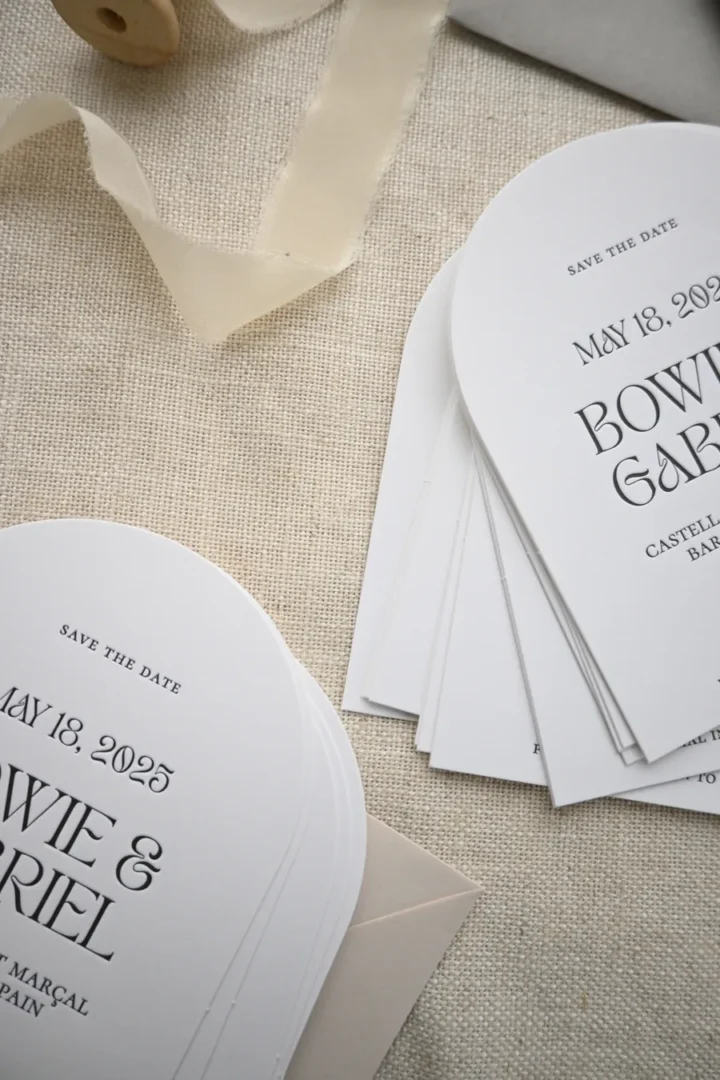
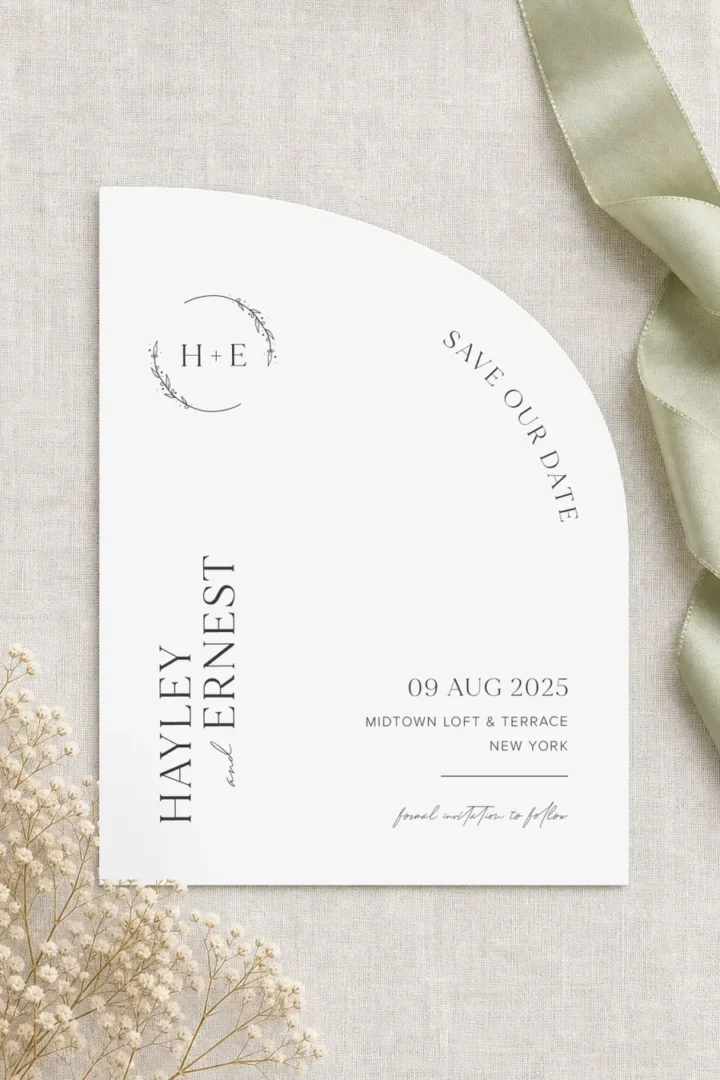
Pictured above: letterpress arch save the dates. Browse the letterpress save the date collection.
Send save the dates 6 to 8 months before your wedding. For destination weddings, holiday weekends, or peak-season dates, send 9 to 12 months ahead so guests can book travel and accommodation. Sending within 4 months is generally too late, skip straight to invitations instead.
Timing your save the dates is one of the first big decisions of wedding planning, and getting it wrong in either direction creates real problems. Send too early and guests lose the card or forget the details before your wedding arrives. Send too late and people have already committed to vacations, work trips, or other events. Save the dates are the very first piece of wedding stationery your guests receive, setting the tone for your celebration before a single invitation goes out. This guide covers exactly when to send save the dates for every wedding type, a complete month-by-month 2027 and 2028 reference, a printable planning countdown, and everything your card needs to include.
Quick Reference: When to Send Save the Dates
| Wedding Type | When to Send Save the Dates | When to Send Invitations |
|---|---|---|
| Local wedding | 6–8 months before | 6–8 weeks before |
| Destination wedding | 9–12 months before | 3–4 months before |
| Holiday weekend or peak season | 10–12 months before | 6–8 weeks before |
| Short engagement (under 4 months) | Immediately, or skip to invitations | 4–6 weeks before |
Shop save the dates at Paperlust
Magnets, photo cards, postcards and flat cards, designed in Australia with free samples.
In this guide
- The general rule: 6 to 8 months
- Timing by wedding type
- Month-by-month reference for 2027 and 2028
- Your save-the-date countdown checklist
- The save-the-date to invitation gap
- Special situations: long engagements, second marriages, international guests
- What to include on your save the date
- Who gets a save the date
- What if details change after sending
- Digital vs printed save the dates
- How to decide when to send
- Frequently asked questions
When to Send Save the Dates: The General Rule
The standard advice is to send save the dates between 6 and 12 months before your wedding. That range exists because no two weddings are the same, but for most couples planning a local or regional celebration, 8 to 10 months out hits the sweet spot.
Eight to ten months gives guests enough lead time to request time off work, make childcare arrangements, and book travel, without so much runway that the card gets buried or forgotten. It also gives you time to finalize the only details that need to be on the card: your confirmed date and general location.
Earlier is not always better. Sending 14 or 15 months out sounds considerate, but your plans may still be in flux, guests are unlikely to take action that far in advance, and the card risks being genuinely forgotten by the time your wedding month rolls around. Eight to ten months is the range where guests feel informed without feeling like they need to act immediately.
One important clarification: you do not need every detail confirmed before sending. You need your date locked in and a general sense of location. City and state is enough. The full venue address and logistics all come with the formal invitation.
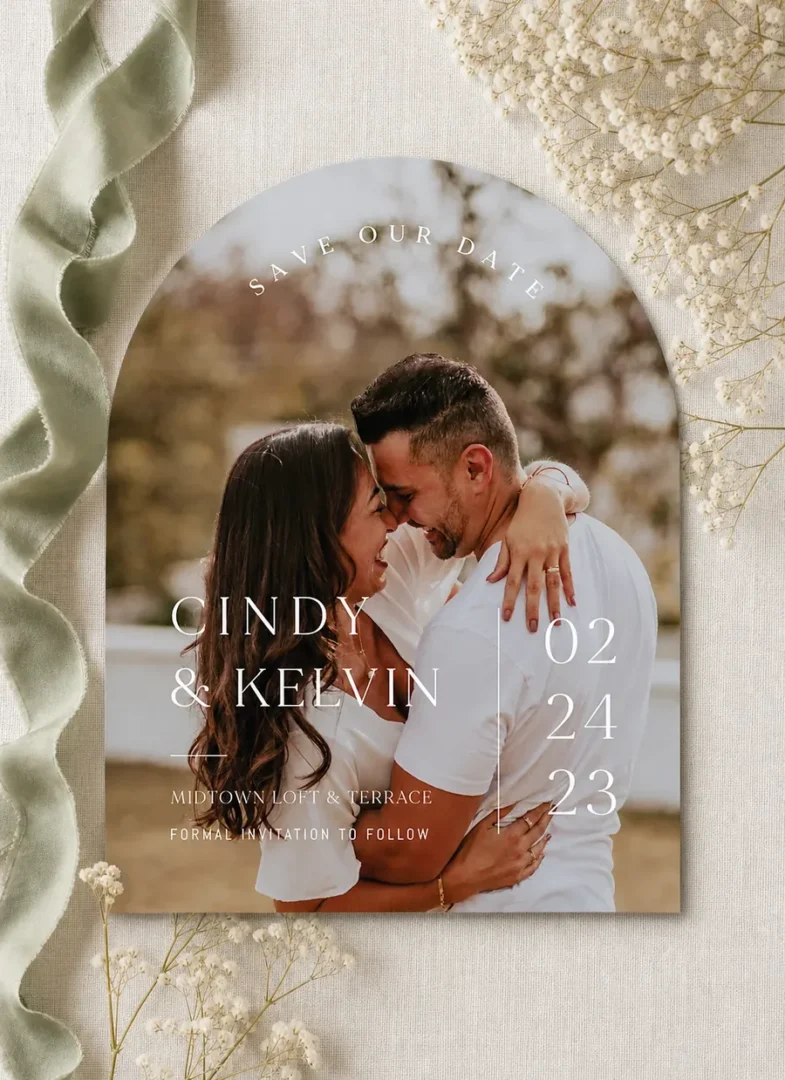

Browse save the dates in every style
Lock in your timeline with a design you love, from minimalist to photo-led.
When to Send Save the Dates by Wedding Type
Local Wedding
For a wedding where most guests live within driving distance, 6 to 8 months is the right window. Your guests do not need to book flights or arrange extended stays, so they have more flexibility. That said, even local guests benefit from early notice for requesting time off or arranging overnight stays. If your wedding falls on a standard weekend, the 6-month mark is a reliable minimum.
Destination Wedding
Destination weddings need the most lead time of any wedding type. Aim to send save the dates 9 to 12 months before the date. Guests need time to research flights, book accommodations, and request extended vacation time. Many destination venues also offer accommodation blocks with preferential rates that guests should reserve before those blocks close, often 6 to 9 months before the wedding.
Nine months works well for domestic destination weddings, such as a vineyard in Napa or a mountain lodge in Colorado. International destination weddings benefit from the full 12 months. That lead time allows guests to:
- Renew or apply for a passport. US passport processing takes 6 to 8 weeks standard and 2 to 3 weeks expedited. Any guest who does not hold a current valid passport needs that window plus booking time. At 12 months out, they have room to handle it without stress.
- Book international flights early. International airfare pricing typically climbs sharply within 6 months of departure. Giving guests a 12-month runway means they can lock in reasonable fares.
- Arrange multi-day accommodation and local transportation. International weddings often require guests to plan 3 to 5 nights of travel, not just a one-night hotel stay.
- Request extended leave from work. A destination wedding may require 4 to 7 days away, which typically needs management approval well in advance.
Your destination save the date should include your wedding website address so guests can find accommodation recommendations, hotel block deadlines, and travel logistics. For weddings where guests must book a specific hotel block, make that deadline visible and prominent on your website, not buried in fine print.
Consider pairing your save the date with a separate information card listing your recommended hotels, hotel block booking deadline, and nearest airports. This gives guests everything they need to take action immediately, without overcrowding the save the date itself.
Holiday Weekend or Peak Season
If your wedding falls on a long weekend, over a holiday, or during peak summer or fall season, send save the dates 10 to 12 months out. The competing pressures are specific and real.
Holiday weekends (Memorial Day, Labor Day, Fourth of July, Thanksgiving-adjacent): These are when families schedule reunions, vacations, and other milestone events. Flights and hotel rooms in popular destinations book out 6 to 9 months ahead of holiday weekends. Giving guests nearly a year of notice is not excessive. For a Fourth of July beach wedding or a Thanksgiving mountain retreat, it is the practical minimum for asking people to prioritize your date in a calendar that was already filling up.
Peak summer (June, July, August): Summer is the most popular wedding season in the US, which creates the most competition for accommodation blocks, travel, and guest calendars. If your date falls in these months, apply the same 10 to 12 month standard as a holiday weekend. Your guests are fielding other wedding invitations, summer plans, and travel bookings at the same time.
Peak fall (September, October): Fall is the second-most popular wedding season, and October in particular sees high demand for venues, flights, and lodging in leaf-peeping destinations. A fall wedding in New England, the Pacific Northwest, or any agricultural wine region competes directly with peak tourism. Apply the 10 to 12 month rule here too.
One practical note for holiday-weekend weddings: make the event context clear on your wedding website the moment you launch it. A Fourth of July wedding in a beach town, a Thanksgiving weekend celebration in a ski resort, a Labor Day wedding in wine country. Each one tells a different travel story. Help guests plan by making that story visible immediately.
Short Engagement (Under 4 Months)
If you have less than four months between engagement and wedding, send save the dates immediately after confirming your date and venue. If you have fewer than eight weeks before the wedding, consider skipping the save the date entirely and going straight to formal invitations. At that point, combining the two makes more practical sense than mailing two rounds of cards within weeks of each other.
Shop save the date magnets
Magnets stick to guest fridges, a quiet reminder all the way to RSVP day.
Save the Date Send Dates for 2027 and 2028 Weddings: Month-by-Month
Use this table as your ready-made timeline for 2027 and 2028 weddings. “Send save the dates by” targets the 8-month sweet spot; “send invitations by” is 8 weeks before the wedding date.
| Wedding Month | Send Save the Dates By | Send Invitations By |
|---|---|---|
| January 2027 | May 2026 | November 2026 |
| February 2027 | June 2026 | December 2026 |
| March 2027 | July 2026 | January 2027 |
| April 2027 | August 2026 | February 2027 |
| May 2027 | September 2026 | March 2027 |
| June 2027 | October 2026 | April 2027 |
| July 2027 | November 2026 | May 2027 |
| August 2027 | December 2026 | June 2027 |
| September 2027 | January 2027 | July 2027 |
| October 2027 | February 2027 | August 2027 |
| November 2027 | March 2027 | September 2027 |
| December 2027 | April 2027 | October 2027 |
| January 2028 | May 2027 | November 2027 |
| February 2028 | June 2027 | December 2027 |
| March 2028 | July 2027 | January 2028 |
| April 2028 | August 2027 | February 2028 |
| May 2028 | September 2027 | March 2028 |
| June 2028 | October 2027 | April 2028 |
Destination or holiday weddings: shift the save-the-date column 2 to 4 months earlier than shown above.
Your Save-the-Date Countdown Checklist
Use this table to map out every step from locking your date to mailing your cards. The milestones are built around an 8-month send window. Print it directly from your browser (File > Print) or screenshot it to track your progress. For destination or holiday-weekend weddings, shift each row 2 to 4 months earlier.
| Months Before Wedding | Task | Notes |
|---|---|---|
| 12 months | Lock your wedding date | This is the only detail you absolutely need before sending a save the date. A general location (city and state) is enough at this stage; the full venue address goes on the invitation. |
| 11 months | Start building your guest list | Work from a rough count first. Hold B-list guests back until you see early RSVPs; sending save the dates to guests who may not receive an invitation creates awkwardness. |
| 10 months | Confirm your general location | City and state is all you need for the save the date. The full venue name and address belong on the invitation once they are finalized. |
| 9–10 months | Collect guest mailing addresses | Send a digital form (Google Forms or a wedding website address collector) to family and close friends. Chasing addresses at the last minute is the most common cause of delayed mailing. |
| 9 months | Choose your save-the-date design | Browse the full save the date collection or order a $5 sample pack to compare paper weights and print finishes before you commit. Need wording help? See the save the date wording guide. |
| 8–9 months | Place your print order | Allow 1 to 2 business days for your designer proof, then production and shipping time. Add 6 weeks of lead time if ordering letterpress or foil stamp. Digital print orders ship faster. Orders over $350 USD qualify for free DHL express shipping. |
| 8 months | Address envelopes | Use Paperlust’s Address Manager tool to import guest addresses via spreadsheet, or book a calligrapher 4 to 6 weeks ahead if you want hand-lettered envelopes. |
| 8 months | Mail save the dates | Your target send date. Save the dates travel alone; do not delay mailing while waiting for RSVP inserts or other enclosures that belong in the invitation suite. |
Destination and holiday-weekend couples: move every row 2 to 4 months earlier. If your target send date is 12 months out, lock your wedding date at 16+ months, start your guest list at 15 months, and so on.
The Save-the-Date to Invitation Gap
The standard gap between save the dates and formal wedding invitations is 4 to 6 months. On a typical 8-month save-the-date timeline, invitations follow at 6 to 8 weeks before the wedding, giving couples a 6-month window to finalize every detail: venue address, ceremony time, catering count, RSVP logistics, and accommodation information.
That window exists for practical reasons. You cannot put finalized ceremony times, meal choices, or RSVP deadlines on a save the date sent 8 months out because most of those decisions are not yet made. The gap is the time you have to make them.
What to do during the gap
- Confirm ceremony and reception times with the venue.
- Finalize catering count and any meal-choice or dietary-option logistics.
- Confirm accommodation blocks and note the booking deadline so guests see it in your invitation suite.
- Design your full invitation suite: invitation card, RSVP card, information card, and any enclosures. See the full wedding invitation collection for designs that match your save the date.
- Set a realistic RSVP deadline, typically 3 to 4 weeks before the wedding so your caterer has confirmed numbers.
For a full breakdown of invitation timing, see the complete guide to when to send wedding invitations.
When the gap collapses
Short engagements compress the gap. If you are working with a 4-month engagement, save the dates and invitations may only be 4 to 6 weeks apart, or the save the date step may not be practical at all. When the gap has collapsed:
- If you have 10 or more weeks until the wedding, send save the dates now and follow with invitations 2 to 4 weeks later.
- If you have fewer than 8 weeks before the wedding, skip save the dates and go straight to invitations. At that lead time, combining both functions in a single mailing is the better call.
- Notify your most important guests by phone or text the same day you mail, especially those who need to arrange travel. Do not rely on postal delivery times when the schedule is this compressed.
For destination weddings where the gap closes, move to a combined save-the-date and invitation format, or send the invitation as early as possible (3 to 4 months out) and flag it clearly as the sole advance notice.
Save the Date Timing for Special Situations
Most save-the-date guidance assumes a standard 12 to 18 month engagement and a local wedding. These situations call for a different approach.
Long Engagements (18+ Months)
If your engagement is 18 months or longer, do not send save the dates at the 18-month mark. Guests are unlikely to keep track of a card that arrives a year and a half before the wedding. The card will get lost, misplaced, or simply forgotten by the time the date actually arrives.
Wait until you are 10 to 12 months from the wedding date, then follow the standard timeline. Use the extra time to build your guest list carefully, collect addresses without pressure, and choose a design you will still be happy with when the wedding day comes. There is no advantage to sending early when early means forgettable.
If you have a long engagement and want to give people a heads-up earlier, a personal message, phone call, or social media post serves that purpose better than a save the date that will sit in a drawer for a year and a half.
Second Marriages
There is no etiquette rule requiring save the dates for a second marriage. Many couples planning a smaller, more intimate second wedding skip them and go straight to invitations, particularly when the guest list is made up of close family and friends who already know the news.
Send save the dates for a second marriage when:
- Guests need to travel or book accommodation.
- The wedding falls on a holiday weekend or peak-season date.
- The guest list is large enough that a formal heads-up is genuinely useful.
If you do send save the dates, the same timing rules apply: 6 to 8 months for a local wedding, 9 to 12 months for a destination. Tone and design are entirely up to you. Second weddings can be just as formal and celebratory as first weddings, and the stationery should reflect what you actually want.
Sending to International Guests
Any guest traveling internationally needs 9 to 12 months of advance notice, regardless of your overall wedding type. International travel involves passport applications or renewals, multi-leg flight bookings, extended leave requests, and a significant budget commitment.
US passport processing takes 6 to 8 weeks standard and 2 to 3 weeks expedited. A guest whose passport expired in 2021 and has not renewed it needs that processing window plus flight and accommodation booking time. Sending at 12 months out gives them room to handle it without feeling rushed.
If your wedding is largely local but includes a handful of international guests, send the same save the date to everyone at the 8 to 10 month mark and follow up personally with your international guests the same day. Give them your wedding website address and point them directly to accommodation recommendations. Consider pairing save the dates with information cards that list hotel blocks, nearest airports, and local transportation options. It removes the guesswork for guests who are unfamiliar with the area and makes it easy for them to start planning right away.
What to Do If You Have Already Sent Invitations
If you sent invitations without a prior save the date, you do not need to do anything else. The information has been communicated. Sending a save the date after invitations have already gone out would be confusing and redundant.
This situation is most common with short engagements, small weddings where personal phone calls served the same purpose, or couples who reconsidered the save-the-date step after going straight to invitations. In all of these cases, the invitation is the right and complete move. Follow up personally with guests who need to arrange travel if lead time is short, but there is no additional stationery needed on top of an already-sent invitation.
What to Include on Your Save the Date
Save the dates should be simple. They exist to hold the date, not to communicate your entire wedding. Here is what belongs:
- Both names
- The wedding date (day, month, year)
- City and state (not the full venue address)
- Wedding website URL (optional)
- “Invitation to follow”
What to leave off:
- Full venue address: Details can change. Save it for the invitation.
- RSVP instructions: You cannot track RSVPs meaningfully months out, and asking creates confusion.
- Registry information: Save this for your wedding website or invitation suite.
- Menu or dietary options: These decisions happen much closer to the wedding.
- Ceremony or reception times: Confirm these in the invitation once they are finalized.
Shop save the date postcards
Postcard-format save the dates, lower postage, still premium stock.
Who Gets a Save the Date?
Save the dates go to day guests only. If you are planning a separate evening reception, evening-only guests do not receive a save the date. They receive an invitation when the time comes.
Practical rules for your list:
- One per household. Couples and families receive one card addressed to everyone invited from that address.
- Adult children living at home. If an adult child is invited as an individual (not just as part of the family), send them their own card so the invitation is clear.
- Finalize your guest list first. Only send save the dates to people who will definitely receive an invitation. Sending one and then not following up creates awkwardness. If you have a B-list, hold off on those until you see early RSVPs.
- Out-of-town guests. Anyone who needs to travel more than a few hours benefits from earlier notice, even if your wedding is not technically a destination event.
What If Details Change After Sending?
Wedding plans shift, and that is okay. Here is how to handle the most common scenarios.
Venue change: If your city and state remain the same, there is no urgent need to send an update. The correct address will appear on the invitation. If the new venue is in a meaningfully different location, send a brief update card or email as soon as possible so guests can adjust any travel plans.
Date change: This requires immediate action. Send a revised save the date or a clearly labeled update card as soon as the new date is confirmed. Mark it clearly (“Date Change Notice”) and communicate directly with your most important guests before the card arrives. Do not wait for invitations to communicate a date change.
Minor changes: If only small details shift (ceremony time, venue name), there is no need for a second mailing. Correct these in the invitation and note changes on your wedding website if you have one.
The core principle: any change affecting travel or accommodation plans should be communicated immediately. Day-of logistics changes can wait for the invitation.
Digital vs Printed Save the Dates: Timing Differences
Printed save the dates require the most lead time. Once your design is ready, factor in proofing (1 to 2 business days at Paperlust), production, and shipping. Build in at least 2 weeks before your target mail date for digital save the dates (6 weeks for letterpress or foil stamp). If you want cards in guests’ hands 8 months before your wedding, begin the ordering process around the 9-month mark.
The case for printed cards goes beyond logistics. A beautifully designed card arriving in the mail creates real anticipation. It lands on a kitchen counter or fridge and stays there as a daily reminder of your upcoming celebration in a way that a digital notification never quite replicates.
Digital save the dates can be sent the same day you design them, which is a genuine advantage when working under time pressure. They cost less and are easy to update if details change. The trade-off is that they lack the keepsake quality of a printed card and are easy to overlook in a full inbox.
Many couples use both: printed cards for close family and the wedding party, and digital notices for guests who live internationally or prefer digital communication. Either way, the same timing guidelines apply.
Browse our full range of save the date cards, with designs starting from $1 per card across digital print, flat foil, letterpress, and more. Not sure which paper or print style suits your wedding? Order a $5 sample pack to feel the difference before you commit. And when you are ready for the next step, our guide on when to send wedding invitations walks you through the full stationery timeline. Orders over $350 USD qualify for free DHL express shipping to the US.
Custom stickers and labels complete your stationery. Browse custom stickers and custom labels at Paperlust Print Shop, from $0.08 each.
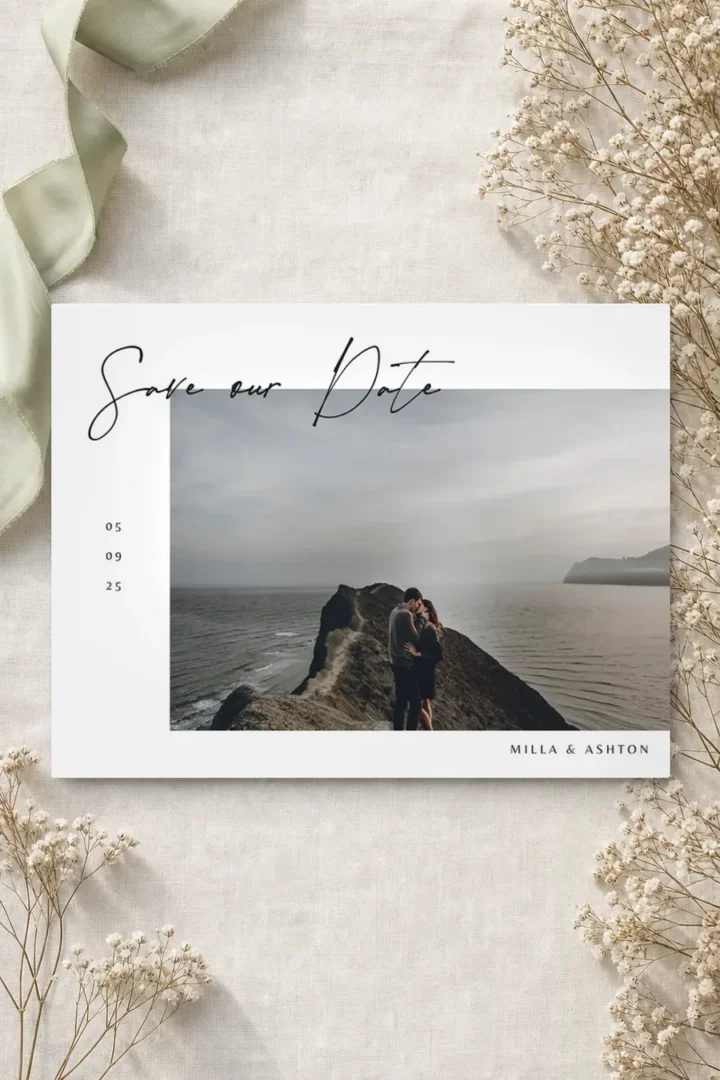
Shop photo save the dates
Printed photo save the dates with matching digital versions, cover both channels.
How to Decide When to Send Your Save the Dates
Three factors determine your send date: where the wedding is (local vs destination), how much travel guests need to do, and how flexible your guest list still is.
1. Map your timeline backwards from the wedding date
For a local wedding, save the dates ship 6-8 months out. For destination weddings, push to 8-12 months out. Holiday-weekend weddings (Memorial Day, Labor Day, summer long weekends) need an extra month of lead time so guests can book accommodations before they sell out. Build the printing deadline 3 weeks before the send date (6 weeks for letterpress or foil stamp) to allow for design revisions and shipping.
2. Decide whether your list is locked
If your guest list still has plus-one questions or family politics to resolve, sending save the dates too early creates the awkward ‘received a save the date but no invite’ problem. Wait until the list is at least 90% locked before printing. Late-add guests can be handled with formal invitations only, there’s no etiquette breach in skipping the save the date for last-minute additions. For the conventions that apply once full invitations go out, see our wedding invitation etiquette guide.
3. Decide between digital and printed (or both)
Digital save the dates ship faster (same day if needed) and cost nothing per guest, but they get lost in inboxes and feel less special. Printed save the dates carry more weight and end up on fridges, but they require a longer lead time. Many couples send digital first to lock the date, then follow with printed save the dates 2-3 months later. See the digital save the dates guide for hybrid strategies.
Frequently Asked Questions
Is it too late to send a save the date 4 months before the wedding?
Four months is on the shorter end but workable for a local wedding where guests do not need to arrange major travel. For a destination wedding or a peak-season date, 4 months is tight, and some guests may already have conflicting plans. Send as soon as possible, follow up personally with your most important guests, and order printed cards immediately if you have not already.
Can I send save the dates before choosing a venue?
Yes, as long as your date is confirmed. Save the dates only need your names, the date, and a general location (city and state is enough). You do not need a venue address, and that level of detail belongs on the invitation anyway. List the city and state, include “invitation to follow,” and update your wedding website once the venue is finalized.
Do I need to send save the dates if I’m having a small wedding?
There is no rule requiring save the dates for small or intimate weddings. A personal call or message can serve the same purpose for a tight guest list. That said, even small weddings benefit from save the dates when any guests need to travel, request time off, or plan around family logistics. And for couples who want their stationery to feel cohesive, a beautifully designed card is worth it regardless of guest count.
How long after save the dates do invitations go out?
Formal wedding invitations typically go out 6 to 8 weeks before the wedding, or 3 to 4 months before for destination weddings. The gap between save the dates and invitations is usually 4 to 6 months on a standard timeline. Use that window to finalize venue, catering, and RSVP logistics so your invitation suite is complete and accurate. See our full guide on when to send wedding invitations for a detailed breakdown.
When should I send save the dates for a destination wedding?
For destination weddings, send save the dates 9 to 12 months before the date. International destinations need the full 12 months so guests can arrange passports, book flights, and secure accommodation. Domestic destination weddings can work with 9 months. Include your wedding website address on the save the date so guests can find hotel block deadlines and travel recommendations as soon as they receive the card.
How early should international guests receive save the dates?
International guests need 9 to 12 months of advance notice to arrange passports (or renewals), book international flights, and request extended vacation time. If only some of your guests are traveling internationally, send the same save the date to everyone at the 8 to 12 month mark, but follow up personally with your international guests the same day with accommodation and travel information.
When should save the dates go out if we have a long engagement?
If your engagement is 18 months or longer, wait until you are 10 to 12 months from the wedding date before sending save the dates. Sending much earlier risks the card being lost or forgotten. Use the extra lead time to finalize your guest list, collect mailing addresses, and choose a design you love before placing your order.
Do second marriages need save the dates?
Save the dates are optional for second marriages. Many couples planning a smaller second wedding skip them and go straight to invitations, especially when the guest list is made up of close family and friends. Send save the dates for a second marriage if guests need to travel, if the date falls on a peak-season or holiday weekend, or if the guest list is large enough that a formal heads-up is genuinely useful.
What should I do if the gap between my save the dates and invitations is too short?
If you are running behind schedule, send invitations as soon as they are ready without waiting for the standard gap. If you have fewer than 8 weeks before the wedding and have not yet sent save the dates, skip them and go straight to invitations. Notify your most important guests by phone or text the same day you mail, especially those who need to arrange travel. The timing gap is a guideline, not a rule.
Ready to send? Shop save the dates
Free envelopes with every order. Order a sample pack before you commit.
Such helpful advice! As a wedding stationery designer, I always encourage couples to send save the dates early, especially for destination weddings or when guests need to make travel arrangements. Giving guests plenty of notice makes the planning process so much easier for everyone! 💕