
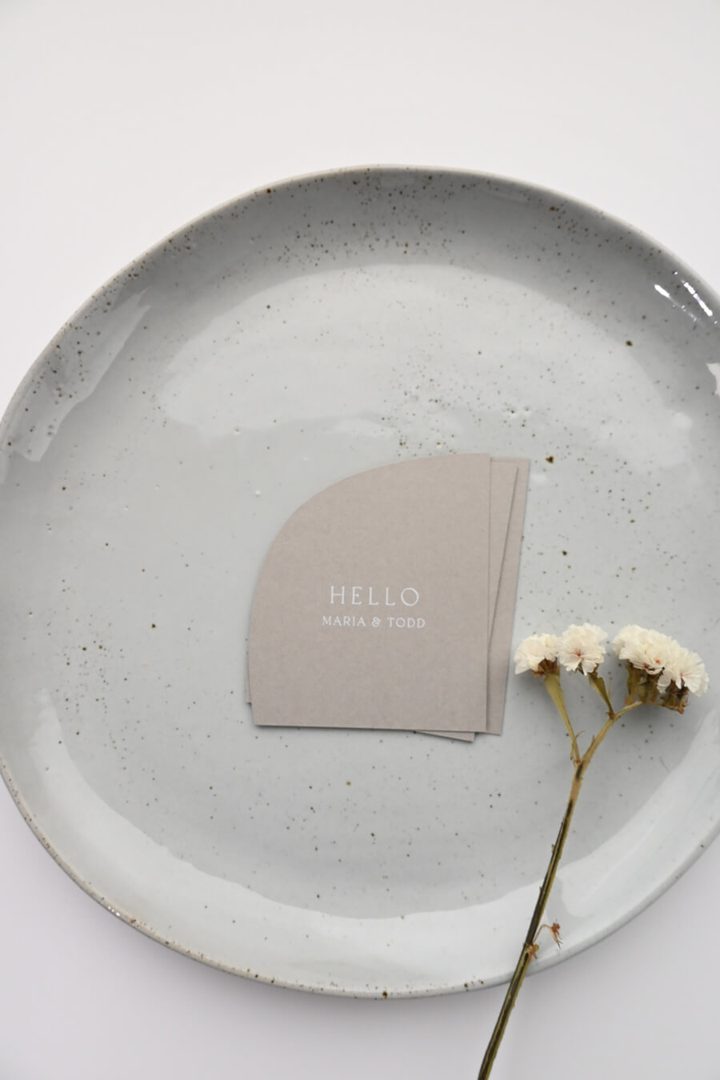
- Paperlust offers six main printing techniques for wedding invitations: digital, letterpress, flat foil, foil stamp, metallic, and white ink, plus colour stock + foil for dark backgrounds.
- Letterpress presses type physically into 300-600gsm Wild Cotton paper, creating a tactile impressed finish impossible to replicate digitally.
- Flat foil and foil stamp are different: flat foil has no deboss; foil stamp uses a custom die that creates both a pressed impression and a mirror-bright metallic finish.
- Metallic print is a subtle gold/silver pigment at a fifth print station, understated and affordable compared to real foil.
- Production takes 3 to 5 business days for digital, metallic, and white ink; 7 to 10 business days for flat foil; 20 to 23 business days for letterpress and foil stamp. DHL Express delivers to US in 2 to 4 business days.
- Order the $5 sample pack (seven print method samples) before deciding, no screen shows you what letterpress feels like in your hands.
The print method is the single decision that most shapes how your wedding invitation looks and feels. A great design executed in the wrong technique falls flat; a simple design executed in the right one can be extraordinary. This guide explains every printing technique available for wedding invitations in 2026, what each one is, how it works, what you’ll feel and see, what it costs, and how to decide which is right for your specific wedding.

Why Printing Technique Matters
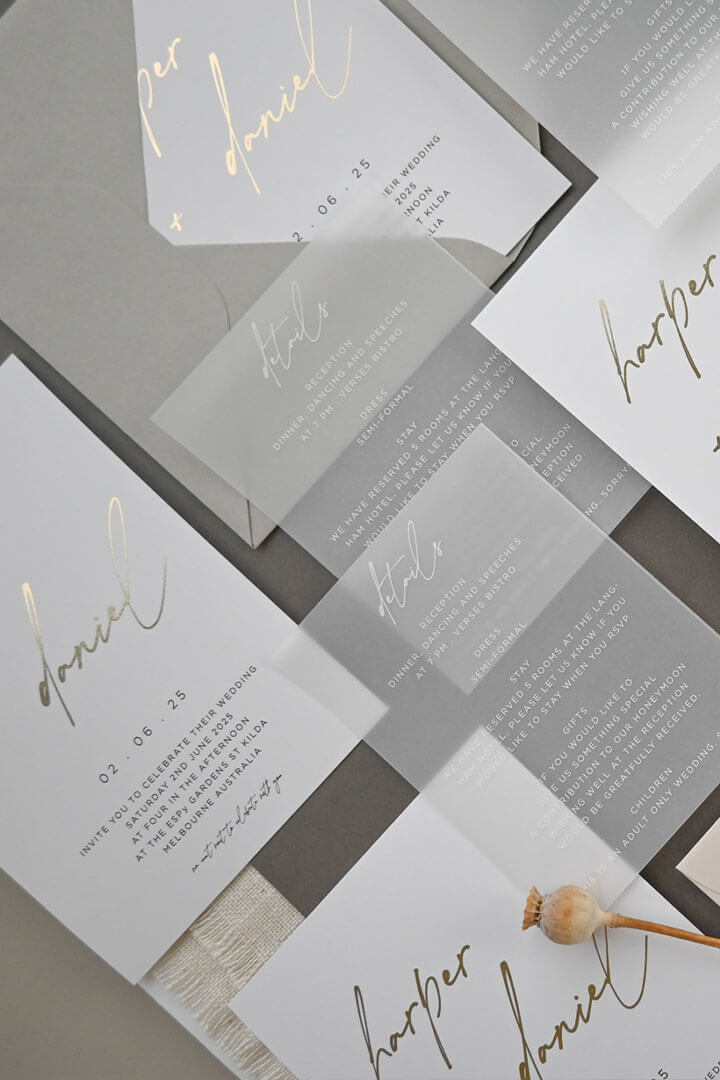
Two invitations can share the same design layout, the same font, and even the same paper weight, and still feel completely different because of the print method. Letterpress presses ink into the paper, creating a physical indentation you can feel with a fingertip. Foil stamp does the same but with mirror-bright metallic foil. Flat foil sits on the surface without a deboss. Digital print reproduces any design faithfully but has no tactile dimension beyond the paper itself.
Understanding these differences before you commit to a print method prevents the most common stationery disappointment: expecting letterpress and receiving digital, or expecting the shimmer of real foil and ordering metallic print. This guide makes those distinctions clear.
Quick Comparison: All Print Methods at a Glance
| Method | Tactile Effect | Color Range | Min Order | Production |
|---|---|---|---|---|
| Digital print | None (paper texture only) | Full color / unlimited | No minimum stated | 3 to 5 business days |
| Metallic print | None | Full color + subtle metallic | No minimum stated | 3 to 5 business days |
| Flat foil | Smooth surface foil (no deboss) | 12+ foil colors | 10 cards (30 for 350gsm HW) | 7 to 10 business days |
| White ink | Slight ink texture | White (+ can underlay CMYK) | No minimum stated | 3 to 5 business days |
| Foil stamp | Debossed impression + foil | 12+ foil colors | 50 cards | 20 to 23 business days |
| Letterpress | Deep debossed impression | Spot colors (not full CMYK) | Varies by design | 20 to 23 business days |
| Colour Stock + Foil | Smooth surface foil on coloured card | Foil on dark/coloured base | 10 cards | 7 to 10 business days |
Digital Print: The Versatile Standard
Digital print is full-color inkjet or laser printing onto card stock. It’s the same technology that has improved dramatically in quality over the past decade, and today’s professional digital print produces crisp, accurate, richly colored results that photograph and present beautifully. It is not a compromise, it is the correct choice for a wide range of designs.
What digital print is best for
- Designs with full-color photography or photographic elements
- Watercolor illustrations with complex gradients and multiple colors
- Heavily illustrated designs with fine detail
- Budget-conscious couples who want quality without premium pricing
- Couples who need a faster turnaround (3 to 5 business days vs. 20 to 23 for letterpress)
What digital print cannot do
- Create a tactile pressed impression in the paper
- Produce mirror-bright metallic effects (metallic print is the closest alternative; it’s subtle rather than mirror-bright)
- Print white on dark paper (white ink is a separate technique)
Compatible papers
Matte (300gsm), Linen (300gsm), Kraft (290gsm), Blush, Metallic stock, and Premium (380gsm). The widest range of any print method.
Browse digital wedding invitations for the full collection.
Letterpress: The Heritage Luxury Technique
Letterpress is the oldest print technique in modern commercial use, and the one that produces the most distinctive result. In letterpress, a custom plate presses inked type and design elements physically into the paper surface, creating a debossed impression: a visible, touchable indentation you can feel running your fingertip across the card.
At Paperlust, letterpress uses hand-mixed inks and prints exclusively on Wild Cotton paper (300gsm or 600gsm). The combination of cotton fiber content, hand-mixed color, and the pressed impression produces an invitation that reads as genuinely artisanal in a way no other technique achieves.
What letterpress is best for
- Classic, heritage, and formal wedding aesthetics
- Couples who want a genuinely tactile, heirloom-quality result
- Designs based on clean typography and restrained layout (letterpress suits text-heavy, illustration-light designs best)
- Guests who will notice and appreciate the craft behind the printing
What letterpress cannot do
- Reproduce full-color photography or watercolor gradients, letterpress is spot-color printing, not CMYK
- Print on any stock other than Wild Cotton (300gsm or 600gsm)
- Production takes 20 to 23 business days from proof approval
Letterpress + foil combination
Letterpress and foil can be combined on the same card: letterpress provides the pressed impression for text and design elements, and metallic foil is applied to specific elements (a monogram, a crest, a decorative border). This is one of the most luxurious combinations available. Note that these are two separate production processes, they must be designed with both techniques in mind from the start. Contact Paperlust’s design team before briefing a letterpress + foil project.
Browse letterpress wedding invitations to see the full collection.
Flat Foil: Mirror-Bright Metallic Without the Deboss
Flat foil applies mirror-bright metallic foil directly to the surface of the card without pressing a die into the paper. The foil sits flat on the surface, it has a brilliant, reflective quality, but you won’t feel a debossed impression under your finger the way you would with foil stamp.
Flat foil is significantly more accessible than foil stamp: no custom die is required (which reduces setup cost), the minimum order is 10 cards (vs. 50 for foil stamp), and production runs on the faster 7 to 10 business day timeline. For couples who want real metallic foil but don’t need the pressed impression of foil stamp, flat foil is the smart choice.
Flat foil colors available
Gold, pale gold, rose gold, silver, copper, red, green, blue, hot pink, celestial blue, and holographic. The holographic finish shifts between rainbow colors depending on viewing angle, a striking choice for contemporary designs.
Compatible papers for flat foil
Matte stock, Premium 380gsm, 350gsm Heavyweight (minimum 30 for this weight), and Colour Stock + Foil (270gsm and 500gsm).
Browse flat foil wedding invitations.
Foil Stamp: Debossed Impression with Mirror-Bright Metallic
Foil stamp uses a custom-made die, a precisely engraved metal plate, that is pressed under heat and pressure to simultaneously bond metallic foil to the paper surface and create a physical debossed impression. The result combines the reflective brilliance of foil with the tactile depth of a pressed mark in the paper.
Foil stamp is the premium foil technique. The custom die means higher setup costs and a minimum order of 50 cards. It also requires 20 to 23 business days in production. But the result is bespoke: a foil-stamped invitation has a specificity and precision, the sharp edges of the impressed type catching the light, that no other technique replicates.
Important distinction: foil stamp vs. letterpress
Both foil stamp and letterpress create a debossed impression in the paper. They are different processes:
- Letterpress: pressed impression with ink (no foil unless specifically combined); requires Wild Cotton paper; hand-mixed inks; heritage character
- Foil stamp: pressed impression with metallic foil (no ink unless specifically combined); works on specialty textured and Wild Cotton papers; produces mirror-bright metallic finish at the impression site
Do not describe foil stamp as “letterpress” or imply they are the same process. They are separate techniques with different results and different aesthetic associations.
Compatible papers for foil stamp
Specialty textured stocks and Wild Cotton. Contact Paperlust’s design team to confirm paper compatibility for your specific design.
Browse foil stamp wedding invitations.
Metallic Print: Subtle Gold Without Real Foil
Metallic print is digital printing with a fifth color station: a dry toner metallic pigment that is applied in addition to the standard CMYK inks. The result is a gold or silver element with a visible, warm metallic sheen, but understated compared to real foil. It does not have the mirror-bright reflectivity of flat foil or foil stamp. Think of it as a step between standard digital and real foil in both appearance and price.
What metallic print is best for
- Couples who want a gold or metallic element but can’t justify the cost of foil
- Designs where the metallic element is a subtle accent rather than a centerpiece
- Faster turnaround than foil stamp (3 to 5 business days vs. 20 to 23)
- No minimum order unlike foil stamp
Common misconception: “metallic gold digital ink”
Metallic print is sometimes confused with “metallic gold digital ink”, but that description is inaccurate. The metallic effect comes from a dry toner pigment at a fifth imaging station, not from metallic ink in the traditional sense. The distinction matters because the visual result is different from what “metallic ink” might imply: it’s a soft, warm shine rather than a reflective mirror finish. If a mirror-bright gold result is what you want, choose flat foil or foil stamp.
Compatible papers for metallic print
Matte 300gsm, Linen 300gsm, and Premium 380gsm.
Browse metallic wedding invitations.
White Ink: Printing on Dark and Textured Stocks
White ink is a fifth-color print process that applies white pigment as part of the same print pass as CMYK inks. This makes it possible to print white on dark-colored stocks like navy, black, forest green, or kraft brown, where white-colored CMYK inks would simply disappear into the background.
White ink can be used on its own (white text on dark stock) or as an underlay for CMYK colors, the white base creates a clean, opaque foundation that allows full-color printing on dark stocks without the colors being affected by the dark background.
Compatible papers for white ink
Kraft (290gsm), Vellum (180gsm), and Colour stocks (270-300gsm) in cobalt, aqua, black, navy, forest green, violet, burgundy, and grey.
White ink is NOT available on Blush
White ink does not achieve sufficient contrast on Blush paper. If you want a white element on a pink-toned background, the design must be executed differently, typically with a near-white element in the digital layer or a different background tone.
Browse white ink wedding invitations.
Colour Stock + Foil: Real Foil on Dark Backgrounds
Colour Stock + Foil combines European coloured card (available in 270gsm and 500gsm weights) with real metallic foil. It is ECF and FSC certified. The dark, saturated background of the card combined with the mirror-bright foil creates the most dramatic contrast available in any invitation print method.
This technique is distinct from flat foil on white or light stock: the dark background fundamentally changes how the foil reads. On a black 500gsm card, gold foil appears almost as if illuminated. On navy, silver foil takes on an almost ethereal quality. This is the print method that produces the darkest, most luxurious invitations in the Paperlust collection.
Available colours for the card base include red, black, navy, and vellum. The 500gsm weight option is among the most physically substantial cards in the entire stationery category.
Choosing Your Print Method: A Decision Tool
- Want full color photography or watercolor illustration? Digital print only, letterpress and foil cannot reproduce gradients or photographic imagery.
- Want something guests can physically feel? Letterpress (ink impression) or Foil Stamp (foil + impression). Flat foil sits on the surface without deboss.
- Want real gold/silver shimmer? Flat foil (mirror-bright, no deboss, min 10), Foil Stamp (mirror-bright + deboss, min 50), or Metallic print (subtle, no deboss, no minimum). These are three distinct products.
- Want white text on a dark background? White ink on Colour stock, Kraft, or Vellum.
- Want the most dramatic dark-luxury result? Colour Stock + Foil in the 500gsm weight with gold or silver foil.
- Need it fast? Digital, metallic, or white ink: 3 to 5 business days. Flat foil: 7 to 10 business days. Letterpress or foil stamp: 20 to 23 business days.
- Not sure what each feels like? Order the $5 sample pack (seven print method samples across different techniques) before committing.
The Gold Invitation Problem: Three Techniques, Three Results
Gold wedding invitations are one of the most searched invitation types, and also one of the most confused, because “gold” means three genuinely different things depending on which technique you use. Understanding the difference prevents the most common expectation mismatch in wedding stationery:
| If you want… | Use this technique | Why |
|---|---|---|
| Mirror-bright gold with a flat surface | Flat Foil (gold) | Real metallic foil, no deboss, min 10 cards, 8-10 BD |
| Mirror-bright gold with a pressed tactile impression | Foil Stamp (gold) | Real foil + custom die deboss; min 50 cards; ~20 BD |
| Subtle warm gold sheen, most affordable | Metallic Print | Dry toner pigment; no foil; no min; 8-10 BD |
None of these is the same as the others. “Gold letterpress” is not a standard technique at Paperlust, letterpress uses hand-mixed inks in colors you choose, not gold foil. If you want gold and letterpress together, that is a letterpress + foil stamp combination (two separate processes). Describe this clearly when briefing your design.
Production and Proofing Timeline
Every order at Paperlust follows the same proof process regardless of print method:
- You place your order and upload your design details
- A professional designer assigned to your order sends a proof within 1-2 business days
- You review the proof and approve or request changes, unlimited ordinary proof edits at no extra charge
- Production begins after your approval
- Shipping via DHL Express delivers to US addresses in 2-4 business days after dispatch
DHL Express shipping is free on orders over $350 USD. For orders below this threshold, shipping is calculated at checkout.
About This Guide
This guide was written by the Paperlust content team using verified specifications from Paperlust’s production team and print catalog as of May 2026. All technique descriptions, paper compatibility listings, minimum order quantities, and production timelines are sourced from Paperlust’s internal production records and the live paperlust.co/information/print-type/ page (verified March 2026). Descriptions of physical properties (how each technique looks and feels) are based on physical samples from Paperlust’s Melbourne studio.
Sources: Paperlust production team; paperlust.co/information/print-type/ (verified March 2026); Paperlust print catalog (May 2026).
Frequently Asked Questions
What is the difference between flat foil and foil stamp?
Flat foil applies mirror-bright metallic foil to the card surface without pressing a die into the paper, the foil sits flat with no debossed impression. Foil stamp uses a custom die that presses under heat and pressure, creating both the metallic foil finish AND a physical debossed impression in the paper. Foil stamp requires a minimum of 50 cards and takes 20 to 23 business days; flat foil requires a minimum of 10 and takes 7 to 10 business days.
Is letterpress the most expensive print method?
Letterpress and foil stamp are the most expensive per-card methods at Paperlust, primarily because both use specialty papers (Wild Cotton for letterpress) and have longer production runs (20 to 23 business days). Flat foil is more accessible than foil stamp. Digital print, metallic, and white ink are the most affordable methods.
Can I mix print methods in the same suite?
Yes. Many couples use letterpress or foil stamp for the main invitation card and digital print for RSVP cards, info cards, and thank you cards. This approach captures the luxury feel at a lower total cost than an all-letterpress suite. The 15% bundle discount applies when you order three or more card types together, even if they use different print methods.
Can letterpress print in multiple colors?
Yes, but each color requires a separate pass through the press, which increases complexity and cost. Single-color or two-color letterpress designs are the most common. For designs requiring three or more colors with complex gradients, digital print is typically more cost-effective and produces a more accurate result.
What is the minimum order for each print method?
Flat foil: 10 cards (30 for 350gsm Heavyweight stock). Foil stamp: 50 cards. Colour Stock + Foil: 10 cards. Digital, metallic, and white ink: no stated minimum for standard sizes. Letterpress minimum varies by design, contact Paperlust’s team to confirm for your specific design.
How does letterpress differ from digital at the same weight?
Both might use 300gsm paper, but letterpress requires Wild Cotton with its cotton fiber texture, while digital print uses Matte, Linen, or other smooth stocks. The bigger difference is tactile: letterpress presses type into the paper, creating a debossed impression you can feel. Digital print has no impression, the ink sits on the surface. In side-by-side comparison, the difference is immediately apparent both visually and to the touch.
Does Paperlust offer any gold letterpress invitations?
Letterpress at Paperlust uses hand-mixed inks, not metallic foil. Letterpress can print in any ink color, including metallic gold ink, but this is different from the mirror-bright finish of real foil. For mirror-bright gold with a pressed impression, the technique is foil stamp (not letterpress). For a warm gold ink with an impression, it would be letterpress with gold ink. Discuss your specific vision with Paperlust’s design team to confirm the best approach.