

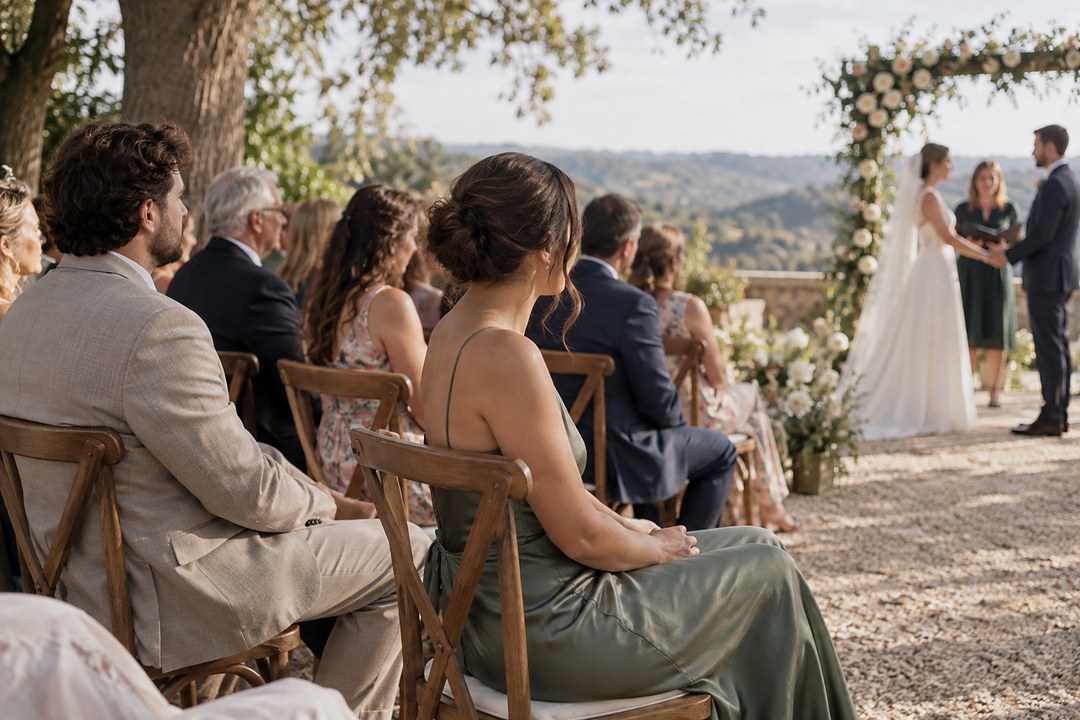
- An unplugged ceremony sign works best by the entrance to the ceremony, where guests walk past it on arrival.
- The request covers the ceremony only and ends when the recessional begins.
- A walking guest absorbs a short headline, one clear request, and a gentle reason.
- The officiant repeats the request right before the processional, which is when guests act.
- Tell guests early on the website, program, or details card so the sign feels like a reminder.
You are standing behind the last row of chairs, waiting for the processional to start, and you catch sight of a phone rising above a guest’s shoulder. That is the moment a clear unplugged ceremony sign earns its place.
The right sign does more than ask guests to put their devices down. It gives them wording they will actually follow, placed where they cannot miss it and backed by a spoken announcement from the officiant. This guide groups the wording by tone, from classic to funny to short, covers where the sign goes and what it is made of, and gives ready-to-copy scripts for the day itself.
What an unplugged ceremony sign asks of guests
An unplugged ceremony asks guests to silence and put away their phones and cameras so no photos, video, or livestreaming happens while the ceremony takes place.
An unplugged wedding covers just the ceremony, unless the couple extends the request. The quiet expectation ends when the recessional begins, and phones are welcome again at the reception. No one collects phones at the door; guests simply keep devices out of sight and on silent.
Couples usually make the request for three reasons. A hired photographer gets a clear shot down the aisle to the couple without raised phones blocking the frame. Guests watch the moment with their own eyes instead of a screen. And when the couple looks out, they see faces rather than black rectangles.
One honest limit matters here. A sign by itself gets overlooked, especially when guests are greeting each other and finding seats. It works as a reminder, not the only instruction.
The five parts a clear sign needs
A clear unplugged ceremony sign needs five parts in this order: a headline, a one-sentence request, a short reason, a note on when phones are welcome again, and a thank-you with the couple’s names.
- Headline: Use a phrase like “Welcome to our unplugged ceremony” or “Unplugged ceremony” so the purpose is obvious at a glance.
- The request: Ask guests to silence phones, put cameras away, and enjoy the ceremony without screens.
- The reason: Add a few words about being present or leaving the photography to the photographer.
- When phones return: Mention the reception or the end of the ceremony so guests know the rule has a boundary.
- Thanks and names: Close with a warm thank-you and the couple’s first names.
A walking guest takes in only a few words, so keep the sign to a headline and two or three short lines. First person plural, “we” and “us”, plus the word please, softens the request and makes it feel like a shared wish rather than a rule.
Please silence phones and put cameras away
so we can see your faces, not your screens.
Phones are welcome again at the reception.
Thank you, Maya and Daniel
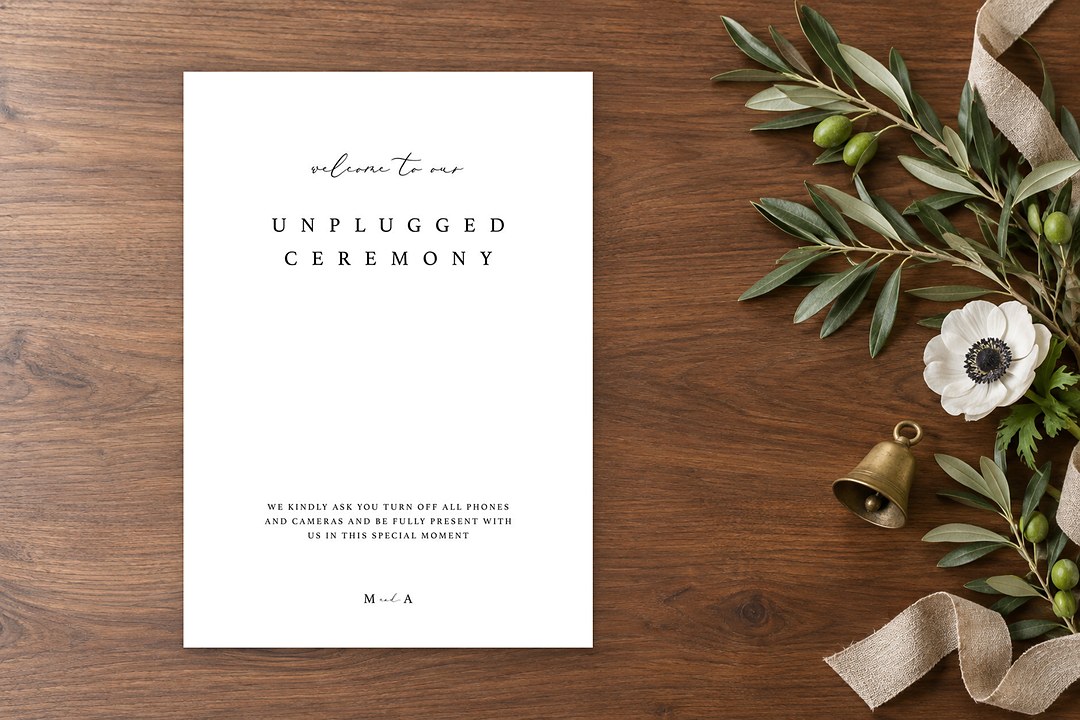

Polite and classic sign phrasing
Polite wording works in any setting when the request stays short, warm, and framed as the couple’s wish. Use these unplugged ceremony wording options as a starting point, then add your names or a welcome line.
Some guests will not know the word unplugged. They may wonder whether the ceremony is off the grid or whether a charger is involved. The sign needs plain words: silence phones, put cameras away, and no photos during the ceremony. Keep unplugged as the headline, then spell out the action in the line beneath it, so no one has to decode the term while the processional is about to begin.
This evening is unplugged.
We kindly ask that phones and cameras stay out of sight
so every guest may share the ceremony in person.
We will see you at the reception afterward.
Be here now. Please put away phones and cameras, and watch this moment with your own eyes.
We would love your full attention during the ceremony.
Once the recessional begins, feel free to bring your phones back out.
We want to see your smiles, not your screens.
Please silence phones and keep cameras down until we are pronounced married. Thanks!
We have waited a long time for this, and we want to look out at the people we love.
Phones silent, cameras away, hearts fully present.
Funny and rhyming sign lines
Funny wording suits a casual crowd when the couple already jokes around, and rhyming wording gives the sign a keepsake quality guests will remember.
Playful lines
Keep the jokes aimed at screens and the couple’s own vanity, never at a guest.
Phones down, cameras away. We promise to share the professional photos later.
Enjoy the ceremony unplugged.
Keep it tucked away until the reception.
Please let them take the pictures. Phones away during the ceremony.
Signs in rhyme
Rhymes work when the lines read easily in one pass and the request remains the clearest part.
and let our photographer capture the day.
No need to zoom or frame the shot,
just be here with the love we’ve got.
let the photographer do their job right.
we want your eyes on us today.
your attention matters most.
Set the phone down, look this way,
be here with us on our wedding day.
Phrasing that points to the photographer
Guests accept the request most easily when they know the moments are being captured by someone better placed than they are.
Please enjoy the ceremony unplugged and leave the photos to them.
Please leave your phones in your pocket so he has a clear view and you can be in the moment.
Short signs, paired signs, and church ceremony lines
Short wording gives you more lettering room; combined signs save space when the welcome or seating note matters too; church wording keeps the request reverent.
Very short options
Short wording works best when the sign will be read while guests walk and every word needs to stay legible.
Pairing with welcome or seating notes
Try this when the same sign carries the welcome message; warm wedding welcome sign wording examples can help you balance both jobs.
Some couples also set out a memorial table with its own short sign to remember family who have died; keep it near the guest book or in a quiet corner, never beside the bar, and use wording large enough to read in low light.
This is an unplugged ceremony, so please keep phones away.
Please sit anywhere you like and keep the ceremony unplugged.
Please switch phones to silent and enjoy the moment with us.
In a sacred setting
Church wording suits a house of worship where the request should sound like an invitation to be present.
Please silence phones and refrain from photography during the ceremony.
we ask that all phones and cameras be put away while we exchange our vows.
Thank you for honoring our unplugged ceremony.
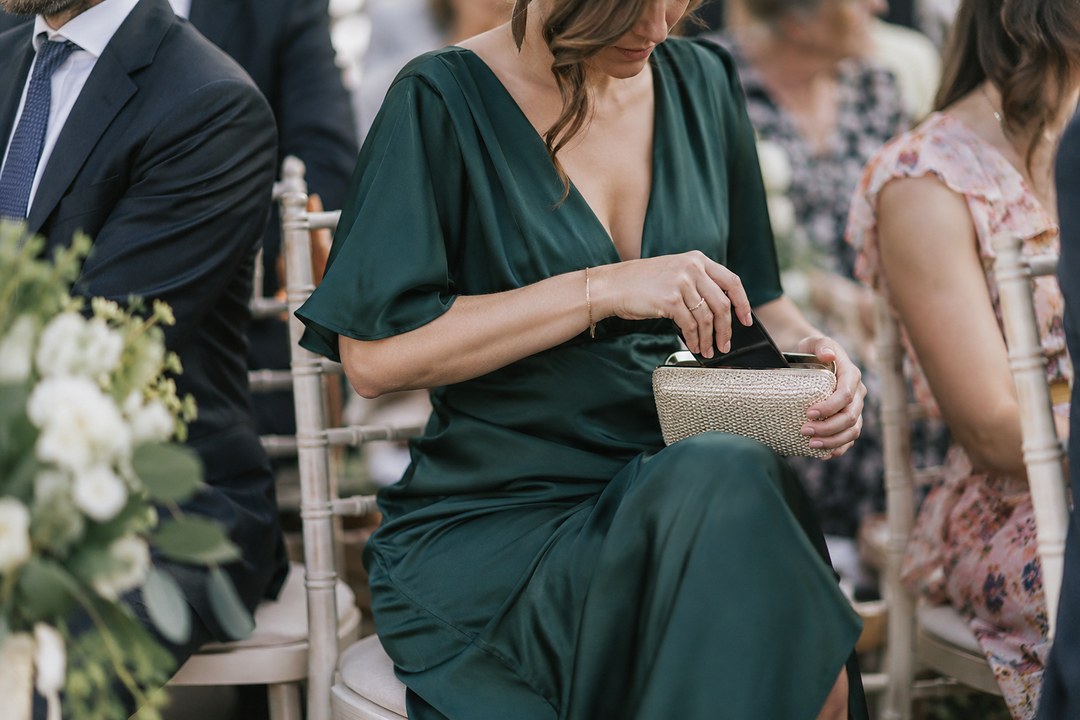
Placement, size, and materials for your sign
The sign belongs at the entry to the ceremony, where people walk past it on arrival.
| Sign spot | Guests who pass it | What to know |
|---|---|---|
| Ceremony entrance | Every guest walking in | Read before seating, when attention is freest |
| Start of the aisle | Guests passing by on the way to seats and those seated near the aisle | Seen just before guests settle, while the aisle is still clear |
| Program or welcome table | Guests picking up materials | Pairs with the written program line |
| A second entrance | Guests arriving another way | Prevents the main sign from being missed |
Keep the message short enough that a guest reads it while walking. Shorter lines let the letters run bigger, so a headline and two short lines beat a paragraph every time. An unplugged wedding sign reads best when the lettering is big enough to catch from a few steps away without shouting.
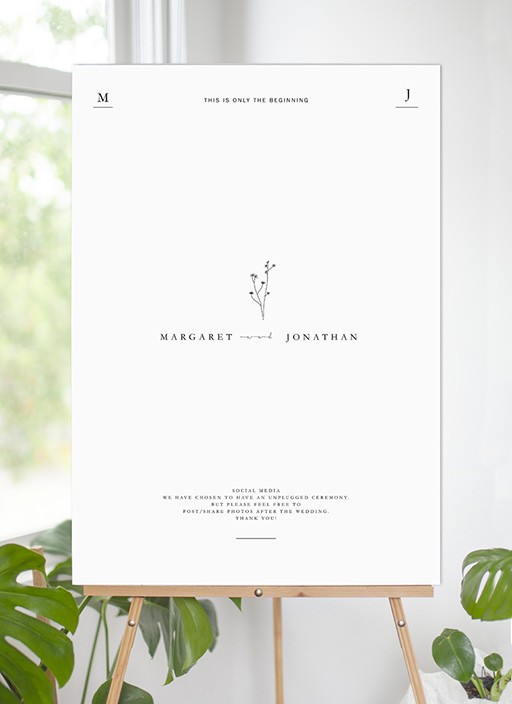
Paperlust wedding signs are personalized online with your names, date, and wording. You can choose fabric or rigid Polyboard; acrylic and vinyl-foil Polyboard are available on selected designs. One Polyboard design, for example, comes as a 5 mm rigid board in A1, 33.1 inches high x 24 inches wide (841 x 594 mm), and because it is not self-standing, it needs an easel or venue support. If you prefer fabric, a hanging design is a soft printed textile; one such design measures 78.74 inches high x 25.59 inches wide (2000 x 650 mm). Each design page shows its size. Browse the wedding signs catalog to see designs you can personalize.
After you order, a designer sends a digital proof; the first proof comes one to two business days after ordering. Printing starts only after you approve it, so you check the wording, names, date, and line breaks on this sign before it goes to print. That is where a missing word or an awkward line break gets caught. Paperlust signs are printed in Melbourne, Australia, and delivered internationally.
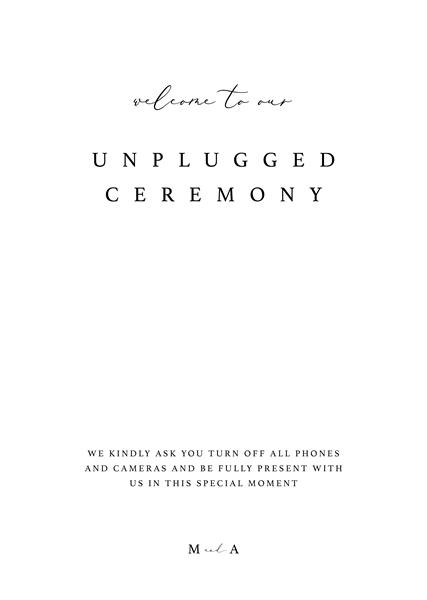


The spoken request the officiant gives
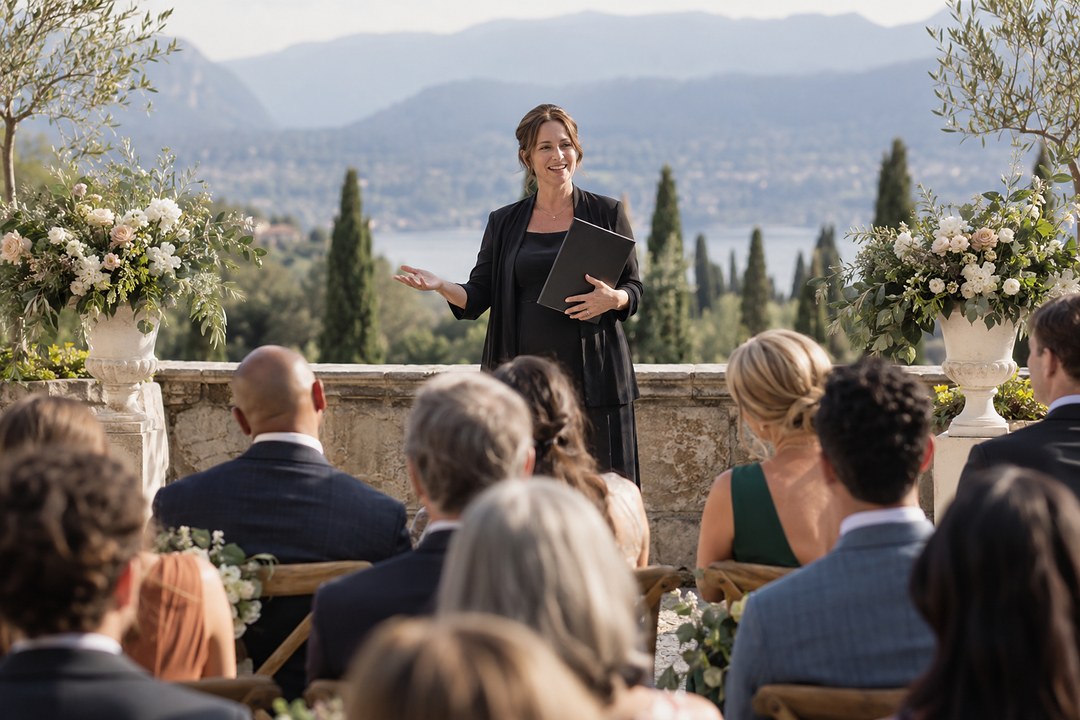
The sign is the reminder; the officiant’s short spoken unplugged ceremony announcement is the instruction guests actually act on.
It belongs right before the processional, once guests are seated. If you are unsure where that falls among the welcome, readings, and processional, a clear breakdown of the order of a wedding ceremony can help you brief the officiant. Ushers, the coordinator, or the MC can repeat the request while seating guests so late arrivals hear it too.
Give the officiant a small note card in writing rather than a line they must remember from a rehearsal. Include the exact wording, the tone you want, the couple’s reason, and any photo window you are allowing. The request falls right after the welcome and immediately before the processional; if a phone comes out mid-ceremony, the officiant should keep going without pause and leave any quiet follow-up to the coordinator or an usher afterward.
Early notice on the site, program, and details card
The sign should be the final reminder rather than the first notice, because guests follow a request better when they have already heard it before the day.
Use the wedding website for the fuller explanation, the ceremony program for the day-of line, and a details card with the invitation for the earliest heads-up. Wedding party members can send a short text the week before for any friends who are not detail readers. For the website, warm wedding website wording examples can help you sound like yourselves. For the paper line, match the tone in wedding program wording.
For the wedding website
On the program
On an invitation details card
In a text from the wedding party
Warm rules, exceptions, and forgetful guests
Asking for an unplugged ceremony is polite when the same rule applies to every guest and the wording frames it as the couple’s wish, not a criticism of phones in general.
Address any relative likely to object privately, before invitations go out. Say the photographer’s line of sight gets blocked by raised phones, that the ceremony is short, and that a family member who cannot attend can watch through one chosen relative’s quiet stream if needed. The goal is not to win a debate but to make the wish clear and then hold the same warm line for every guest.
For a middle option, a photo window of roughly ten to thirty seconds after the couple reaches the front lets guests take one or two pictures, then phones go away. The officiant can say:
Some exceptions make sense. One relative may be asked to stream for someone who cannot travel, or someone who must stay reachable for work or children may keep a phone on silent. Those quiet arrangements do not change the public request.
If a phone still comes out anyway, do not correct anyone publicly. The coordinator, ushers, or MC can quietly remind guests as they find seats, and then the moment moves on. At the recessional, the unplugged part ends, and guests can bring phones out again for the reception.
Frequently asked questions
What does an unplugged ceremony mean?
It means guests are asked to keep phones and cameras silent and out of sight, with no photos, video, or livestreaming during the ceremony itself. Guests are not asked to hand over their phones at the door; they simply keep devices tucked away. The request lasts only until the recessional starts, and the reception is separate unless the couple says otherwise.
Is it rude to ask guests not to take photos?
Not when the request is warm, applies to everyone, and explains what the couple wants: a clear view for the photographer, faces instead of screens, and guests watching with their own eyes. Phrasing it as “we invite you to be present” rather than “no phones allowed” keeps it from feeling cold or scolding.
Is an unplugged ceremony sign enough on its own?
No, a sign by itself gets overlooked. Guests act on the officiant’s brief spoken request just before the processional, after everyone is seated. The coordinator or ushers can repeat it as people find their seats. The sign works best as a visual reminder by the entrance.
Does the unplugged request cover the reception too?
Only if the couple says so. The standard unplugged ceremony lasts until the recessional starts; after that, the quiet rule lifts for the reception. If you want phones away for part of the reception, add a separate note so guests know the boundary.
Can guests take any photos at all during the ceremony?
Some couples allow a short photo window of about ten to thirty seconds once the couple reaches the front. The officiant invites pictures for that brief moment, then asks everyone to put phones away. If no window is announced, guests should keep devices tucked away until the recessional.
We want an unplugged ceremony but do not have a professional photographer. What should we do?
Designate one friend as the photographer and say so on the sign or website, like “Our friend Leo is photographing the ceremony.” That gives guests confidence the moment is being captured and keeps every other phone out of the aisle. A single designated person can take a clear set of photos without a wall of screens.
Should the unplugged request go on the invitation or the wedding website?
The wedding website can hold the fuller explanation, while a short line on a details card inside the invitation gives the earliest heads-up. The sign and ceremony program then act as day-of reminders. Putting the full request flat on a formal invitation can feel heavy, so a details card is often the better paper home.