
A black-tie wedding is a statement – one that says the couple chose formality, grandeur, and an evening that guests will still be talking about twenty years later. In 2026, black-tie weddings are evolving: the bones are the same (tuxedos, floor-length gowns, a venue with presence), but the palette and personalization have loosened up in the best possible ways. This guide walks you through every element of planning a classic black-tie wedding that feels both timeless and genuinely yours.

- Dress code: Tuxedos for men; floor-length gowns for women (mandatory)
- Typical start time: 6:00-7:00 PM ceremony; late reception
- Venue types: Grand ballroom, luxury hotel, historic estate, museum
- Invitation style: Engraved or letterpress on heavy cotton; traditional wording
- Color palette: Black, ivory, midnight navy, jewel tones, gold
- Budget signal: Black-tie implies a premium event; guests dress accordingly
What Is a Black-Tie Wedding?
Black tie is the most formal dress code below white tie in American wedding culture. It signals a specific level of ceremony, venue, and production that guests recognize immediately. The term on your invitation is a promise: this will be a polished, elevated evening with formal service, sophisticated decor, and an atmosphere that calls for your best.
In 2026, black-tie couples are personalizing within that framework – choosing jewel-tone florals over all-white, incorporating meaningful cultural elements, or starting the reception with a cocktail hour that showcases their personalities before the formality of dinner begins. The structure is classical; the soul is individual.
The Perfect Black-Tie Venue
The venue is the foundation. A black-tie wedding needs a space with architectural authority: high ceilings, chandeliers or dramatic lighting potential, a dance floor with presence, and rooms that accommodate the full multi-hour program (cocktail hour, seated dinner, dancing).
Grand Hotel Ballroom
A ballroom in a luxury hotel is the classic black-tie setting. Look for ornate moldings, parquet floors, and in-house catering operations equipped for multi-course service. The Ritz-Carlton, Four Seasons, and historic grand hotels in major US cities remain the benchmark.
Historic Estate or Mansion
A grand turn-of-the-century estate – stone facade, manicured grounds, formal dining rooms – delivers a black-tie atmosphere that no ballroom can fully replicate. Guests feel transported. Look for properties on the historic register in the northeast, mid-Atlantic, and southeast for a range of capacities and styles.
Museum or Cultural Institution
An art museum, natural history museum, or grand library offers the formality of a ballroom with far more visual interest. Couples photographed against museum collections look incredible, and guests enjoy the sense of private access to a usually public institution.
Dress Code: Couples and Guests
The Couple
The rules for the couple are flexible – this is your wedding – but dressing into the black-tie level signals that you mean it. Grooms: a classic black tuxedo with white dress shirt and black bow tie is the safe, timeless choice. In 2026, midnight navy and deep charcoal have become strong alternatives. Brides: a floor-length gown in any fabric from structured satin to fluid chiffon works – the length is the signal, not the silhouette.
Guests – Women
Floor-length gowns are standard black-tie for women. In 2026, the most popular choices are A-line and column gowns in jewel tones (emerald, sapphire, deep burgundy), classic black, and champagne. Midi-length is only acceptable if the invitation reads “black tie preferred” rather than “black tie required.”
Guests – Men
A tuxedo (black or midnight blue) with a white dress shirt, black bow tie, and patent leather or polished leather shoes. A well-tailored dark suit is acceptable for “black tie preferred” events but falls short of “black tie required.” When the invitation is unambiguous, tuxedos are expected.
The Black-Tie Color Palette
Black-tie weddings in 2026 are moving beyond all-white into richer, more dramatic territory. The best palettes pair a neutral base with one or two saturated accents:
| Palette | Base | Accent | Best Season |
|---|---|---|---|
| Classic Formal | Black + ivory | Gold | Year-round |
| Midnight Jewel | Navy + charcoal | Emerald or sapphire | Fall-winter |
| Old Hollywood | Black + ivory | Champagne + silver | Evening events |
| Modern Formal | Ivory + warm white | Blush + pale gold | Spring-summer |
Formal Wedding Invitations and Stationery
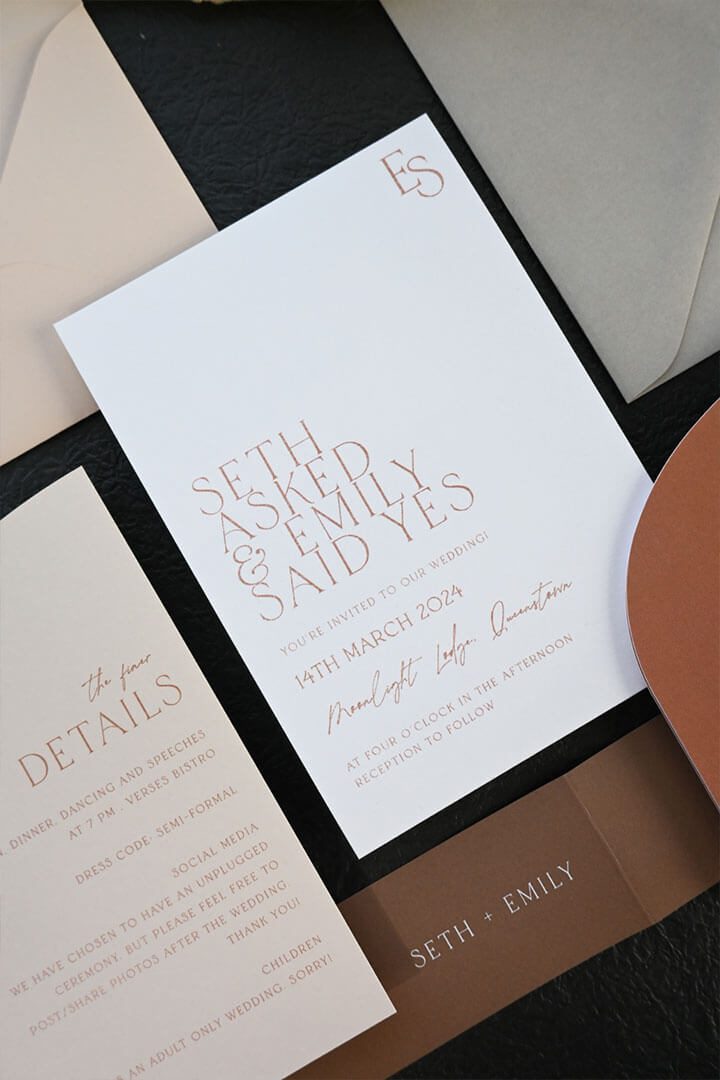
The invitation is where guests learn what to expect. A black-tie invitation has two jobs: communicate the dress code clearly and set the tone for an elegant evening before guests ever arrive.
The Traditional Black-Tie Invitation
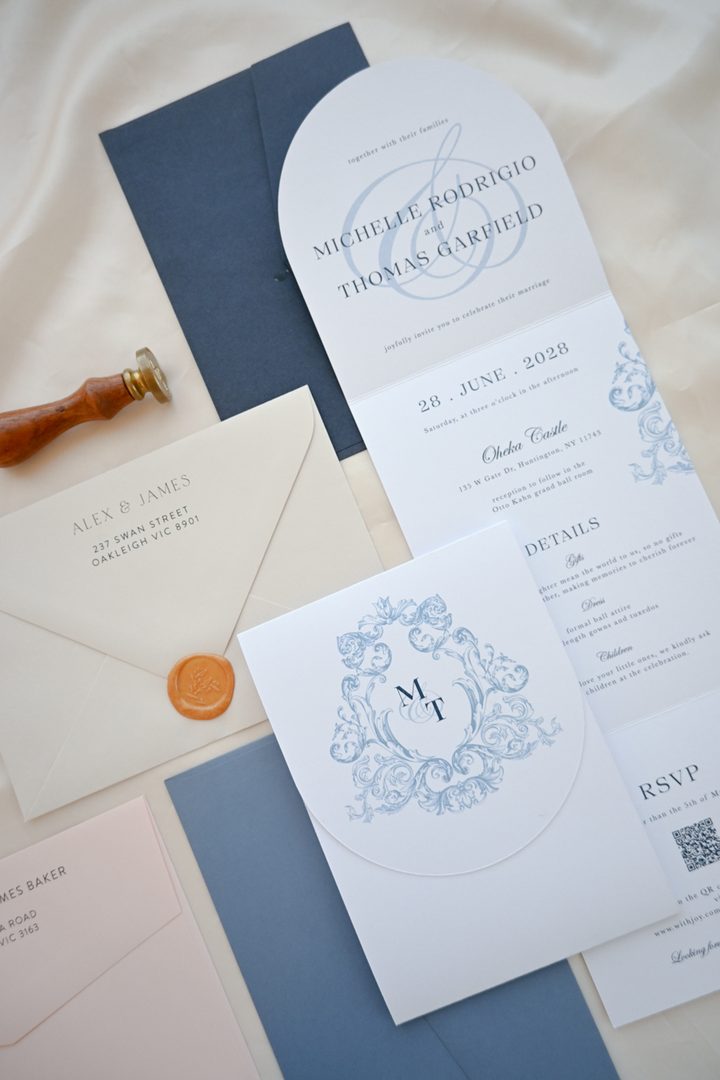
Classic black-tie invitations use engraved or letterpress printing on heavy cotton paper – ideally 500-600gsm Wild Cotton stock. The text is formal and third-person. “Mr. and Mrs. James Harrison request the honour of your presence…” The dress code (“Black Tie Required” or “Black Tie”) appears in the bottom right corner of the invitation.
Wording That Works
Traditional black-tie wording avoids casual phrasing. “Kindly reply by” rather than “RSVP by.” “The honour of your presence is requested” rather than “Please join us.” The formality of the wording mirrors the formality of the event.
Stationery Elements
A complete black-tie suite includes: the invitation card, inner and outer envelopes, a details insert, and a reply card with pre-addressed and stamped reply envelope. For the most formal events, printed hand-addressing on the outer envelope completes the look.
Design your formal wedding invitation suite
Letterpress on 600gsm Wild Cotton, flat foil on Premium stock, and more – from $2.04 per card
Your day-of stationery matters equally. Ceremony programs and printed dinner menus at each place setting reinforce the formal register throughout the evening and give guests something to take home.
Florals for a Black-Tie Wedding
Black-tie florals lean structured and opulent. The most effective arrangements for formal venues are tall enough to not interrupt sightlines across a dining table (over 24 inches) or low enough to sit well below eye level (under 12 inches). Mid-height arrangements create visual clutter in a grand room.
Classic Choices
- White garden roses and calla lilies: The quintessential black-tie combination – clean, architectural, timeless
- Deep red or burgundy roses: For a richer, more dramatic palette
- White orchid installations: Dramatic and long-lasting for all-day events
- Greenery as structure: Italian ruscus, dusty miller, and eucalyptus add texture without competing with the blooms
The Ceremony Installation
A black-tie ceremony benefits from a single dramatic focal point: a full floral arch, a pair of towering pedestal arrangements, or a dramatic aisle lined with identical arrangements at each row. The symmetry of formal ceremony design is part of its appeal.
Reception Details: Menu, Service, and Music
The Menu
Black-tie receptions mean plated, multi-course dining – not buffets, not food stations (though a cocktail hour with passed hors d’oeuvres and stations is standard). A formal dinner typically runs: amuse-bouche or pre-starter, first course, second course, main course, dessert. Wine and champagne service throughout.
Service Style
American or French service (synchronized plating or tableside presentation) signals the formality level. Avoid buffet-style service at a black-tie dinner – it contradicts the register of the event.
Music
A live band – ideally a big band or jazz orchestra for dinner service, transitioning to dance music for the reception – is the black-tie standard. If a DJ is chosen, the quality of production and sound design needs to match the room.
The Black-Tie Wedding Timeline
Black-tie weddings traditionally begin in the evening to allow guests time to dress after work. A classic timeline:
- 5:30 PM: Guest arrival and cocktail hour begins
- 6:30 PM: Ceremony (30-40 minutes)
- 7:15 PM: Cocktail reception
- 8:00 PM: Seated dinner begins
- 10:00 PM: First dance, speeches, dancing
- 12:00 AM – 1:00 AM: Reception ends
The Cocktail Hour: Setting the Tone
The cocktail hour at a black-tie wedding is not optional – it is the bridge between ceremony and dinner where guests decompress, reconnect, and settle into the atmosphere you have created. Getting it right matters as much as the seated dinner itself.
Passed Hors d’Oeuvres
Passed hors d’oeuvres served by uniformed staff are the black-tie cocktail standard. Aim for five to seven distinct bites, rotating through guests continuously for the full hour. A balance of cold and warm, protein and vegetarian, and one or two surprising or signature bites rounds the selection. Avoid anything messy, large, or structurally challenging to eat while standing in formal attire.
The Bar Setup
A cocktail hour bar should offer: a signature cocktail or two (served on trays as guests arrive), a champagne or prosecco option, a full spirits bar, and non-alcoholic alternatives that receive the same presentation quality as the alcoholic offerings. The bar itself should match the aesthetic – a white-clothed bar station, a polished brass or mirrored back bar, or a velvet-draped setup all work. Avoid plastic or visually casual bar setups.
Entertainment
A string quartet, jazz trio, or solo pianist sets the black-tie cocktail atmosphere without competing with conversation. This is the moment for background music, not performance. If your main reception entertainment is a full band, the cocktail hour provides the contrast that makes the dancing feel like an event when it begins.
Music: Band vs. DJ for a Black-Tie Wedding
The music decision is one of the most consequential for a black-tie reception. Both options can work at the highest level – but they deliver different experiences.
The Case for a Live Band
A live band – particularly a big band, swing orchestra, or high-production pop cover band – creates an energy that no DJ can fully replicate. The visual presence of musicians in formal attire adds to the aesthetic. Live arrangements of recognizable songs feel fresh and personal. The premium cost (typically $5,000-$25,000 for a quality band) is significant but often considered the single best investment in the reception experience.
The Case for a DJ
A skilled wedding DJ can execute a black-tie reception flawlessly at a lower cost point. The advantages: every song is the original recording, set transitions are seamless, and a skilled DJ reads the room in real time. For cocktail hour, a curated playlist approach often works better than a live trio. For the reception, a DJ who specializes in upscale events and has experience with formal affairs is the critical qualification.
Transportation: Arrivals and Departures
Black-tie weddings and black car service are natural partners. Guest parking in formal attire – navigating concrete garages in gowns and patent leather – is a practical and aesthetic problem. Solutions that fit the register of your event:
- Valet parking: The minimum expectation at a hotel or estate black-tie wedding; provides dignity of arrival without the logistics burden
- Shuttle service: A fleet of luxury coaches from a central hotel to the venue and back removes DUI risk and eliminates parking logistics simultaneously
- Black car service: For smaller guest lists, a fleet of black car services with designated drop-off and pick-up coordinates adds a genuinely special layer to the guest experience
- Couple’s exit vehicle: A classic car, vintage Rolls Royce, or helicopter exit is a black-tie wedding detail that photographs magnificently and costs less than most couples expect
Flowers and Their Meaning at a Black-Tie Wedding
The flower choices at a formal wedding carry weight beyond aesthetics – they signal intention and connoisseurship to guests who are paying attention. A black-tie event is one where floral choices genuinely matter, because the guests attending are likely to notice both quality and composition.
Classic Choices and What They Communicate
White garden roses are the black-tie bride’s most reliable choice: they suggest elegance without pretension, look magnificent in large-scale arrangements, and photograph beautifully under chandelier lighting. White calla lilies carry an architectural quality – their trumpet form is graphic and modern, making them excellent for structured ceremony arrangements. White orchids, particularly phalaenopsis in large-scale trailing arrangements, read as genuinely luxurious and sophisticated.
For couples who want color in a formal setting: deep red or burgundy ranunculus and roses bring a saturated jewel-tone richness that works against ivory and cream. Emerald foliage – glossy camellia leaves, magnolia, Italian ruscus – adds structure and a depth of green that dried botanicals cannot match. Avoid pale pastels in a very formal black-tie setting: dusty rose and blush read as too casual for the register.
Scale and Architecture
Black-tie florals must be scaled to the room. Centerpieces that read beautifully in a small venue disappear in a grand ballroom. As a rule of thumb: low centerpieces should be under 12 inches to avoid blocking sightlines; tall centerpieces should be over 26 inches to clear them entirely. Mid-height arrangements between 12 and 24 inches create an awkward visual barrier across long tables and should be avoided.
Ceremony florals follow the same logic: large-scale pedestal arrangements at the ceremony altar, lush garland along the aisle marking rope, and a full floral arch or half-arch as the backdrop all work at black-tie scale. A single floral sprig on an unadorned wooden stand reads as insufficient.
After the Wedding: Preserving Your Black-Tie Wedding Elements
A black-tie wedding generates significant investment in beautiful objects – florals, stationery, attire, accessories – and some of these are worth preserving beyond the day itself.
Invitation Suite Preservation
A complete invitation suite (invitation, envelope, reply card, details card) is worth framing. A shadow box arrangement with the invitation as the centerpiece, a swatch of invitation envelope liner, and the reply card response you received first makes a genuinely beautiful keepsake. Professional invitation framers specialize in this and can create a presentation piece that functions as wall art for decades.
Floral Preservation
Bouquet pressing and resin embedding have both improved significantly in the past five years. A pressed bouquet display, or individual blooms embedded in a clear resin block, preserves both the form and – somewhat – the color of the flowers. Freeze-drying is the most color-accurate preservation method, though it requires a specialist and takes 4-6 weeks.
The Wedding Album
For a black-tie wedding, a heirloom-quality printed album in a leather or linen cover is the appropriate keepsake format – not a digital gallery, not a photo book from a mass-print service. Commission an album through your photographer using archival papers and binding. This is a physical object meant to last a century, and the quality of the materials should match the quality of the occasion.
Frequently Asked Questions
Do I have to say “black tie” on the invitation?
Yes – if you want guests to dress formally, the invitation is the only reliable way to communicate this. “Black Tie Required” is unambiguous. “Black Tie Preferred” signals that a formal suit is acceptable. If you omit the dress code entirely, guests will default to cocktail attire.
What is the difference between black tie and black tie optional?
“Black Tie Optional” means tuxedos are welcome but a dark suit is also appropriate. It gives guests flexibility. “Black Tie” without “optional” means tuxedos are expected. “Black Tie Required” leaves no room for interpretation.
Can a black-tie wedding be outdoors?
A garden or outdoor black-tie ceremony is possible, but the reception should be in an enclosed venue where climate and lighting can be controlled. Gravel paths and outdoor terrain are also a challenge for formal footwear – provide alternatives or choose paved outdoor spaces.
How formal should the ceremony program be for a black-tie wedding?
Match the formality of the invitation. A flat letterpress program card in the same paper stock and font family as the invitation suite is the cleanest choice. Avoid printed booklets for strictly formal events.
What flowers are most appropriate for a formal black-tie wedding?
White and cream garden roses, calla lilies, white orchids, and anemones are all ideal. Deep red, burgundy, or emerald arrangements work beautifully for evening jewel-tone palettes. Avoid wildflower or rustic arrangements – they are too casual for the register of a black-tie event.
Browse Paperlust’s wedding invitation collection: letterpress on Wild Cotton, foil stamp on black or navy stock, and metallic-on-dark designs that signal formal black-tie from the moment guests open the envelope.