

Australia ·
United States ·
United Kingdom ·
Canada ·
New Zealand
- A great Christmas card message has four parts: a greeting, a personal note, a forward-looking wish, and a sign-off, the whole thing can be as short as two sentences.
- This guide has 60+ ready-to-copy wording examples organized by relationship, tone, and life situation, find the one that fits and personalize from there.
- Business cards call for warm but professional language: express gratitude for the year, skip the family updates, and always sign with your full name and title.
- For religious recipients, match their tradition, use “Merry Christmas” freely with Christian family, shift to “Season’s Greetings” or “Happy Holidays” for interfaith or secular contacts.
- Cards for difficult life moments (grief, divorce, a first Christmas alone) need gentleness over cheerfulness: acknowledge the moment rather than papering over it.
- New sections added: family messages (15 examples), friends (heartfelt and funny), business and work wording, and funny messages.
A Christmas card is the one piece of mail people actually want to receive. It sits on the mantel, gets read more than once, and, when you get the wording right, makes the person feel genuinely thought about. The trouble is staring at a blank card interior knowing you have approximately 12 square inches to say something that doesn’t sound like a Hallmark insert.
This guide solves that. Whether you’re writing to your parents, your biggest client, your kids’ teacher, or the neighbor you only ever wave at, you’ll find a ready-made starting point below, plus the five-step framework to personalize any of them in under a minute. Start with the full Christmas card collection to find the design, then come back here for the words.
- Writing to family? Jump to the Family Messages section for 15 copy-ready examples organized by tone and situation.
- Writing to friends? The Friends section has heartfelt and funny options, choose based on the relationship.
- Writing business cards? Jump to the Business and Work section, professional wording by recipient type and relationship depth.
- Want something funny? The Funny Messages section has 10 ideas that land without offending.
- Unsure what tone to strike? The Wording by Tone table shows the same core message in Warm, Funny, Formal, Spiritual, Short, and Long versions side by side.
- Navigating a sensitive situation (loss, divorce, first Christmas away)? Go straight to the Life-Stage Moments section.
- Wondering when and how to send? See the How to Send Christmas Cards section for timing, addressing, and card-list advice.
How to Write a Personalized Christmas Card
Even a two-sentence card can feel personal if it follows this framework. These five steps apply whether you’re writing to your grandmother or your most important client, the structure is the same, only the tone shifts.
Step 1: Choose your tone for this recipient
Before you write a word, decide on one adjective: warm, funny, formal, spiritual, or simple. Your tone sets every word that follows. A funny card to your closest friend lands perfectly, the same card to your boss’s wife does not. Think about how you normally communicate with this person and match that register. If you’d text them a meme, you can be funny. If your interactions are mostly email sign-offs, stay warm and professional.
Step 2: Open with a greeting that fits the occasion
The opening line anchors the whole card. “Merry Christmas” works for most recipients who celebrate. “Season’s Greetings” or “Happy Holidays” is the right call for contacts whose traditions you’re not certain about. For very close family, a warmer opening like “Wishing you the most magical Christmas” sets a more personal tone before you get into the personal note. Avoid hollow corporate openings like “At this time of year we wish to extend our warmest…”, they read as mail-merged.
Step 3: Reference a shared moment or memory
This is the step most people skip, and it’s the only step that makes a card irreplaceable. One specific detail, a trip you took together, a joke you share, something that happened this year, transforms a generic Christmas message into something the recipient keeps. It doesn’t need to be elaborate. “Still laughing about our September road trip disaster” is enough. For business cards, the shared moment is the professional relationship: “What a year it’s been working on [project/partnership].”
Step 4: Add your wishes for the year ahead
Close the main message with a forward-looking line. This is standard in Christmas cards because it bridges the holiday into the new year. Keep it genuine and specific where you can. For people going through a hard time, a simple “thinking of you this season and hoping the new year brings easier days” is exactly right.
Step 5: Sign off with intention
Your sign-off should match your relationship. “With love” is right for family and close friends. “Warm wishes” or “Warmly” works for most social contacts. “Best regards” or “With appreciation” suits professional relationships. And your actual name, not just your first name if the recipient might not immediately connect it, ensures the card doesn’t create a guessing game. For household cards, sign from everyone: “Sarah, Tom, Mia & the dog.”
Your words and design are one choice: the same sign-off lands differently on a photo card, a metallic card, or a typographic card, so work from the Christmas card ideas before you order.


Wording by Relationship
The examples below are grouped by who you’re writing to. Each one is complete and ready to use, personalize by replacing bracketed placeholders or swapping a detail from your own year.
For Parents
For Siblings
For Your Spouse or Partner
For Kids (from parents)
For Grandparents
For In-Laws
For Close Friends
For Casual Friends and Acquaintances
For Long-Distance Friends
For Friends You’ve Fallen Out of Touch With

For Clients and Customers
Business Christmas cards set the tone for the relationship heading into the new year. Keep the message professional, reference the working relationship, and always sign with your full name and company. Browse the Christmas card collection for designs that strike the right professional note.
For Employees and Teams
For Suppliers and B2B Partners
Christian and Catholic Christmas Messages
For family and friends who observe Christmas as a religious holiday, a message that acknowledges the spiritual meaning of the season feels appropriate and sincere.
Interfaith and Non-Denominational Messages
Spiritual but Not Specifically Religious
For Teachers
For Neighbors
For Your Mail Carrier, Delivery Driver, or Regular Service Providers
For Your Doctor, Dentist, or Healthcare Team
For a Party Host or Dinner Host
If you are the one doing the hosting this year, Christmas party invitations set the tone before guests arrive. Browse designs in foil and flat-print finishes that match everything from a formal dinner to a casual neighborhood gathering.

Wording by Tone
If you know the relationship but not the right register, this table shows the same core sentiment expressed in six different tones. Pick the row that matches your personality and your recipient, then use it as a starting point.
| Tone | Example | Best for |
|---|---|---|
| Warm | Wishing you a Christmas filled with the people and moments you love most. Thinking of you with much warmth. | Most relationships, universally safe and sincere |
| Warm | This time of year always makes me think of you. Wishing you and yours a beautifully cozy and joyful Christmas. | Friends you don’t see often but hold close |
| Funny | Merry Christmas! Here’s hoping Santa brings you everything on your list and none of the things on your ex’s list. | Close friends, fun-loving family, people who will get the joke |
| Funny | Merry Christmas! May your holiday be merry, your eggnog be spiked, and your family arguments be brief and forgotten quickly. | Siblings, close friends, laid-back extended family |
| Formal | Season’s greetings. We wish you and your family a peaceful and joyful holiday season and look forward to continuing our relationship in the new year. | Professional contacts, clients you haven’t met in person |
| Formal | On behalf of [Company], we extend our sincere wishes for a wonderful Christmas season and a prosperous 2027. | Corporate sign-offs, large client lists |
| Spiritual | May the peace and hope of Christmas fill your heart and home this season. Wishing you a blessed and holy holiday. | Religious family members, faith community |
| Spiritual | At this holy time, may you find the stillness and joy that only this season brings. Merry Christmas with love and blessings. | Devout recipients who appreciate a faith-centered tone |
| Short & Simple | Merry Christmas! Thinking of you and wishing you all the best. With love. | Large card lists, acquaintances, anyone when time is short |
| Short & Simple | Happy holidays! Wishing you a wonderful season. Warmly. | Professional contacts, interfaith or secular recipients |
| Short & Simple | Merry Christmas! Love you lots. See you soon. | Close family when the relationship says it all |
| Long & Heartfelt | This year has been one of the most meaningful of my life, and you’re a big part of why. Your friendship, your humor, your steady presence through the hard parts, I don’t take any of it for granted. Wishing you a Christmas as wonderful as the one you give everyone around you. Love you more than I say. | One or two truly close people who deserve the full version |
| Long & Heartfelt | Merry Christmas! What a year. I’ve been thinking about what to write in this card for weeks because you mean more to me than a card can really hold. But here’s the short version: thank you for being exactly who you are. Wishing you a holiday season as good as you are, and a new year full of everything you deserve. | Best friends, partners, beloved family members |
Wording for Life-Stage Moments
Christmas is not always uncomplicated. These templates are written for the moments when life has shifted, when the usual “Merry Christmas!” formula doesn’t quite fit, and the right words matter more than ever.
First Christmas as a Married Couple
A New Baby’s First Christmas
After a Loss or Bereavement
A Christmas card written during or after grief is one of the kindest things you can receive. These messages lean into acknowledgment rather than forced cheer, a single honest sentence is worth more than three paragraphs of cheerfulness in the wrong direction.
Going Through a Divorce or Separation
Celebrating Christmas Abroad or Far from Home
First Christmas in a New Home
Decision Aid: Which Template for Which Recipient
Use this table to quickly match your recipient to the right tone and section of the wording library above.
| Recipient | Recommended tone | Go-to sign-off | One rule to follow |
|---|---|---|---|
| Parents | Warm, personal | With all my love | Include one specific memory or gratitude from this year |
| Siblings | Warm or funny | Love you | A little humor lands well; one specific shared joke elevates it |
| Spouse / partner | Heartfelt, romantic | Always yours / I love you | Write something only they would recognize as true |
| Kids (young) | Playful, magical | Love, Mom & Dad | Mention Santa; keep sentences short and concrete |
| Grandparents | Sentimental, warm | With love always | Thank them for their role in the family |
| In-laws | Warm, inclusive | With love | Sign from the whole household; reference the family unit |
| Close friends | Personal, funny OK | Love always / miss you | One real shared memory separates a great card from a generic one |
| Casual friends | Warm, brief | Warmly / warm wishes | Two sentences is enough; don’t over-engineer it |
| Long-distance friends | Warm, a little wistful | Miss you / love and hugs | Name the distance explicitly, it shows you feel it too |
| Clients / customers | Professional, warm | With appreciation / warm regards | Reference the working relationship; skip personal family updates |
| Employees | Appreciative, encouraging | With gratitude | Acknowledge their specific contribution to the year |
| B2B partners | Formal-warm | Best regards / warm regards | Forward-looking line about the year ahead is expected in business cards |
| Teachers | Grateful, warm | With gratitude / warmly | Name your child and something specific they said about the teacher |
| Neighbors | Friendly, brief | Warm wishes | Sign the whole household; keep it neighborly, not overly personal |
| Service providers | Brief, appreciative | With thanks | A simple thank-you for their work is the right call, don’t overthink it |
| Religious recipients | Spiritual, sincere | With love and blessings | Use their tradition’s language naturally; don’t perform unfamiliar piety |
| Interfaith / secular | Warm, inclusive | Season’s greetings / warm wishes | “Happy Holidays” or “Season’s Greetings” over “Merry Christmas” |
Christmas Card Messages for Family: 15 Examples
Family Christmas cards carry a different weight than any other card on your list. They land in households where history lives, where everyone knows who you used to be and who you’ve become. The best family messages acknowledge that shared continuity while speaking to this specific Christmas. Use these 15 copy-ready examples as starting points, then add the one detail only you would know.
Warm and Sentimental (for parents, grandparents, close relatives)
For the Extended Family Christmas Card (household send)
Funny Family Messages (for siblings, cousins, families with a shared sense of humor)
For Distant or Estranged Family (reconnecting tone)
Christmas Card Messages for Friends: Heartfelt and Funny Options
Friend Christmas cards divide into two camps: the ones that make someone laugh out loud, and the ones that make them reach for it off the mantel weeks later to read again. Both are wins. The key is knowing which register fits the friendship, and being willing to go there fully rather than hedging toward generic.
Heartfelt Messages for Close Friends
Funny Christmas Card Messages for Friends
For Group Friends
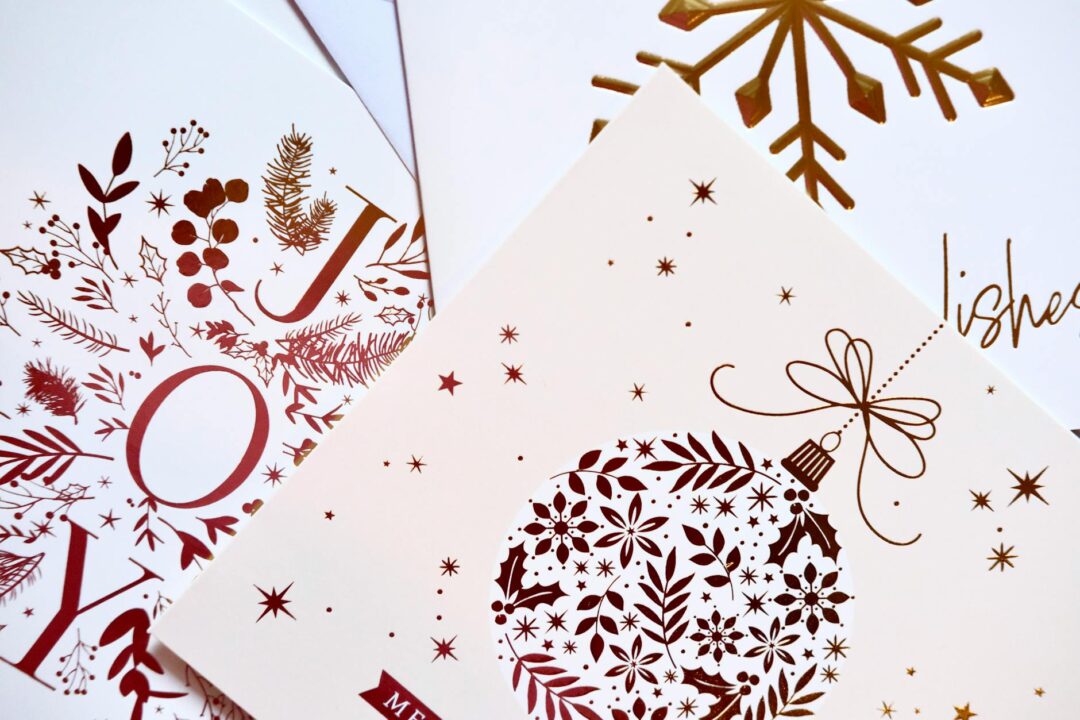
Business and Work Christmas Card Messages: Professional Wording
Business Christmas cards serve a strategic function beyond goodwill, they reinforce the relationship heading into Q1, signal that you see the partnership as valuable, and differentiate you from competitors who email a generic “Happy Holidays” GIF. Getting the wording right matters. The rules are consistent: professional warmth over formal distance, gratitude for the specific relationship, a forward-looking line about the year ahead, and your full name plus company on the sign-off.
For Long-Term Clients (3+ years together)
For New Clients (first year of the relationship)
For Work Colleagues
For Managers and Senior Leaders
Corporate Sign-Offs (for large lists, bulk sends)
For bulk business card sends, browse the Christmas card collection, where designs come in digital and flat foil finishes suited to professional contexts. Flat foil on a dark or cream stock makes a strong impression without veering into overly festive territory. For a large list with individual sign-offs, Variable Name Printing puts a different recipient name on each card, so the run still reads as addressed to a person. Planning a year-end event or staff celebration alongside your cards? The corporate event invitations collection has designs built for professional gatherings. If you’re based in Australia, visit this corporate Christmas cards page, which delivers to Australian addresses; if you’re in the United States, visit this corporate Christmas cards page, shipped by our US shop.
Your logo is set into the artwork by an assigned designer, not dropped on top of it, so the corporate Christmas cards you send carry your company identity.
Funny Christmas Card Messages: 10 Ideas for Lighthearted Notes
A genuinely funny Christmas card is rarer than it should be. Most attempts either play it too safe (a mild pun, a gentle quip about elves) or go too edgy for the relationship. The sweet spot is warm humor that’s specific enough to feel intentional but universal enough to land without context. Here are 10 ideas that work across a range of relationships.
The best funny Christmas card message pairs the humor with something warm. A punchline is fine, a punchline followed by a genuine “I love you” or “I’m glad you’re in my life” is the combination that lands. The humor gets a laugh; the warmth is what they remember.
How to Send Christmas Cards
Getting your message right is step one. Getting it there on time is step two. Postal volumes spike hard from late November through December, and what takes 2-3 days in July can take 8-10 days during peak holiday season. Here is the practical guide to making sure your cards arrive before Christmas Day.
Timing: When to Mail
For senders in the United States, aim to have domestic cards in the mail by December 10. For regional or rural addresses, PO Boxes, and APO/FPO destinations, post by early December to be safe. For international mail from the US, target late November for most countries. USPS publishes its official holiday shipping deadlines at USPS.com each year, typically in October, and those are the definitive reference for the current season.
For senders in Australia, metro domestic cards can go out in early December. Regional and remote addresses benefit from late November posting. International cards from Australia to the US, UK, Europe, and Asia should ideally leave by late November. Australia Post publishes country-specific cut-off dates each year on their website, worth checking by early November.
A practical order of events: order your Christmas cards by late October or early November so you have them in hand before the rush. Write personal messages through the second and third weeks of November. Post international cards first, then domestic. This avoids the scramble that leaves cards arriving after New Year’s.
Building and Managing Your Card List
A Christmas card list is worth maintaining year-round as a simple document or spreadsheet. The most useful columns: name, address, whether you received a card from them last year, and any address update notes. That last column matters more than people realize, people who move typically send a card from the new address, which is your automatic update. And the “did they send to me?” column helps you manage reciprocity without guessing each December.
Categories worth separating on your list:
- Must-send family: parents, siblings, grandparents, close relatives. These go first.
- Close friends: people who would notice if the card did not arrive.
- Professional contacts: clients, colleagues, suppliers. These often go to work addresses.
- Community contacts: neighbors, teachers, service providers. Shorter messages, usually.
- International addresses: flag these separately because they need to go out earliest.
When your list grows past 30-40 cards, batch your writing by category. Write all the family cards in one sitting, then move to friends, then professional contacts. It keeps the tone consistent within each group and speeds up the process considerably.
Sending Cards to Business Contacts
Professional Christmas cards follow slightly different rules from personal ones. Send to the recipient’s work address, not their home, a card arriving at someone’s house without a personal connection can feel intrusive. Use professional card designs rather than family photo cards. Sign with your full name and company name so the recipient can immediately place you. Time business cards to arrive the week of December 9-13, early enough to be seen before holiday office closures, not so early that it gets lost in November mail.
For teams sending a large volume of client cards, printed designs in flat foil or metallic finishes strike the right balance between premium and professional. For businesses also hosting year-end events, send Christmas party invitations 3-4 weeks in advance, enough notice to clear the calendar without competing with peak December schedule chaos.
Addressing the Envelope
The envelope is the first thing the recipient handles. A few rules that signal care before the card is even opened:
- Use the recipient’s full name, not “the family” alone.
- For married couples with different last names: “Sarah Collins & Tom Martin” or “Sarah & Tom Collins-Martin”.
- For households with children: “The Smith Family” or list everyone: “Sarah, Tom, Mia & Jake”.
- For formal or business contacts: use titles: “Mr. & Mrs. Robert Smith” or “Dr. Jane Williams”.
- Always include your return address on the back flap, undeliverable cards come back to you, and recipients can update their list with your current address.
Handwrite the address where you can. A handwritten envelope signals that this card was sent to a specific person, not a mailing list. For very large business card sends where handwriting is impractical, a clean printed label is fine.
International Cards
Sending cards internationally adds transit time, different addressing formats by country, and in some cases customs considerations for cards with enclosures. For cards to the UK, include the full postcode on the last line. For US-to-Australia or Australia-to-US, allow at least 2-3 weeks and mail by late November. For countries where postal reliability is lower, a digital card that arrives guaranteed is a practical alternative, it is better to reach someone than to have a card sit in customs until February.
One practical tip for large international lists: group your cards by country and address them all in one session. Switching between address formats mid-session introduces errors. If you are sending to 5 or more countries, keep a reference sheet with the correct address format for each country at the top of each group.
For the full etiquette breakdown covering addressing conventions, digital vs. paper, and managing your list when someone sends you a card you did not send them, see the Christmas card etiquette guide.
Christmas Card Etiquette Quick-Refs
Getting the message right is only half of it. The way you address, time, and present your cards signals as much as the words inside. For the full etiquette breakdown, addressing envelopes correctly, when to mail, how to handle digital alternatives, and the do’s and don’ts of Christmas card lists, see the complete Christmas card etiquette guide.
The short version:
- Timing: Aim for cards to arrive the first week of December. Mail by late November to be safe, postal volumes spike hard in December.
- Addressing: Use full names on the envelope. For households, address to everyone: “The Smith Family” or “Sarah, Tom, and kids.” For formal business cards, use professional titles.
- Handwrite the inside: Even if the card is professionally printed, a handwritten note inside makes it personal. A stamped signature alone feels form-letter.
- Photo cards: Photo Christmas cards work brilliantly for family updates, just keep the message inside focused on the recipient, not just an update on your own year.
- Business cards go to the office: For professional contacts, send to work addresses and avoid family photos on the card design.
- Apostrophes: “The Smiths” (plural, no apostrophe). “The Smiths’ home” (possessive). Never “The Smith’s.”
Looking for thank-you card wording to follow up after the holidays? The thank-you card collection has designs that work year-round. And if you need save the dates for any event coming up in 2027, it’s the right time to start.
Christmas Card Wording FAQs
When should I send Christmas cards?
For domestic mail, aim to have cards in the mail by December 10 (US) or the first week of December (Australia). International cards to the UK, Europe, and other countries should leave by late November to ensure pre-Christmas delivery. Allow extra time for rural addresses, APO/FPO mail, and any year when postal delays are forecast. Order your cards by late October or early November so you have enough time to write personal messages and post in batches rather than rushing everything out at once.
What should I write in a Christmas card to someone I’m not very close with?
Keep it short, warm, and genuine. Two sentences is completely fine: a greeting and a forward-looking wish. Try: “Season’s greetings! Wishing you and your family a peaceful and happy holiday season and all the best in 2027.” The goal isn’t depth, it’s to show you thought of them. Anything more risks overstating the closeness of the relationship.
How long should a Christmas card message be?
For most relationships, two to four sentences is the sweet spot. A greeting, one personal line, a forward-looking wish, and a sign-off. For very close family and best friends, you can go longer, up to a paragraph or two, if the relationship warrants it. For casual acquaintances, professional contacts, and large card lists, two sentences is appropriate and will be appreciated. The goal is sincerity, not volume.
What’s the difference between “Merry Christmas,” “Happy Holidays,” and “Season’s Greetings”?
“Merry Christmas” is specific to the Christmas holiday and is warm and appropriate for recipients who celebrate it. Use it freely with Christian family and friends. “Happy Holidays” is inclusive, it covers Christmas, Hanukkah, New Year’s, and other December celebrations, and is the safer choice for contacts whose traditions you’re unsure about. “Season’s Greetings” is the most neutral and formal option, commonly used in business contexts and for large mixed-tradition card lists. All three are completely appropriate; the choice is about matching your message to your recipient.
What should I write in a Christmas card for a business contact?
Keep it professional and warm. Express genuine gratitude for the working relationship, include a forward-looking line about the year ahead, and sign with your full name and company. Avoid sharing personal family news in professional cards. A strong example: “Thank you for a wonderful year of working together. We’ve valued every interaction and look forward to everything 2027 brings. Warm regards, [Name], [Company].” For dedicated business card designs, see the Christmas card collection.
How do I write a Christmas card to someone going through a hard time?
Acknowledge the reality rather than papering over it. A card that ignores a known hardship (a loss, an illness, a separation) can feel more jarring than comforting. You don’t need to dwell on it, a single sentence that says “I know this Christmas looks different this year and I’m thinking of you” is enough. Follow it with a genuine wish for warmth and peace rather than forced cheer. The recipient will feel seen, not burdened.
Is it okay to use a printed signature on Christmas cards?
For large business card sends, a printed signature or company name is standard and expected. For personal cards to family and friends, always add at least a handwritten sign-off, your actual name in your own hand. Even a single handwritten line transforms a printed card into something personal.
How do I address a Christmas card to a family?
For a household with the same last name, “The Smith Family” or “The Smiths” is clean and correct (note: no apostrophe for the plural). If the family has different surnames, list everyone by first name: “Sarah, Tom, Mia and Jake.” For formal cards, you can use “Mr. and Mrs. Smith and family.” Never use “Smith’s” (possessive) when you mean the family unit.
What do I write in a religious Christmas card?
For Christian recipients, lean into the spiritual meaning of the season naturally and sincerely. Examples: “May the joy of this sacred season fill your heart and home” or “Wishing you a blessed Christmas as we celebrate the greatest gift of all.” For Jewish or other non-Christian recipients during December, “Happy Hanukkah” (if relevant) or a simple “Happy Holidays” is more appropriate than Christmas-specific language.
Can I write something funny in a Christmas card?
Absolutely, for the right recipients. Humor works brilliantly in Christmas cards when it matches the relationship. If you’d joke with someone in person, you can joke in a card. Keep it warm rather than sharp, and avoid anything that could be read the wrong way without your tone of voice. The safest funny cards play on shared experiences or universal holiday situations.
What’s the best sign-off for a Christmas card?
Match the sign-off to the relationship. “With love” or “Love always” for family and close friends. “Warmly” or “Warm wishes” for most social relationships. “With appreciation” or “With gratitude” for professional contexts. “Best regards” for formal business. Sign with the names of everyone sending the card: “Sarah, Tom & the kids.”
How do I write a Christmas card message that stands out?
The single thing that separates a card people keep from one that gets recycled is specificity. One real detail, a shared memory from this year, something the person said that stuck with you, a quality you genuinely admire in them, makes a card irreplaceable. You don’t need eloquence; you need accuracy. “Still laughing about that road trip in August” beats “Wishing you all the best” every single time. Use the five-step framework: tone, greeting, shared moment, forward wish, sign-off.
What should I avoid writing in a Christmas card?
Avoid hollow corporate language, humor about sensitive topics (finances, weight, health, relationship status), forced cheerfulness toward someone going through a hard time, and overly long messages that become more about you than the recipient. In personal cards, avoid listing your own accomplishments at length without acknowledging the other person. In business cards, always include your full name and company on the sign-off. Never send a card with only a printed interior and no handwritten element for close personal relationships.
Sources and Further Reading
The wording examples and etiquette guidance in this article draw on established holiday card traditions, contemporary American and international card-writing customs, and the following references:
- American Greetings Card Writing Guide: industry standard framework for greeting card message structure
- Emily Post’s Etiquette, 19th Edition: addressing conventions, holiday correspondence etiquette
- Paperlust design team insights on what wording customers most commonly request for printed Christmas cards
For the etiquette side of Christmas cards, timing, addressing, digital vs. physical, and what to do when someone sends you a card you didn’t send them, see the full Christmas card etiquette guide.
Ready to find the perfect card?
Browse 500+ Christmas card designs, digital print, flat foil, and metallic finishes. Ships worldwide with free DHL express on orders over $350 USD.