
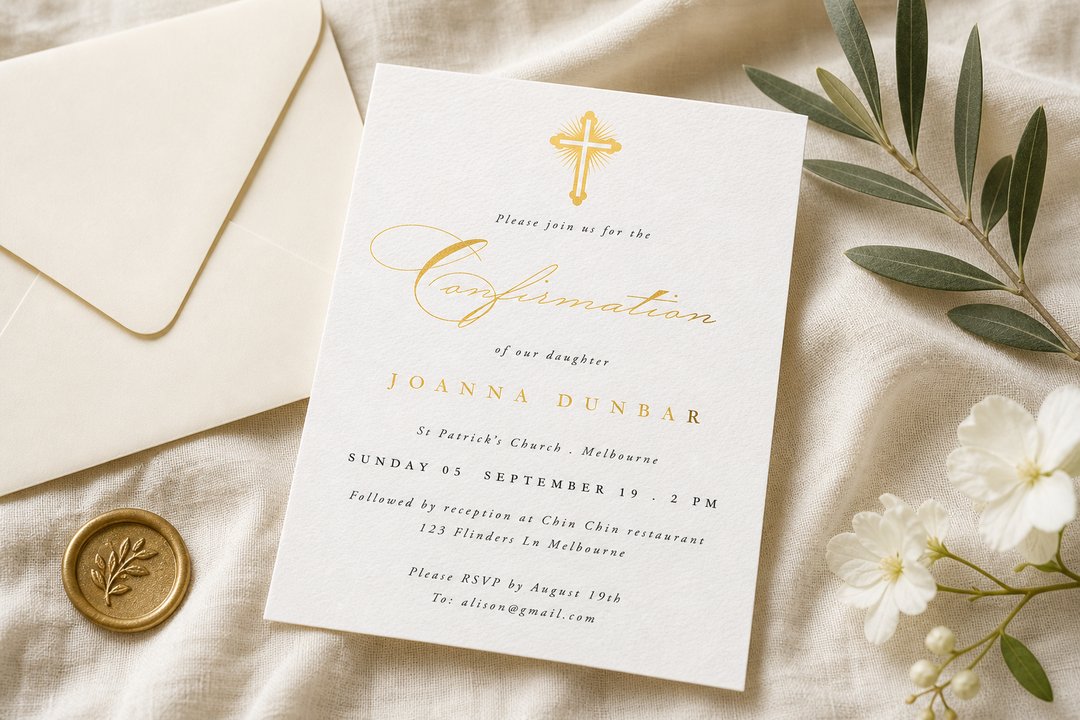
Confirmation is one of the most significant milestones in a young Catholic’s faith life, and the invitation sets the tone for the entire celebration. Whether you want classic and reverent or modern and personal, the right wording and design can honor the sacrament beautifully. This guide walks you through everything you need, from the key details to include on a Catholic confirmation invitation to wording samples for every style and tone.
- Send confirmation invitations 4-6 weeks before the ceremony, with an RSVP date 2-3 weeks out.
- Always include the confirmand’s name, confirmation saint name, church, date, time, and reception details.
- Catholic-specific extras: the sponsor’s name and a scripture verse opening both add meaning without crowding the card.
- Formal wording is standard, but warm and modern tones work beautifully for smaller family gatherings.
- Gold flat foil and letterpress are the most popular print choices for Catholic confirmation invitations.
- Browse confirmation invitations from Paperlust with a designer proof in 1-2 business days.
What Is Catholic Confirmation?
Confirmation is the third sacrament of initiation in the Catholic Church, completing what was begun at Baptism and strengthened at First Communion. In the US, it is typically celebrated between ages 14 and 16, though the timing varies by diocese. During the ceremony, a bishop anoints the confirmand’s forehead with sacred chrism oil and says, “Be sealed with the gift of the Holy Spirit.” The confirmand chooses a confirmation name, usually that of a saint who will serve as a patron, and a sponsor stands with them as a witness to their faith. The ceremony draws on Pentecost, when the Holy Spirit descended on the apostles, and scripture passages such as Ephesians 1:13, Acts 8:14-17, and 2 Timothy 1:7 are central to its meaning.
What to Include on a Catholic Confirmation Invitation
A clear, complete invitation removes guesswork for your guests. Here are the essential elements, plus the Catholic-specific details that make the invitation feel truly meaningful.
Essential details
- Full name of the confirmand (first, middle if used formally, and last)
- Confirmation saint name (the name chosen in honor of their patron saint)
- Date and time of the confirmation Mass
- Church name and full address (include directions note or entrance guidance for large parishes)
- Reception details (venue, time, address, or a separate enclosure card if the reception is elsewhere)
- RSVP information (phone, email, or response card with a clear date)
Optional but meaningful
- Sponsor’s name – honoring the person who stands with the confirmand during the ceremony
- Bishop’s or priest’s name – particularly relevant when a bishop is visiting from outside the parish
- Dress code note – parishes often ask guests to dress modestly and semi-formally
- Scripture verse – a single verse printed on the front or interior of the card sets a reverent tone
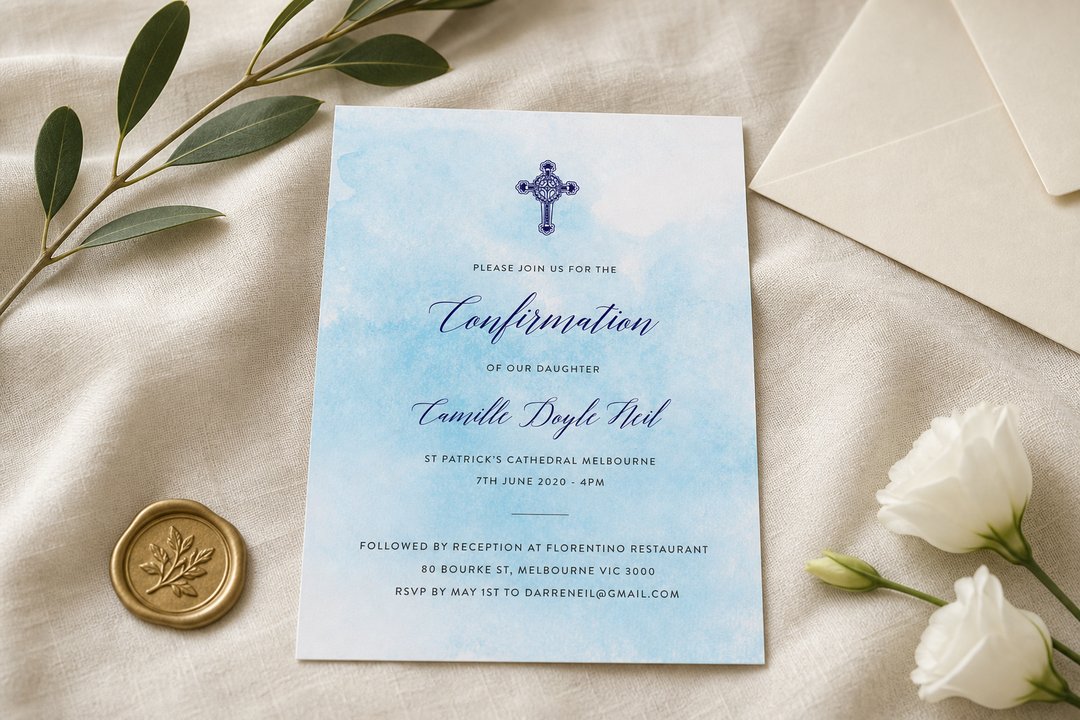

Catholic Confirmation Invitation Wording Examples
The samples below cover the main scenarios you are likely to need. Each can be adapted for your family, parish, and tone. Copy the one closest to your vision, then customize the names, dates, and details.
Formal traditional wording (daughter)
joyfully invite you to celebrate
the Sacrament of Confirmation
of their daughter
Emma Rose Walsh
on Saturday, the twenty-first of September
at two o’clock in the afternoon
Saint Michael’s Catholic Church
4200 North Ashland Avenue, Chicago, Illinois
Reception to follow at the Walsh Residence
Kindly reply by September 7th
Formal traditional wording (son)
gratefully invite you to witness
the Sacrament of Confirmation
of their son
James Patrick Fitzgerald
Sunday, the fifth of October at eleven o’clock
Our Lady of Perpetual Help Church
203 East Mission Road, San Antonio, Texas
Luncheon to follow
RSVP by September 21st to maureen@email.com
Including the confirmation saint name
the Sacrament of Confirmation
of their daughter
Sofia Grace Moreno
taking the name *Clare*
in honor of Saint Clare of Assisi
Saturday, March 15 at 2:00 PM
Saint Francis of Assisi Parish
7111 West Belmont Avenue, Elmwood Park, Illinois
Dinner reception to follow at 5:00 PM
The Grand Ballroom at Belmont Hills
Kindly RSVP by March 1st
Honoring the sponsor
together with sponsor
Patricia Sullivan
joyfully invite you to witness
the Confirmation of
Lucas Michael Collins
Saturday, October 18 at 3:00 PM
Saint Dominic Catholic Church
2345 Oak Park Boulevard, New Orleans, Louisiana
Please join us for a reception to follow
RSVP by October 4th: (504) 555-0198
Opening with a scripture verse
but a spirit of power, of love, and of self-discipline.”
2 Timothy 1:7
With grateful hearts, Kevin and Sarah Donovan
invite you to celebrate
the Sacrament of Confirmation
of their daughter
Bridget Marie Donovan
Sunday, April 27 at 10:00 AM
Saint Patrick’s Cathedral, New York
Reception to follow at Noon
The Fitzpatrick Grand Ballroom
141 East 44th Street, New York City
RSVP by April 13: (212) 555-0148
Modern, warm tone
Please join us as our daughter
Mia Theresa Garcia
receives the Sacrament of Confirmation
Saturday, September 6 at 1:00 PM
Holy Family Catholic Church
610 South Garfield Avenue, Monterey Park, California
Backyard celebration to follow at 3:00 PM
Let us know by August 23rd if you can make it: mgarcia@email.com
Reception-only or separate reception card wording
in celebration of
Marcus Antonio Rivera’s Confirmation
Saturday, May 10 at 6:00 PM
La Paloma Event Center
3800 North Zaragosa Road, El Paso, Texas
RSVP by April 26th
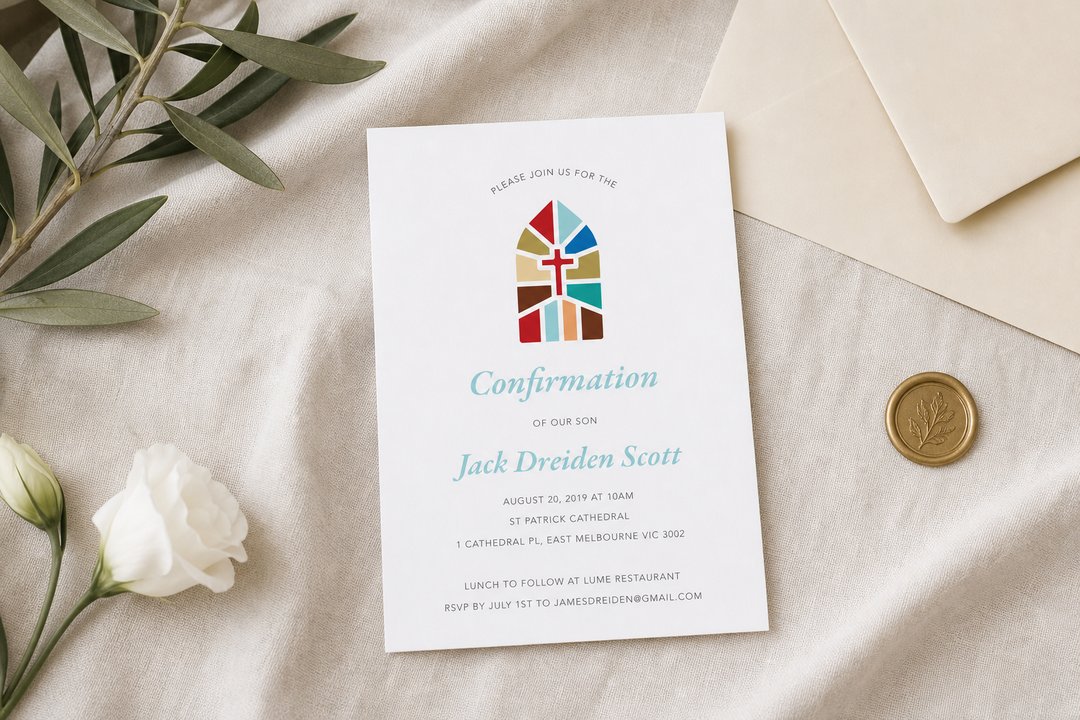
Wording for a Girl vs. a Boy: Does It Change?
The structure stays the same for both. The main differences are pronouns (“their daughter” vs. “their son”) and the confirmand’s full name including their chosen saint name. Some families also adjust tone slightly, leaning into more floral, delicate language for a daughter or more structured phrasing for a son, though neither is required. Choose the tone that feels right for your child and your family’s style.
Confirmation Invitation Colors and Design Ideas
Catholic confirmation invitations tend to favor palettes and symbols that carry spiritual weight. Here are the most popular directions and the print methods that work best for each.
Classic cream and gold
Ivory or warm white card stock with gold lettering or a gold cross motif is the most timeless choice. A flat foil cross or gold foil monogram adds a genuine metallic shine without raised texture. This pairing works equally well for girls and boys, and it photographs beautifully for framing afterward.
Navy, deep burgundy, or forest green
Rich, dark backgrounds with silver or white ink lettering feel formal and contemporary at the same time. White ink on navy colour stock is a striking combination that stands out from the traditional cream palette. This direction suits families who want something distinctive and modern while keeping the tone respectful.
Blush and rose gold
For a daughter’s confirmation, a blush and rose gold palette with foil accents is increasingly popular. A delicate floral frame or olive branch motif keeps the design elegant rather than overly decorative.
Faith symbols to consider
Cross, dove, Holy Spirit flame, olive branch, and the chi-rho (XP monogram for Christ) are all traditional and instantly recognizable. A subtle debossed impression from letterpress printing adds a tactile quality that feels more handcrafted and lasting than a flat printed symbol.
Print method guide
- Digital print, Best for: Full-color designs, photos, larger quantities; Feel: Clean, versatile, most affordable
- Flat foil, Best for: Gold cross, silver border, metallic monogram; Feel: Mirror-bright shine, no deboss
- Letterpress, Best for: Classic religious symbols, heritage feel; Feel: Pressed impression into 300gsm or 600gsm cotton
- Metallic print, Best for: Subtle gold or silver sheen across text or motifs; Feel: Gentle shimmer, more subtle than foil
Explore the full range of designs and print options in our confirmation invitations collection.
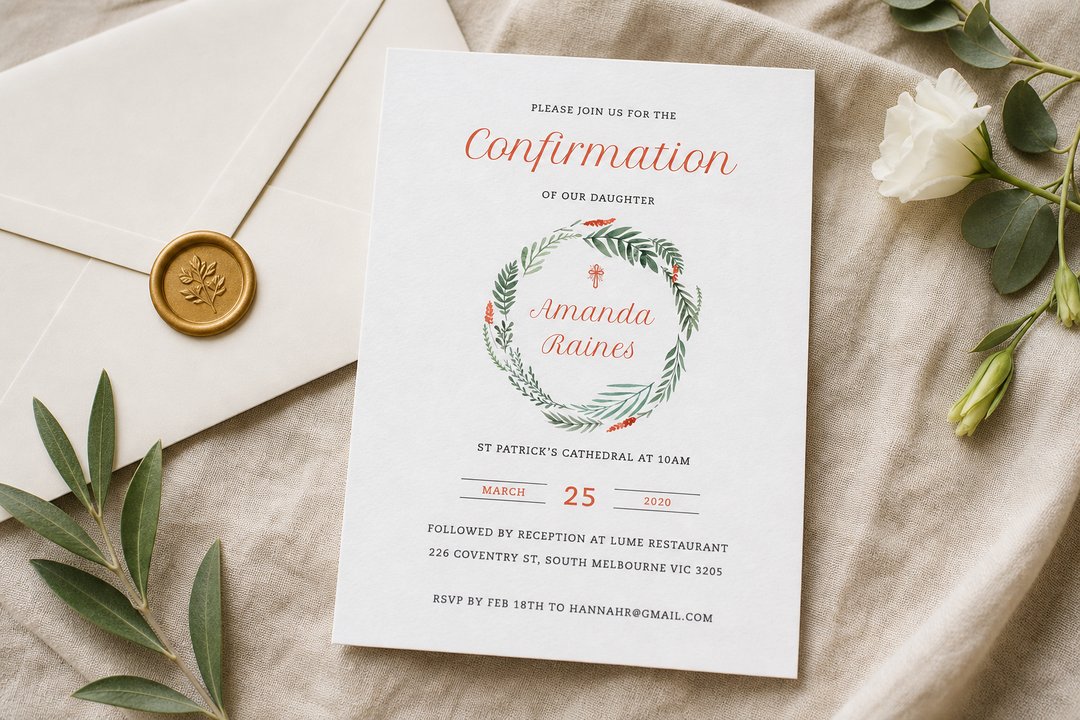
When to Send Confirmation Invitations
A general rule for confirmation invitations is 4-6 weeks before the ceremony date. This gives guests enough time to arrange travel if needed, request time off work, and RSVP with confidence.
Set your RSVP date 2-3 weeks before the ceremony so you have time to finalize catering and seating for the reception.
A few additional timing tips:
- If your guests are coming from out of town or out of state, add an extra 2-3 weeks and mail 6-8 weeks out.
- If a parish Mass is open to the general congregation, you may only need to invite close family and friends to the reception. In that case, a separate reception card enclosed with the main invitation works well.
- Invitations to parents and close family members are traditionally sent by mail. For acquaintances and wider family, digital invitations are increasingly accepted.
3 Things That Make Catholic Confirmation Invitations Different
1. The confirmation (saint) name
The confirmation name is one element that sets Catholic invitations apart from other religious milestones. When a young Catholic chooses a confirmation name, they are claiming a patron saint whose example they want to follow. Including this name on the invitation, with a short line such as “taking the name Clare, in honor of Saint Clare of Assisi,” adds a deeply personal and faith-filled touch that guests will remember.
2. The sponsor
A confirmation sponsor is not the same as a baptismal godparent, though the roles are spiritually connected. The sponsor is typically someone who practices the faith actively, is at least 16 years old, and is not a parent of the confirmand. Including their name on the invitation honors their role and lets guests understand the full community of support around the confirmand.
3. Scripture as an invitation opener
A short scripture verse printed at the top of the card serves as both an invitation and a statement of faith. The most commonly used verses for confirmation invitations include:
- 2 Timothy 1:7 – “For God did not give us a spirit of timidity, but a spirit of power, of love, and of self-discipline.”
- Ephesians 1:13 – “In him you also…were sealed with the promised Holy Spirit.”
- John 14:16 – “And I will ask the Father, and he will give you another Advocate to help you and be with you forever.”
- Philippians 4:13 – “I can do all things through him who strengthens me.”
Choose one verse that resonates with the confirmand personally or reflects your parish’s focus for this class.
If you want to pair the confirmation invitations with matching thank-you cards or a christening-style suite, browse our christening invitations for coordinating sacramental stationery.
Frequently Asked Questions
When should I send Catholic confirmation invitations?
Send confirmation invitations 4-6 weeks before the ceremony. If several guests are traveling from out of state, mail 6-8 weeks ahead and set your RSVP date 2-3 weeks before the event.
What is a confirmation name and should I include it on the invitation?
A confirmation name is the name of a Catholic saint the confirmand has chosen as their patron. Including it on the invitation, with a line such as “taking the name Thomas, in honor of Saint Thomas the Apostle,” is a meaningful touch. It is optional but widely appreciated by guests.
Should the sponsor be listed on the confirmation invitation?
It is not required, but listing the sponsor honors their role in the confirmand’s faith journey. A common format is “[Parent Names], together with sponsor [Sponsor Name], joyfully invite you to witness…” Keep the sponsor line brief so the confirmand’s name remains the clear focus.
What is the difference between a boy’s and a girl’s confirmation invitation wording?
The core wording structure is identical. The primary differences are pronouns (“their son” vs. “their daughter”) and the full name including the confirmation saint name. Design choices, such as color palette and motif, often differ by family preference, but the wording itself does not need to change significantly.
Can I use the same wording for a Catholic confirmation and a Protestant confirmation?
The structure is similar, but Catholic wording typically names the sacrament explicitly (“the Sacrament of Confirmation”) and may include the saint name and sponsor. Protestant and non-denominational wording tends to focus on faith commitment rather than sacramental language, using phrases like “affirming faith” or “confirming their commitment to Christ.”
What print method is best for Catholic confirmation invitations?
Flat foil is the most popular choice for a gold cross or metallic border, giving the card a genuine mirror-bright shine. Letterpress is ideal if you want a pressed, tactile impression on thick cotton paper, which feels especially heirloom-quality. Digital print works well for photo-inclusive designs or any full-color artwork. All three options are available on our confirmation invitations page. If paper and finish matter for the occasion, a $5 sample pack includes seven designs across different print methods so you can compare them before ordering.