
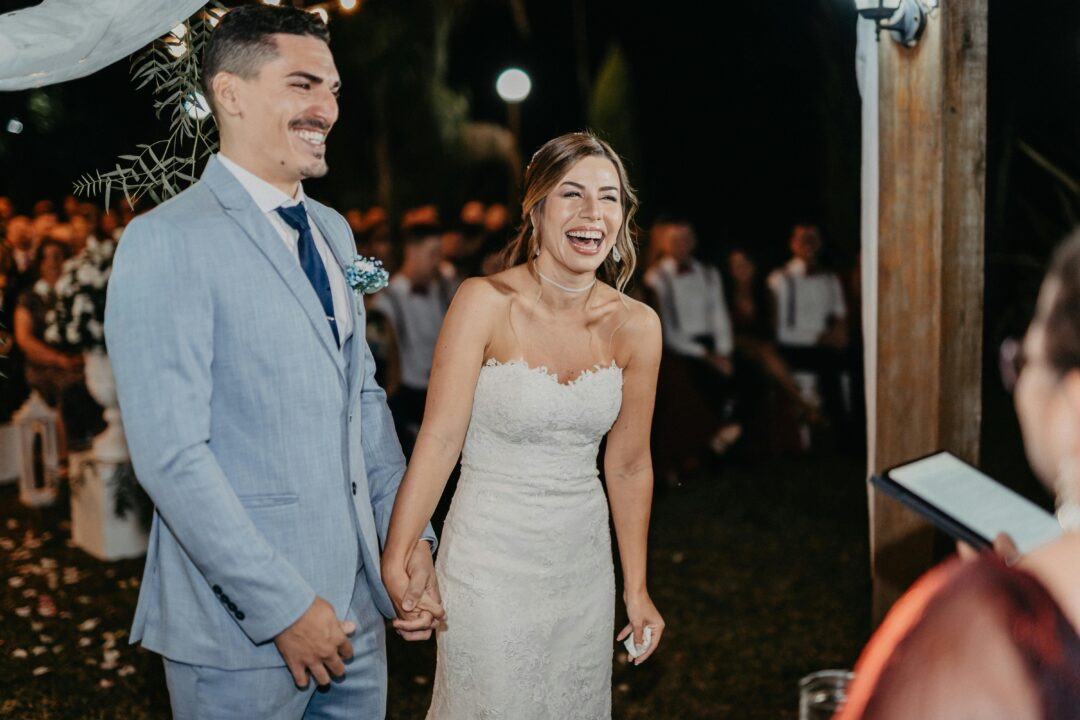

- Funny vows work best when they’re warm and specific – aimed at celebrating your partner, not roasting them in front of a crowd.
- The “sandwich” technique (sincere opener, funny middle, sincere close) is the most reliable structure for keeping humor and heart in balance.
- Avoid inside jokes only a handful of people will understand – the best humorous vows get the whole room laughing together.
- Rehearse your timing out loud – a joke that reads perfectly on paper can fall flat if delivery is rushed or nerves throw off the rhythm.
- Your last line should always be sincere – humor sets the tone, but a genuine promise is what guests remember.
- Use this guide’s 25 examples and 3 full templates as starting points, then make them your own with specific, true details.
Funny wedding vows are one of those things that sound simple – just add jokes – but are surprisingly easy to get wrong. The couples who pull them off aren’t the ones who tried to be funny. They’re the ones who were honest about who they are together and let the humor come from that truth. Whether you’re a genuinely comedic pair or just want a few light moments in an otherwise heartfelt ceremony, this guide gives you everything you need: the rules, the examples, and the templates to get it exactly right.
When Funny Vows Work (and When They Don’t)
Humor in wedding vows isn’t right for every couple or every ceremony – and knowing which side of that line you’re on will save you from an uncomfortable silence at the worst possible moment.
Ceremony type matters
Funny vows are well-suited to outdoor ceremonies, backyard weddings, civil ceremonies, and non-religious celebrations where the tone is already relaxed and personal. They’re generally a poor fit for religious ceremonies, where the context carries a more solemn weight and your officiant may have strong feelings about the content. If you’re marrying in a church, synagogue, mosque, or any faith setting, check with your officiant before you plan anything that gets a laugh – some will embrace it, others genuinely won’t.
Know your crowd
Think about who will be in the room. Humor that lands perfectly for a group of close friends in their thirties can read as awkward when grandparents and young children are in the front row. The best funny vows are inclusive – the whole room is in on the joke, not just a small section of people who know you well. Avoid references that require background knowledge no one has except your closest friends. If the laugh depends on context, cut it or add the context.
Know yourself as a couple
If neither of you is naturally funny in conversation, trying to be funny in your wedding vows is a high-risk move. Humor delivered stiffly reads as uncomfortable, not charming. If wit and banter are genuinely part of your dynamic, that will come through. If they’re not, lean into warmth and specificity instead – those are just as engaging and far more forgiving if nerves kick in.
Check in with your officiant
Some officiants set the tone of the whole ceremony, and humorous vows that clash with their style can create tonal whiplash. Share your draft with your officiant well before the wedding day. A good officiant will flag anything that won’t land in context and can help you set up the moment so guests know it’s okay to laugh.
The Ground Rules for Funny Wedding Vows
These rules aren’t about making your vows less funny – they’re about making sure the humor actually works on the day.
Don’t roast your partner
There is a hard line between affectionate teasing and a roast. Roast-style humor – jokes that highlight your partner’s flaws, embarrassing stories, or anything that makes them want to disappear – does not belong in wedding vows. The room will laugh and then watch your partner’s face, and if they look even slightly uncomfortable, the moment curdles. Every funny vow should make your partner feel celebrated, not exposed.
Punch up, not down
The best targets for humor in wedding vows are shared experiences, universal frustrations, and things that are funny because they’re true about you as a couple. “I promise to always let you pick the restaurant, even when that takes forty-five minutes and we end up at the same place we always go” is funny because it’s specific and relatable. Jokes at the expense of family members, mutual friends, or anyone else in the room are off-limits – this day is not the venue for settling scores or getting laughs at someone else’s expense.
Balance humor with sincerity
Funny vows that are only funny leave guests with a strange feeling – like they laughed but didn’t feel anything. The vows that genuinely move people are the ones that use humor to get the room on your side, then land an emotional punch they weren’t fully expecting. Plan to end on something real. The last sentence of your vows should make your partner feel, not just laugh.
Keep length in check
Funny vows should not be long. Two to three minutes maximum. Comedy depends on pacing and momentum – the longer the setup, the harder the landing. Write your draft, then cut anything that doesn’t earn its place. If a line is a maybe, it’s a cut.
Rehearse timing out loud
Jokes that read perfectly on paper can fall apart in delivery. Read your vows aloud – more than once, and at least once to another person – before the wedding day. Pay attention to where you naturally want to pause. Mark those pauses in your notes. On the day, adrenaline will make you speak faster than you mean to, and a rushed punchline is a dead punchline.
Have a card
Even if you have your vows memorized, have them written on a card. Nerves do unpredictable things to memory, and the moment you go blank in front of two hundred people is not the moment you want to improvise comedy. A card is not a failure – it’s a professional move.
25 Funny Wedding Vow Examples
These examples are organized by personality type – find the category that sounds most like you as a couple, then adapt the language to fit your specific details. The more specific you make them, the funnier and more moving they become. Generic humor is forgettable; specific, true humor is memorable.
Pop Culture & Entertainment Fans
Foodies
Sports Fans
Homebodies
Tech & Gaming Fans
Pet Parents
Travelers
Night Owls & Morning People (Opposites)
Worriers & Over-Thinkers
Bookworms
Early Retirees from Arguments
The Perpetually Lost
The Ones Who Over-Plan
Social Introverts

Balancing Humor with Sincerity
The mechanics of how funny vows actually work come down to a structural choice you make before you write a single word. The couples who get this right don’t just scatter jokes through their vows and hope for the best. They build the vows around a deliberate emotional arc.
The sandwich technique
The most reliable structure for funny wedding vows is what comedy writers call the sandwich: a sincere opener, a funny middle, and a sincere close. This works for two reasons. First, it signals to the room immediately that the vows have emotional weight – guests settle in and feel safe laughing because they already know something real is coming. Second, it means the vows can only end one way: with your partner feeling loved, not just laughed at. The humor earns its place inside a frame that holds.
Here’s how it looks in practice. Your opener is one or two sentences that are completely genuine – something true about your partner, how you feel, or what this day means. Your middle is where the humor lives: two to four specific, warm observations about your life together. Your close is one sentence, and it should be the most real thing you say all day. Not a callback to a joke. Not a punchline. Just the truth.
Why the last line should always be sincere
Guests leave a wedding remembering two things: how the couple looked at each other, and the last thing they said. If the last line of your vows is a joke – even a very good one – you’re ending on a performance. If it’s a genuine promise, you’re ending on a commitment. Those are different things, and an audience always knows which one they heard.
Write your last line first. Figure out what the single most honest thing is that you want your partner to hear, and make that your anchor. Build everything else around it.
Specific is funny; generic is not
The examples in this guide are starting points, not finished vows. What makes a funny vow land in a ceremony is specificity – the actual detail that only you and your partner know is true. “I promise to let you have the last slice of pizza” is fine. “I promise to let you have the last slice of the pepperoni-and-mushroom from the place on Third Street that we order from every Friday and that I have been thinking about since Tuesday” is genuinely funny, because it’s real and specific and the whole room knows you’re telling the truth. Replace every generic reference in your draft with the actual specific thing. That’s where the humor lives.
Funny Vow Templates
These three templates are complete structures you can adapt – not just snippets but full vow drafts with clear arcs from opener to close. Replace the bracketed sections with your real, specific details. The more honest and particular you make the swaps, the better the vows will work.
Template 1 – The Everyday Life Vow (warm and light)
[Partner’s name], standing here with you today, in front of everyone who knows us well enough to know exactly how we got here, I can honestly say this is the least surprising and most important thing I’ve ever done.
I promise to always be the one who turns the lights off before bed, because we both know what happens if I leave it to you. I promise to never open a bag of chips quietly in another room and pretend I didn’t – we live together, you know the sound. I promise to always tell you when you have something in your teeth, even in public, because that is a kindness and you deserve it.
More than any of that, I promise to show up for you – every ordinary Tuesday and every impossible day – with everything I have. I love you completely, and I am so glad it’s you.
Template 2 – The Big Feelings Vow (sincere with comedic relief)
I’ve thought a lot about what I wanted to say today. I wrote several versions of this. Some of them were very serious and beautifully constructed and sounded exactly like vows are supposed to sound. Then I threw them all out, because that’s not how we talk to each other, and today felt like the day to just tell the truth.
I promise to always take your side, right up until the moment you’re clearly wrong, at which point I promise to tell you privately and then take your side anyway. I promise to never make you feel like a burden on the days when everything is heavy – I want to carry things with you, not watch you carry them alone. I promise to respect your [hobby/ritual/quirk] even when I find it completely baffling, because it is yours and you love it and that is enough reason for me.
I love you in a way that I didn’t know was available to me before I met you. You are my favorite person. That is the simplest and most true thing I know, and I’m going to keep knowing it for the rest of my life.
Template 3 – The List Vow (comedic structure with sincere anchor)
[Partner’s name], I have some promises to make you today. I’ve organized them. You know how I feel about organization.
I promise to always text you when I’m on my way home. I promise to never reorganize something you’ve already organized in a way that makes complete sense to you – I have learned my lesson. I promise to be supportive of every project you start and to ask only once, gently, whether you’re still working on it. I promise to always know where the [specific object your partner is always looking for] is, because one of us needs to, and it turns out that’s me.
And I promise you this, above everything else: I will choose you every single day. Not because it’s always easy, but because you are the best thing in my life and I am not going to forget that. I love you, [partner’s name]. Today and always.
For more inspiration and to find a style that fits your whole ceremony, explore our complete wedding vows guide – it covers every vow style and walks you through the full process from draft to delivery.
When your vows are written, think about how your stationery fits the day you’re planning. Browse wedding invitations at Paperlust or take a look at our guide to wedding invitation wording to make sure your tone carries through from invite to ceremony.
Frequently Asked Questions
Are funny wedding vows appropriate for a religious ceremony?
Generally, no – or at least not without explicit approval from your officiant first. Religious ceremonies carry a particular weight and structure, and humorous vows can feel tonally out of place in a faith setting. That said, some officiants are more flexible than others, and there may be room for a light moment within an otherwise traditional framework. Always check with your officiant well in advance, share your draft, and let them guide you on what’s appropriate for your specific ceremony and setting.
How long should funny wedding vows be?
Aim for two to three minutes when spoken aloud at a measured pace. That typically works out to around 250-350 words. Funny vows tend to run shorter than purely sincere ones because comedy depends on pacing and momentum – too much setup and the energy dissipates. Write your draft, cut anything that doesn’t earn its place, then read it aloud and time it. If you’re consistently hitting over three minutes, keep cutting.
Should both partners write funny vows, or just one?
It works best when both partners are on the same page tonally – either both go humorous, or both go sincere. If one partner delivers funny vows and the other delivers deeply emotional ones, the contrast can feel jarring and leave guests unsure how to react. Decide on a shared tone together early in the process. You don’t need to read each other’s vows beforehand, but you should agree on the general energy – light and warm versus heartfelt and serious – before you each start writing.
Can I use an inside joke in my vows?
You can – with one important condition. The joke needs to be either self-explanatory from context or genuinely universal enough that the whole room is laughing with you, not politely smiling while only four people at the front understand what happened. Inside jokes that require background knowledge exclude guests and create a moment of distance rather than connection. If you can’t make the reference land without explanation, either add enough context to make it accessible or save it for a private moment.
What topics should I avoid in funny wedding vows?
Avoid anything that makes your partner look bad, anything that embarrasses family members, anything that references past relationships, and anything that requires your partner to have consented to being the subject of a public joke. Also steer clear of humor that only works if you nail the delivery perfectly – on a day when nerves are running high and timing is unpredictable, that’s a risky bet. The safest and funniest territory is your shared life: specific habits, routines, preferences, and quirks that are true, warm, and unmistakably yours.
Do I need to memorize my funny vows or can I read them?
Reading from a card is completely fine and widely practiced – it is not a sign that your vows are less genuine. In fact, having your vows written on a card is good practice even if you’ve memorized them, because nerves are unpredictable and a memory lapse mid-vow is far more disruptive than glancing at a card. If you want to maximize eye contact and connection, know your vows well enough to look up frequently, and use the card as a safety net rather than a script.
What’s the difference between funny vows and vow roasts?
Funny vows celebrate your partner through warm, affectionate humor – the jokes come from a place of love and make your partner feel seen and cherished. Vow roasts use humor to mock, embarrass, or highlight flaws – even when delivered with good intentions, the effect can be humiliating for your partner in front of everyone they care about. The test is simple: when you read your draft, does each joke make your partner feel good about themselves? If any line makes you hesitate, cut it.
How do I know if my vows are actually funny?
Read them aloud to at least one other person before the wedding day – ideally someone who will tell you honestly if a joke doesn’t land. Laughter is involuntary; if your test audience is politely smiling rather than genuinely laughing, the material needs work. Pay attention to their reaction at each individual joke, not just the overall vibe. A single strong laugh beats three weak ones. If something consistently gets a mild response, either sharpen it with more specific detail or replace it.
Should I show my partner my funny vows beforehand?
This is a personal call, but there’s a strong argument for at least one pre-check on the funny parts. If any of your humor involves your partner specifically – their habits, their quirks, something they do that you’re gently teasing – confirm that they’re comfortable being the subject of that joke in front of your guests. You can do this without revealing the full vows: “I’m planning to mention [thing] in a light way – are you okay with that?” That single check can prevent a moment that lands wrong for the one person whose reaction matters most.
What if I get emotional mid-vow and lose the comedic timing?
Pause, breathe, look at your card, and keep going. Getting emotional during your vows is not a failure – guests find it genuinely moving, even in the middle of humorous content. The key is not to fight it or apologize for it. If you know you’re prone to emotion, structure your vows so the sincerest lines come at the end, after the humor has already done its work. That way, if you get emotional, it’s at the natural landing place rather than in the middle of a setup.
Can I use these funny vow examples exactly as written?
You can use them as a starting point, but the most effective vows are ones that have been personalized with your real, specific details. A vow example that mentions pizza is fine; a vow that mentions the exact pizza place you order from every Friday is funny and true and unmistakably yours. Replace every generic reference with the actual specific thing from your life together. Even small changes make a significant difference to how the vows land in the room.
What should be the very last line of funny wedding vows?
The last line should always be sincere – a genuine, direct declaration of love or commitment without any comedic framing. This is the line your partner will hear ringing in their ears for the rest of the day. Write it first, make it honest, and protect it. No callbacks, no punchlines, no qualifications. Just the truest thing you know about how you feel and what you’re promising. Everything else in your vows can be light and playful; the last line earns that lightness by landing somewhere real.
How far in advance should I write my funny vows?
Start at least six weeks before your wedding. Funny vows take longer to write than purely sincere ones because humor requires refinement – the first draft is almost never the funniest version. Write an early draft, leave it for a few days, then come back and read it aloud. What felt sharp in the writing often sounds different spoken. Give yourself time for at least two or three revision cycles, a test reading to another person, and enough distance to hear the material fresh before the wedding day.
Match the personality
Wedding invitations with character
If your vows are full of humor, your invitations can be too. Browse playful illustrations, hand-lettered scripts, and bold color combos.
About Paperlust
Paperlust has been designing and printing wedding stationery from Melbourne since 2014. With 500+ exclusive designs from independent artists and a team of dedicated designers, every order includes a professional proof within 1-2 business days, two free rounds of edits, and a 100% happiness guarantee – free reprint or full refund if anything isn’t right.
Paperlust was named a Westpac Business of Tomorrow in 2017 and has been featured in leading wedding and lifestyle publications. We ship internationally via DHL Express on orders over $350 USD, with US delivery typically arriving within 2 to 4 business days after production.
Have questions about your vow card design or invitation suite? Our team is available on live chat – and every order includes a designer who works with you to get every detail exactly right.
Ready to design your wedding stationery?
Browse 500+ exclusive invitation designs – from classic letterpress to modern digital print. Every order includes a professional designer, a proof within 1-2 business days, and a happiness guarantee.
Image credits