
Wedding place cards are one of those small details that guests notice immediately when they arrive at a reception, and when they are done well, they set the tone for the entire dining experience. Place cards are a key part of your on-the-day stationery checklist. This guide covers everything: the difference between place cards and escort cards, 40+ wording examples for every tone and formality level, creative display ideas, and exactly when to order so you are not scrambling in the final week.
Place Card Quick Reference
- Escort card = near the entrance, guides guest to their table number
- Place card = on the table, indicates a specific seat
- For <50 guests: place cards alone (or neither) usually works fine
- For 50+ guests: escort cards at the entrance + place cards at the table is the gold standard
- Wording format: First Name Last Name (no “Mr/Mrs” unless formal black-tie)
- With meal icons: add a small symbol (fish, chicken, vegetarian) or color dot to indicate pre-selected meal (see our menu card wording guide)
- Order timeline: 3-4 weeks before the wedding, after your RSVP deadline passes



Place Cards vs Escort Cards: What Is the Difference?
These two terms are often used interchangeably, but they serve distinct purposes in a formal seating arrangement. Understanding the difference helps you decide which setup is right for your reception.
| Feature | Escort Card | Place Card |
|---|---|---|
| Where it sits | Near the reception entrance | At each individual place setting on the table |
| What it shows | Guest name + table number | Guest name (specific seat) |
| Best for | Guiding guests to their table at arrival | Assigning exact seats within a table |
| Used alone? | Yes, for flexible seating within tables | With a seating chart or escort cards first |
| Typical size | Small folded card or flat tag | Tented card or flat card at place setting |
Escort card: Guests find their name displayed near the entrance (often alphabetically), pick up the card, and it tells them which table to go to. From there, they may choose their own seat at that table, or find a place card waiting for them.
Place card: Placed directly at each table setting, indicating the exact seat for a named guest. Always requires guests to first know which table they are at (via a seating chart, escort card, or both).
Seating chart: A large display (printed poster, framed board, or mirror) near the reception entrance listing every guest name alongside their table assignment. Can replace escort cards entirely for casual or semi-formal weddings. If you use a seating chart, you may still want place cards at the table to assign exact seats, especially for plated dinners where meal choices were pre-selected.
When to Use Each (and When to Use Both)
Your guest count and the formality of your reception should guide this decision.
Shop wedding place cards
Custom-printed place cards in letterpress, foil, and flat-print , to match your suite.
Under 50 guests
You probably do not need escort cards or a formal seating chart. A simple layout of which tables are near which can be communicated verbally, or guests can seat themselves once they know their general table. Place cards at the table remain useful for meal pre-selection or for ensuring VIP guests (grandparents, elderly guests) are seated appropriately.
50-100 guests
A seating chart near the entrance paired with place cards at each setting is the most elegant solution. Escort cards work equally well if you prefer the traditional approach, they are easier to update last-minute if RSVPs change, since you can simply swap or add individual cards.
100+ guests
Both escort cards and place cards are strongly recommended. At larger receptions, directing guests to both the right table and the right seat minimizes the chaos of arrival, especially when venues have tight timelines between cocktail hour and the seated reception. Escort cards at the entrance + place cards at the table gives catering staff the precision they need for served meals.
Buffet receptions
For buffet-style receptions where guests serve themselves, place cards are less critical, guests usually sit anywhere at their assigned table. Escort cards or a seating chart to assign tables still helps manage the flow of arrival and ensures your designated seating for wedding party and family is respected.
Wedding Place Card Wording Examples
The best place card wording is clear, consistent across all cards, and matches the tone of your wedding. Below are examples organized by formality level, all designed to be adapted for your specific names and situation.
Formal Wording (Black Tie and Formal Weddings)
For formal events, traditional honorifics and full names are appropriate. Be consistent: if you use “Mr.” for some guests, use the appropriate title for all.
- Mr. James Wilson
- Mrs. Eleanor Wilson
- Mr. and Mrs. James Wilson
- Dr. Sarah Chen
- The Honorable Richard Ashford
- Ms. Amelia Torres
- Mr. David Kim and Ms. Priya Sharma
- Professor Helen Blackwood
Note on “Mr. and Mrs.”: Using a husband’s full name after “Mr. and Mrs.” (e.g., “Mr. and Mrs. James Wilson”) is the most traditional form. Many couples today prefer listing both names separately or using “James and Eleanor Wilson” for a warmer feel.
Modern and Casual Wording
For garden weddings, winery events, and relaxed celebrations, first name only or first and last name without honorifics is entirely appropriate and increasingly common.
- James Wilson
- Eleanor and James
- Sarah + David
- The Martins
- Priya Sharma
- Tom, Mia, Ollie + Leo (for a family of four)
- Team Nguyen
First name only works beautifully for intimate weddings where everyone knows each other, but for larger guest lists, always include the last name to avoid confusion with multiple guests sharing first names.
Wording with Meal Choice Indicators
For plated dinners where guests pre-selected their meal on the RSVP card, indicating the meal choice on the place card helps catering staff deliver the correct plate without asking. Common approaches:
Small symbol or icon (printed in the card design):
- Fish symbol for seafood
- Leaf or “V” for vegetarian
- Chicken silhouette for poultry
- Color-coded dot (gold = beef, green = vegetarian, blue = fish)
Text indicator (typed or handwritten after the name):
- James Wilson / Chicken
- Eleanor Wilson / Salmon
- Sarah Chen / Vegetarian
- David Park / Beef
- Amir Hassan / Vegan
- Lily Morgan / GF (gluten-free)
Keep meal indicators small and subtle, a discrete symbol or a brief word is sufficient. You do not need to list the full menu description on the place card.
Titles and Honorifics: Getting Them Right
Title etiquette can feel complicated, especially with a guest list spanning different generations and professions. Here are the most common situations:
| Guest Type | Formal | Modern/Casual |
|---|---|---|
| Married couple (same last name) | Mr. and Mrs. James Wilson | James and Eleanor Wilson |
| Married couple (different last names) | Mr. James Wilson and Ms. Eleanor Park | James Wilson and Eleanor Park |
| Same-sex couple | Mr. David Chen and Mr. Alex Nguyen | David and Alex |
| Single female guest | Ms. Sarah Torres (use Ms. unless you know she prefers Mrs. or Miss) | Sarah Torres |
| Doctor | Dr. Helen Blackwood | Helen Blackwood |
| Judge or elected official | The Honorable [Name] or Judge [Name] | [First Name Last Name] |
| Child under 10 | Master Oliver Wilson (for boys), Miss Lily Wilson | Oliver or Lily |
When in doubt, go simpler. A guest is far more likely to be pleased by clear, warm first-name-and-last-name wording than offended by an omitted title. The one title to always use correctly: “Dr.”, doctors notice when it is omitted at formal events.
Families and Children at the Table
Handling families cleanly on place cards avoids confusion at busy tables.
- Parents + young children at the same table: One card per adult seat. For children under 10 with their own seat: “Oliver Wilson (child)” or simply “Oliver” if the table is otherwise adults.
- Family with multiple kids: “The Wilson Family” for a table card, or individual name cards per seat depending on your setup.
- Children sharing a seat or a high chair: No place card needed for a non-dining seat.
Creative Display Ideas for Place Cards and Escort Cards
How you display your place cards is as much a design decision as the cards themselves. Here are ideas that work across different wedding styles.
Classic: Tented cards at each place setting
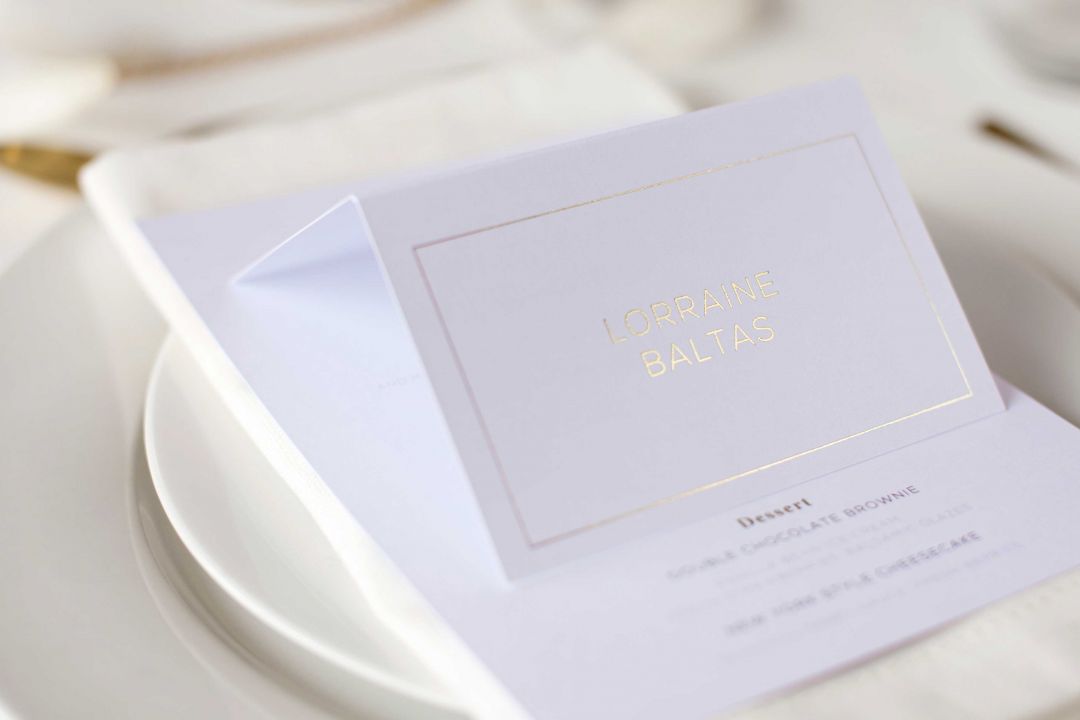
The most traditional approach, a tented (folded) card stands upright at each place setting, leaning against a wine glass or sitting on the charger plate. Clean, readable, and works for any reception format. Tented cards in foil print are especially striking under reception lighting.
Escort card display at the entrance
Alphabetically arranged flat cards on a long table or decorative frame near the reception entrance. Guests find their name, pick up the card, and take it to their table. Variations include attaching cards to a floral wall, hanging them on a greenery backdrop, or placing them in small slots on a wooden board.
Wine bottle or glass tags
Small tags tied to individual wine glasses or placed on top of glasses as the guest’s assigned seat marker. Particularly popular for outdoor and rustic receptions. Works better for smaller guest counts where visibility is not an issue.
Flat cards with a place card holder or stand
A flat card displayed in a metal, stone, or acrylic holder adds dimension to the place setting without a fold. Holders can double as keepsakes or favors for guests to take home.
Alternative escort card formats
- Mini envelopes: Each guest’s card is tucked inside a mini envelope with their name on the front, elegant and allows a small note inside
- Seed packets or favor bags: Name and table number printed on a favor that guests take home, combines escort card and wedding favor in one
- Luggage tags: For destination weddings or travel-themed events
- Polaroid photos: A small photo of the guest (or the couple with that guest) doubles as the escort card, personal and memorable

How Many Place Cards Do You Need?
Order one place card per seated guest at the reception. Do not count per-household here, unlike invitations, every person at the table needs their own card.
Shop wedding menus
Coordinate place cards with menu cards in the same paper, ink, and trim.
Example for 120 guests:
- 120 place cards (one per guest)
- Plus 10-15% buffer for errors or late additions: order 135-140
- If also using escort cards: 120 escort cards separately (or combine into one double-duty card per guest)
Place cards are printed with your specific guests’ names, so there is no flexibility to use extras for different guests. Always order a buffer, a second print run is expensive and stressful in the final week before a wedding.
At Paperlust, you can order place cards from the same design collection as your invitations. Browse the place cards collection to find styles that match your invitation suite.
When to Order Your Wedding Place Cards
Place card timing is tighter than invitation timing because you need your final RSVP count before you can personalize them.
| Step | When |
|---|---|
| Set your RSVP deadline | 4-6 weeks before the wedding |
| Finalize guest names list | Within 3-4 days of your RSVP deadline |
| Submit place card order | 3-4 weeks before the wedding |
| Receive designer proof | 1-2 business days after order |
| Approve and print | Allow 1-2 weeks for production and delivery |
For premium print methods (foil stamping, letterpress), allow an extra 1-2 weeks in your timeline. If you are ordering your place cards within 2-3 weeks of the wedding, contact Paperlust’s team to discuss rush production options.
Also consider ordering your place cards at the same time as your other day-of stationery (menus, programs) so the designer proof review happens in one consolidated round. For a comprehensive view of how all stationery pieces fit together, see the wedding seating chart guide.
Printing Options for Wedding Place Cards
Paperlust offers several print methods for place cards, each creating a different look and feel at the table.
Digital print
The most popular choice for place cards, precise, full-color reproduction of your chosen design. Works with any color palette and accommodates detailed floral or illustration elements. Fastest production time and most accessible price point.
Flat foil
A smooth metallic finish (gold, silver, rose gold, holographic) on selected design elements, typically the name or a decorative border. A foil-finished place card at a well-set table is genuinely striking and photographs beautifully. Flat foil is more affordable than traditional foil stamping and allows fine typography to remain crisp.
White ink
For dark or colored card stock, white ink printing creates a bold, elegant contrast. White ink on navy, forest green, or black card is a popular combination for moody, dramatic wedding aesthetics. The effect is subtle in photos but striking in person.
Foil stamping
The most premium option, a custom die is used to press foil directly into the paper surface, creating a rich, dimensional shine. Best for simple, bold design elements rather than fine text. Requires a minimum order of 50 units and longer production time, so plan accordingly.
How to Choose Your Wedding Place Card Style
Place cards do three jobs at once: they direct guests to seats, set the table’s visual tone, and serve as a small keepsake. The right style depends on your reception layout, your stationery suite, and how much hand-finishing fits your timeline.
1. Match the Card to the Stationery Suite
Place cards should share at least one design element with your invitation suite, colour palette, typeface, or print finish. If your invites are letterpress, foil-stamped place cards reinforce the premium feel; digital print invites pair well with digital-print place cards. Browse wedding place cards by print finish.
2. Decide Between Flat, Tented, and Escort-Card Formats
Flat cards (laid on the napkin or plate) keep tablescapes minimal and photograph cleanly. Tented cards stand on their own and are easier for older guests to spot. Escort cards (hung on a display board near the entrance) work when you have over 80 guests and need to manage flow into the room.
3. Calligraphy or Print: Pick by Volume + Timeline
Hand calligraphy reads luxe but realistically caps at ~80 guests for most calligraphers’ lead times. For 100+ guest counts, choose digital calligraphy fonts printed at 16-18pt, visually similar at table distance, and you can finalise names two weeks out instead of six. Always print 5-10 spare blanks for last-minute seating swaps.
Frequently Asked Questions
What is the difference between place cards and escort cards?
Escort cards are displayed near the reception entrance and guide guests to their assigned table number. Place cards are found at each individual place setting on the table and indicate the guest’s exact seat. Escort cards are typically picked up by guests at arrival; place cards await guests at their seat. Many formal receptions use both: escort cards at the door, place cards at the table.
How do you word wedding place cards?
For formal weddings, use full name with honorifics: “Mr. James Wilson” or “Dr. Sarah Chen.” For modern and casual weddings, first name and last name without titles is perfectly appropriate: “James Wilson” or “Sarah Chen.” For intimate weddings, first name only works well. Always be consistent across all cards, if you use last names for some guests, use them for all.
Do I need both place cards and escort cards?
Not necessarily. For weddings with fewer than 50 guests, place cards alone (or a simple seating chart) are usually sufficient. For 50 or more guests, using escort cards at the entrance plus place cards at the table gives the best guest experience and makes service easier for catering staff. Buffet-style receptions may only need escort cards or a seating chart, since exact seat assignment matters less.
When should I order wedding place cards?
Order place cards 3-4 weeks before your wedding, after your RSVP deadline has passed and you have confirmed your final guest list. Allow 1-2 business days for your designer proof, then 1-2 weeks for production and delivery. For premium print methods like foil stamping, add an extra week or two to your timeline.
How do you indicate meal choices on place cards?
The most common methods are: a small meal icon printed into the card design (fish, chicken, leaf for vegetarian), a color-coded dot, or a brief text label next to the name (e.g., “James Wilson / Chicken”). Keep the indicator small and subtle, its purpose is to help catering staff, not to be the focal point of the card.
How many place cards do I need?
Order one place card per seated guest, unlike invitations, you need one per person, not per household. Add a 10-15% buffer to your order to account for last-minute additions, damaged cards, and keepsakes. Since place cards are personalized with specific names, you cannot repurpose extras for different guests, so a buffer is essential.
Shop Place Cards at Paperlust
Place cards and escort cards to match your invitations, customizable online.