
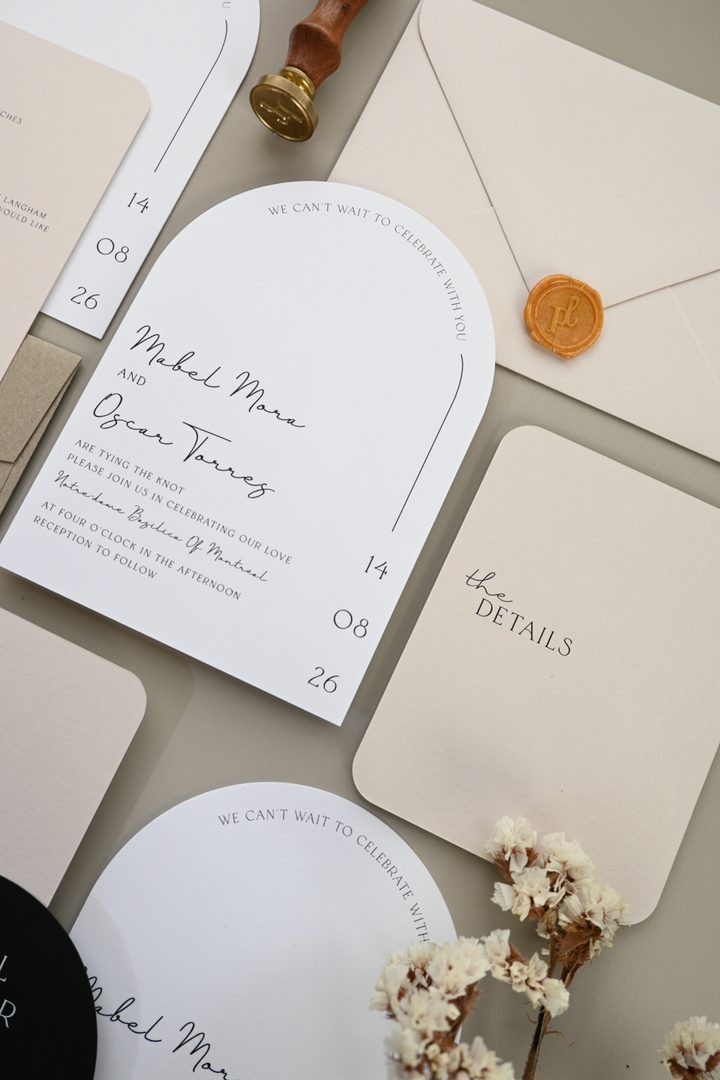
Every couple gets a name. The best weddings make it a mark.
A wedding monogram or crest is a custom symbol built from your initials, shared surname, or illustrated story elements. It unifies every printed piece in your stationery suite, from the invitation envelope to the dinner menu, and it travels far beyond paper. By the end of this guide you will know the difference between a monogram and a crest, how to build one that actually reflects you, exactly where to use it across your wedding, and how Paperlust weaves custom monogram work into its handcrafted stationery.
- A monogram is a letter-based mark; a crest adds a framed shape, illustrated motifs, and optional banner text.
- Traditional three-letter couple monogram order: Bride’s first – Shared last – Groom’s first (last-name initial centered and largest).
- Five core monogram styles for 2026: interlocking script, stacked initials, single-initial crest, split-letter, and modern sans-serif.
- Use your monogram on invitations, menus, signage, napkins, wax seals, and welcome signs for cohesive impact.
- Paperlust prints monograms across digital, flat foil, foil stamp, and letterpress methods.
- Designer proof delivered within 1-2 business days of ordering; two rounds of edits included at no extra cost.
Monogram vs. Crest: What Is the Difference?
The words get used interchangeably at bridal fairs, but they describe two different design objects.
A monogram is a typographic mark made purely from letters. It could be two initials side by side, three letters with the shared last-name initial in the center, or a single oversized letter representing the new family name. The design lives entirely in the letterforms and how they are arranged or layered.
A wedding crest goes further. It wraps those initials inside a structural frame (a shield, oval, arch, or geometric shape) and layers in illustrated elements: florals tied to your bouquet, a motif that nods to your venue or shared hobby, a ribbon banner carrying your wedding date or location, and occasionally a Latin motto or short phrase. The result looks closer to a family coat of arms than a typeset logo.
Which do you need? A monogram works for almost any aesthetic and prints cleanly at every size, from wax seal to welcome sign. A crest rewards couples who want more storytelling on the page and who will use the design across a wide variety of surfaces where the illustrated details can be appreciated. Many couples end up with both: a full crest for the invitation and large signage, and a stripped-back monogram for smaller items like napkins and place cards.
The Five Core Monogram Styles for 2026
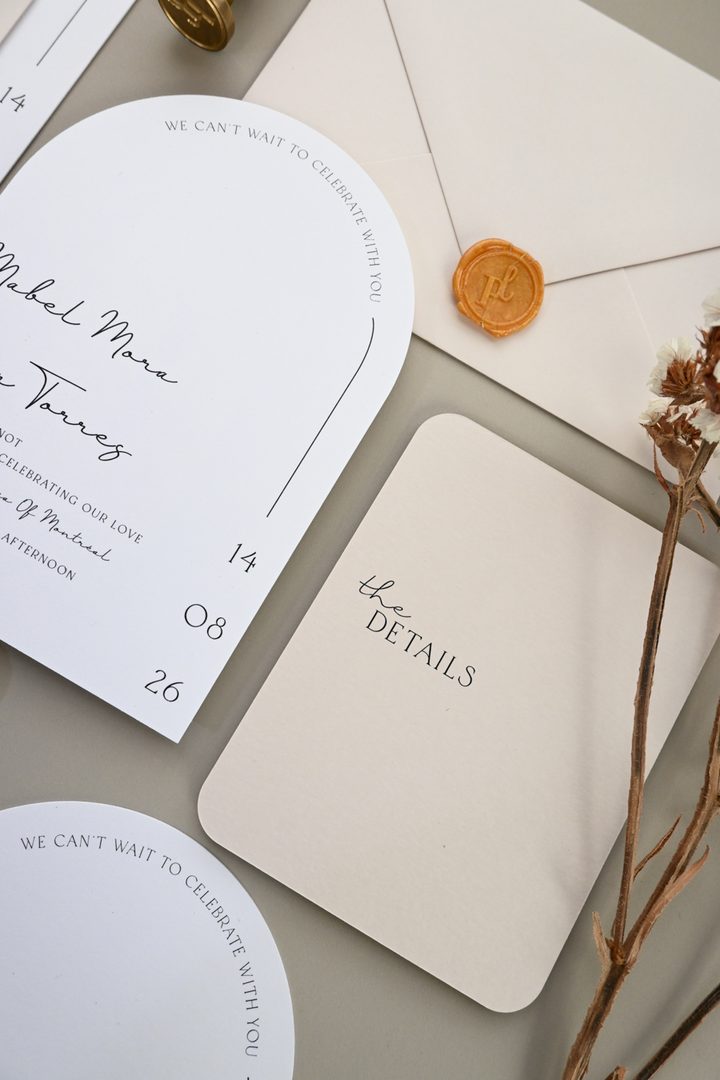

Interlocking Script
The classic. Three letters in flowing calligraphy, often with the first initials of each partner flanking a larger shared last-name initial. The strokes of adjacent letters are drawn to weave into each other, creating an ornate, unified mark. Works beautifully on letterpress and foil stamp, where the press impression picks up the delicate hairlines of script type. Best suited to formal, traditional, and garden-party aesthetics.
Stacked Initials
Two or three letters arranged vertically rather than side by side. This format is distinctly modern and works well in bold serif or geometric sans-serif type. Because the composition is tall, it suits portrait-orientation stationery and ceremony programs. Pair it with clean white space on the invitation for a quiet luxury feel.
Single-Initial Crest
One large letter inside a shaped frame, representing the shared surname. This is the simplest, most versatile option and the easiest to scale across all your stationery items. The crest frame can be a traditional shield, an arched cartouche, or a wreath of your wedding florals. It reads clearly at every size, from an envelope liner watermark to a full-bleed welcome sign.
Split-Letter
A large initial split down the middle with the couple’s surname running horizontally through the break. It has a slightly rustic, editorial quality and works well for couples whose surname is as important to their identity as their initials. The format is particularly strong on signage and napkins where legibility matters more than fine detail.
Modern Sans-Serif (“Wedding Logo”)
Think fashion brand, not coat of arms. Two or three letters in a clean, geometric typeface, sometimes separated by a thin rule or geometric ornament. No script flourishes, no illustrated elements. This is the 2026 “quiet luxury” approach: maximum restraint, high contrast (black on ivory, or gold on navy), strong on digital surfaces as well as print.
Initial Order Etiquette: Which Letter Goes Where?
This is the question couples search most often, and the answer varies depending on the format you choose.
| Format | Traditional Order | Example (Sarah & James Miller) |
|---|---|---|
| Three-letter couple monogram | Bride first – Last (center, larger) – Groom first | S M J |
| Two-letter monogram | Either alphabetical or chosen by the couple | S & J or J & S |
| Single-initial crest | Shared last-name initial only | M |
| Individual (pre-wedding) | First – Last – Middle (last is center) | S M A (Sarah Miller Adams) |
A note on timing: traditionally, couples use their individual initials on save-the-dates and pre-wedding stationery, then switch to the shared married monogram on wedding-day items and thank-you cards. In practice, most modern couples use the shared design from the save-the-date onwards. There is no rule that overrides what you prefer.
For hyphenated surnames, the convention is to build the monogram from the first letter of the hyphenated name (so Miller-Chen becomes MC, not two separate crests). Same-sex couples and couples who are not changing names typically opt for the two-letter format or the single-initial crest of whichever name they will share.
How to Build a Wedding Crest: A Step-by-Step Process
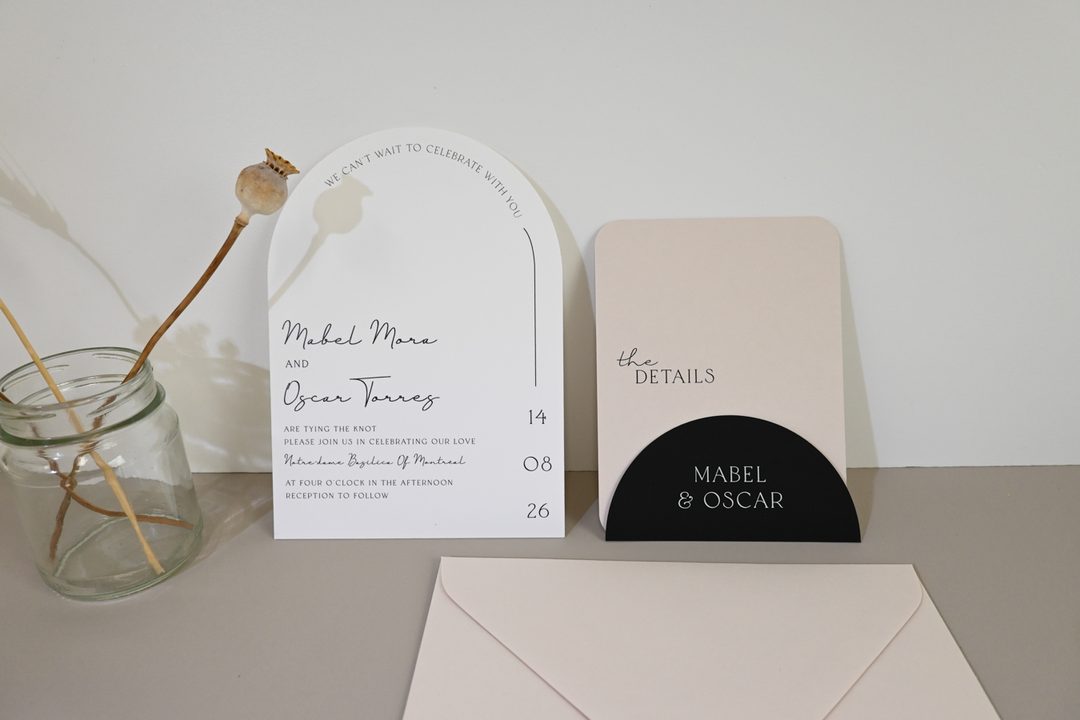
Step 1. Define your aesthetic family
Start with the look and feel of your wedding overall: venue, dress code, color palette, and any dominant theme (coastal, garden, city formal, rustic barn). Your crest should feel native to that world. A hand-painted watercolor wreath looks right at home on a garden estate; a geometric gold crest belongs at a hotel ballroom. Write three adjectives that describe your wedding aesthetic before you touch any design tool.
Step 2. Choose your frame shape
The outer shape of a crest carries a lot of visual weight:
- Shield: classic, heraldic, works at any formality level
- Oval or circle: softer, romantic, great for wreaths and botanical designs
- Arch: modern and very much in line with current stationery trends; echoes church doors and venue architecture
- Hexagon or diamond: geometric, editorial, strong for city-loft and black-tie aesthetics
Choose a shape that mirrors something already present in your wedding: the arch of your ceremony doorway, the oval windows of your venue, or the diamond tiles of your reception floor.
Step 3. Set your type
Pick one primary typeface family and stick to it across all items. A common pairing is script initials (for warmth and romance) with a small-caps serif for any supporting text like the date or venue name. Avoid mixing more than two typefaces. If you go modern sans-serif for the initials, use the same sans-serif for banner text rather than adding a script element.
Step 4. Add your story elements
This is where a crest becomes personal. Choose 1-3 illustrated motifs that reference your shared story:
- Bouquet flowers or regional botanicals (olive branch, magnolia, coastal banksia)
- A pet silhouette (cats and dogs are common; unusual choices like rabbits or horses are memorable)
- A location icon (a mountain range, a harbor, a specific building)
- A shared hobby (books, wine glasses, climbing ropes, a guitar)
- Seasonal foliage tied to your wedding date
The rule is restraint. Every element you add makes the crest busier, which makes it harder to reproduce at small sizes. If you cannot fit your crest cleanly into a 20mm wax seal, you have too many elements.
Step 5. Add banner text (optional)
A ribbon or banner at the base of the crest can carry your wedding date, location, surname, or a short phrase. Keep it to one or two lines. Classic banner text is set in small-caps serif for a clean, formal look. If you want something more personal, a single word in script (“Est. 2026” or simply your location) works well.
Step 6. Create two versions
Always produce a detailed version (for the invitation, welcome sign, and other large applications) and a simplified version that strips back illustrative detail for small applications like wax seals, napkins, and place cards. You should be able to read the core monogram in the simplified version even when it is printed at 15mm across.
Where to Use Your Wedding Monogram Across the Whole Suite
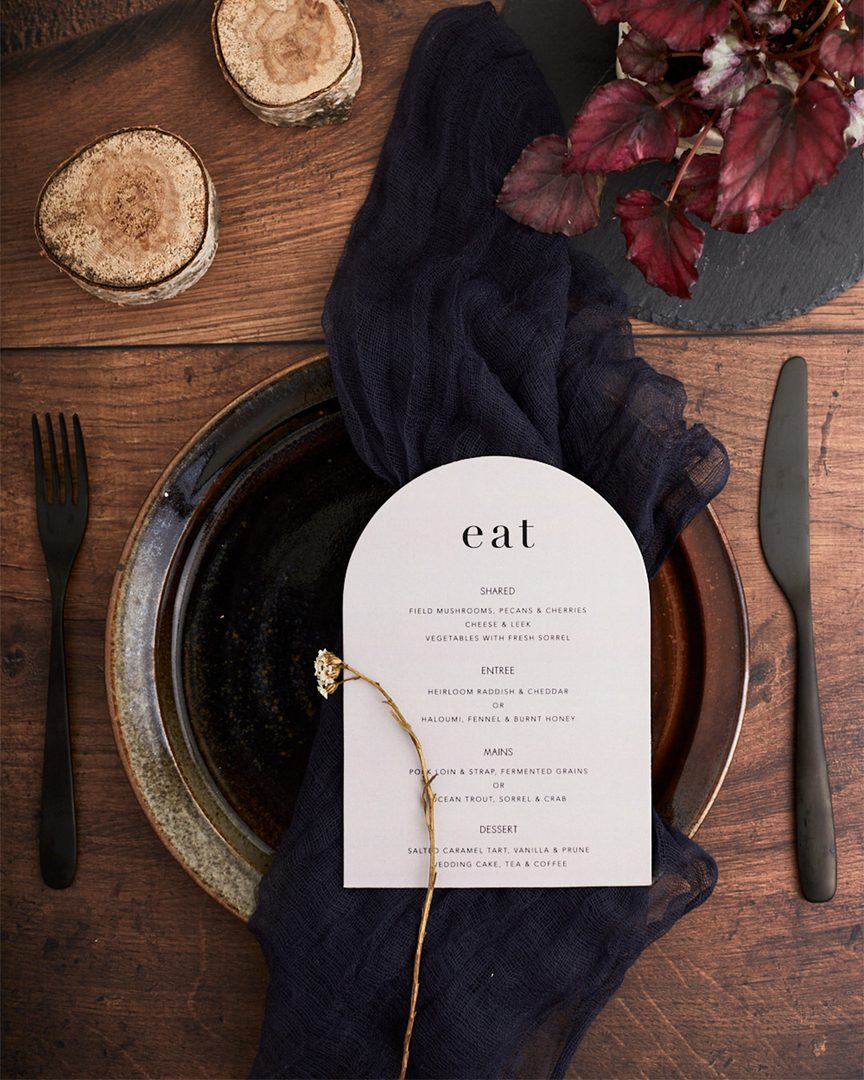
Your monogram or crest becomes the unifying thread that ties every printed and designed element together. Here is where it appears and how to adapt it for each application.
Invitation suite
The invitation is where most couples debut the monogram, usually at the top center of the card or in the upper left corner. For a crest, the top center position reads as intentional and formal. On a more modern layout, the monogram may appear smaller, offset to one corner, or as a blind-emboss detail if you are using letterpress. On Paperlust wedding invitations, your monogram can be incorporated into the design by your assigned designer or placed as a customization on any of the 500+ available designs. Foil stamp and flat foil are the most popular print methods for monogram work because the metallic finish naturally draws attention to the mark.
Wedding menus
Menus sit on the table for the duration of the reception, which makes them a great vehicle for the monogram. Use the full crest at the top of the menu card and allow white space below it before the first course begins. For wedding menus printed on letterpress, the blind-deboss version of your crest (no ink, just the pressed impression) creates a tactile detail guests will feel as they pick up the card.
Wedding signs and welcome signage
A welcome sign at the venue entrance is one of the largest-format applications your monogram will see. This is where the detailed version of your crest does its best work: at 600mm wide, every illustrated element is readable. Consider the simplified monogram version for direction signs, bar menus, and smaller framed prints around the venue. Paperlust wedding signs are available in fabric and printed PVC board, with vinyl foil finishes in gold, silver, and rose gold.
Envelope wax seals
A wax seal on the back flap of your invitation envelope is one of the most impactful and cost-effective ways to add the monogram. Use the simplified single-initial or two-letter version. A wax seal stamp with your chosen initial costs far less than a full crest die and requires no lead time from a printer.
Napkins and favors
Linen napkins embossed or printed with your monogram create an elevated reception table. For favors, the monogram can appear on custom labels, tags, or packaging. On these items the simplified version is always preferable because they will be read at close range in a dimly lit reception.
Ceremony programs
A monogram at the top of a folded ceremony program sets the tone before a word is read. Programs are often held throughout the ceremony, so they receive sustained attention. A clean monogram above the service order looks intentional without competing with the ceremony content.
Print Methods That Make Monograms Shine
The monogram is only as good as the process that reproduces it. Different print methods handle fine letterforms and illustrated detail differently.
| Print Method | Effect on Monogram | Best For |
|---|---|---|
| Digital print | Full color, fine detail, smooth gradients | Watercolor crest illustrations, subtle color blends |
| Flat foil | Mirror-bright metallic, no deboss, faster production | Clean sans-serif or script initials in gold, rose gold, silver |
| Foil stamp | Mirror-bright metallic + pressed deboss impression from custom die | Detailed crests where the tactile dimension matters; minimum 50 cards |
| Letterpress | Deep deboss impression; hand-mixed ink; strongest on bold, simple marks | Single-initial crests and clean monograms; 300gsm or 600gsm Wild Cotton |
| Metallic ink | Subtle gold sheen (dry toner pigment); less mirror-bright than foil | Budget-conscious couples who want shimmer without a metallic die |
One practical note: highly detailed illustrated crests with thin linework reproduce best on digital print or flat foil on a smooth matte stock. Letterpress loves bold, clean marks but can fill in hairline details. If your crest is illustration-heavy, your Paperlust designer will advise on which method preserves the detail at the size you need.
Modern vs. Traditional: Two Directions for 2026
The traditional approach
Traditional monogram design follows rules that have been around for over a century: three letters in script, last-name initial centered and enlarged, often framed by a wreath or laurel. The palette is typically navy, black, or deep green on ivory, or gold foil on white cotton paper. This approach is formal, well-understood, and still widely requested because it photographs well and ages gracefully. On an invitation, it signals that the wedding is a serious, considered event.
The modern approach
Modern wedding logo design borrows from the fashion and lifestyle brand world. It tends toward fewer letters (sometimes just two), geometric or architectural typefaces, high contrast, and no illustrative elements. The palette is more likely to be warm black and cream, or a single rich accent color. The mark looks at home on a digital surface (wedding website header, Instagram story) as well as on printed stationery. It is also the format most couples continue using after the wedding on personal stationery and return-address stamps.
The hybrid that wins in 2026
The strongest designs right now combine a modern typographic monogram with one or two restrained illustrative elements. A clean serif initial inside a minimal arch frame, with a single botanical element at the base, reads as contemporary but still warm. This hybrid approach is versatile enough to scale from wax seal to full-panel welcome sign without losing its character.
How Paperlust Handles Custom Monogram and Crest Work
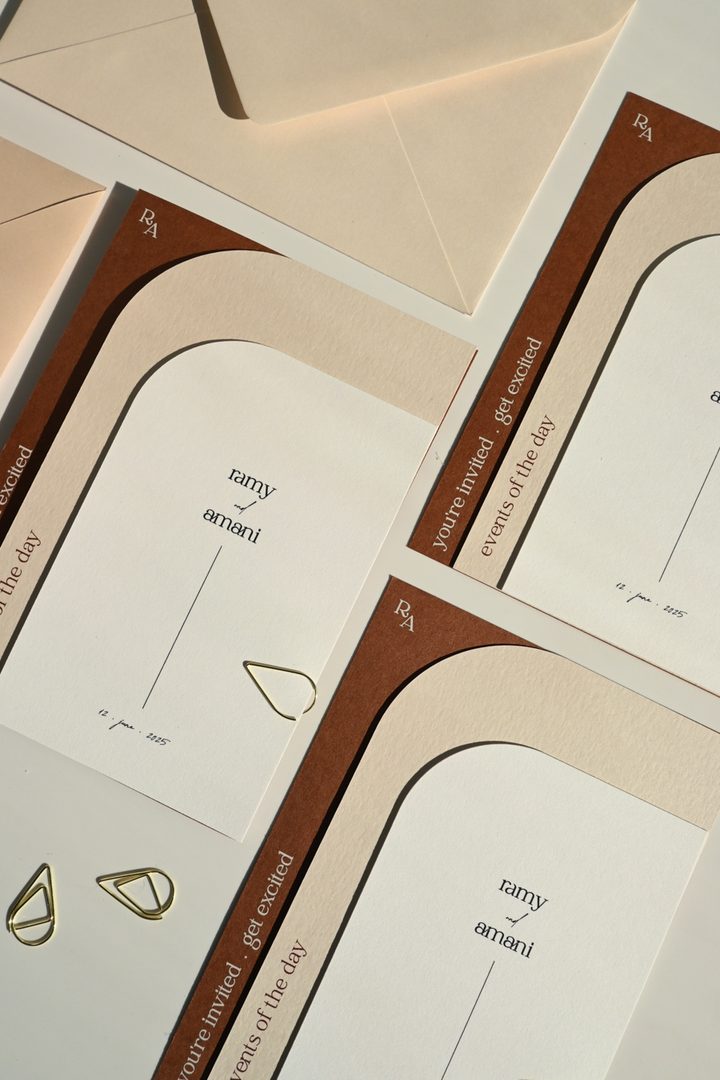
Every Paperlust order comes with a professional designer assigned to your file. For monogram and crest work, the process runs as follows.
When you browse the Paperlust invitation collection, you will find many designs that already incorporate a monogram position. You choose the design, customize your initials and colors via the site’s design tool, and submit the order. Your designer then refines the placement, adjusts letterforms as needed, and sends a digital proof within 1-2 business days. Two rounds of edits are included at no extra charge, so if the initial position, size, or style needs adjusting, you simply mark up the proof and the designer revises.
For couples who want a crest built from scratch rather than adapted from an existing template, Paperlust offers a fully custom design path. You supply the brief (initials, style direction, motifs, color palette) and your designer creates the crest artwork from the ground up. This is the option to choose if you want an illustrated crest with specific botanical or icon elements that do not exist in the standard design library.
Once the monogram or crest is locked, Paperlust can apply it consistently across the full stationery suite: invitations, menus, programs, place cards, and signage. This means your monogram files are not handed back to you to manage across multiple vendors. One studio handles the full suite on the same paper stocks and print methods, which guarantees visual consistency.
Orders over $350 USD qualify for free DHL Express international shipping. For US customers, DHL transit time after dispatch is 2-4 business days.
Do You Actually Need a Monogram?
No. A monogram is a design choice, not a requirement.
Couples who benefit most from a monogram are those who want a cohesive visual identity across a large stationery suite, who are planning a formal or traditional wedding where the level of detail signals the tone of the event, or who want a mark they will continue using on personal stationery after the wedding.
Couples who may not need one are those planning very casual or intimate weddings where heavy visual branding would feel out of place, or those working with a design that is already distinctive enough that adding initials would compete with rather than complement the existing artwork.
If you are unsure, start with a single-initial crest. It is the easiest version to build, the easiest to scale, and the easiest to remove if you later decide it is not adding value to the design.
Before you order, a $5 sample pack puts the paper weight and each print method in your hands, making the final choice an easy one.
Frequently Asked Questions
Whose initial goes first on a wedding monogram?
In a traditional three-letter couple monogram, the bride’s first initial appears on the left, the shared last-name initial (largest) in the center, and the groom’s first initial on the right. For a two-letter monogram, order can be alphabetical or based on couple preference. Modern couples increasingly choose equal formats (side-by-side or stacked) that do not imply any hierarchy.
Do you need a monogram for your wedding invitations?
No. A monogram is an optional design element. Many beautiful invitation suites have no monogram at all. It is most useful when you want a consistent visual mark to carry across a full stationery suite or when the formality of your wedding calls for a polished, branded look. If you are unsure, start with the invitation alone and see whether the design feels complete without one.
What is the difference between a wedding monogram and a wedding crest?
A monogram is a typographic mark made from letters only. A crest adds a structural frame, illustrated motifs (florals, icons, pets, locations), and optional banner text around the core initials. Both can be adapted into a simple two-letter mark or an elaborate illustrated artwork, but a crest typically involves more design work and more decision points about symbols and story elements.
Can you use your wedding monogram after the wedding?
Yes, and many couples design with this in mind. A monogram or crest built around the shared married surname or combined initials works well on personal stationery, return-address stamps, house stationery, holiday cards, and anniversary gifts. If you want the mark to age well, opt for a classic format (interlocking script or single-initial crest) over a heavily trend-driven style that may date quickly.
How many invitations do you need before foil stamp is worth it?
Paperlust requires a minimum of 50 cards for foil stamp. This is because a custom foil die must be made for each design. At 50 cards or more, the die cost is amortized across the run and the per-card price becomes competitive. For smaller quantities (under 50), flat foil achieves a very similar mirror-bright metallic finish with no minimum above 10 cards and no die cost. Your designer can advise on the best option for your quantity and budget.
Can a Paperlust designer create a custom crest from scratch?
Yes. Paperlust offers a fully custom design path where a designer creates your crest artwork from the ground up based on your brief. This covers the full crest: frame shape, illustrated motifs, typography, and color. The custom path is quote-based; contact Paperlust via the custom design page or live chat to discuss your requirements and get a price.