
A wedding menu card is far more than a list of dishes – it is a piece of stationery guests will hold, read, and often take home as a keepsake. Getting the wording right means balancing the practical (guests need to know what they are eating) with the personal (this is your wedding, not a restaurant). This guide gives you 50+ wording templates organized by cuisine style, service format, and dietary situation – so you can find the exact language that fits your reception and copy it directly.
Wedding Menu Card Cheat Sheet
- 5 things every menu card needs: couple’s names or monogram, wedding date, course headings, dish names, and drinks/bar note
- Wording tone should match your invitation – formal invite = formal menu wording; relaxed invite = relaxed menu wording
- Dietary labeling: V = vegetarian, VE = vegan, GF = gluten-free (use only when confirmed allergen-safe by your caterer)
- How many to order: one per guest for plated meals; one per two guests for buffets; one per table for casual receptions
- Size options at Paperlust: Standard 5″x7″, DL tall (4.2″x8.3″), Round 145mm, or die-cut
- Lead time: finalize with your caterer 6-8 weeks out; order menus 3-4 weeks before the wedding


At a Glance: Wedding Menu Card Wording
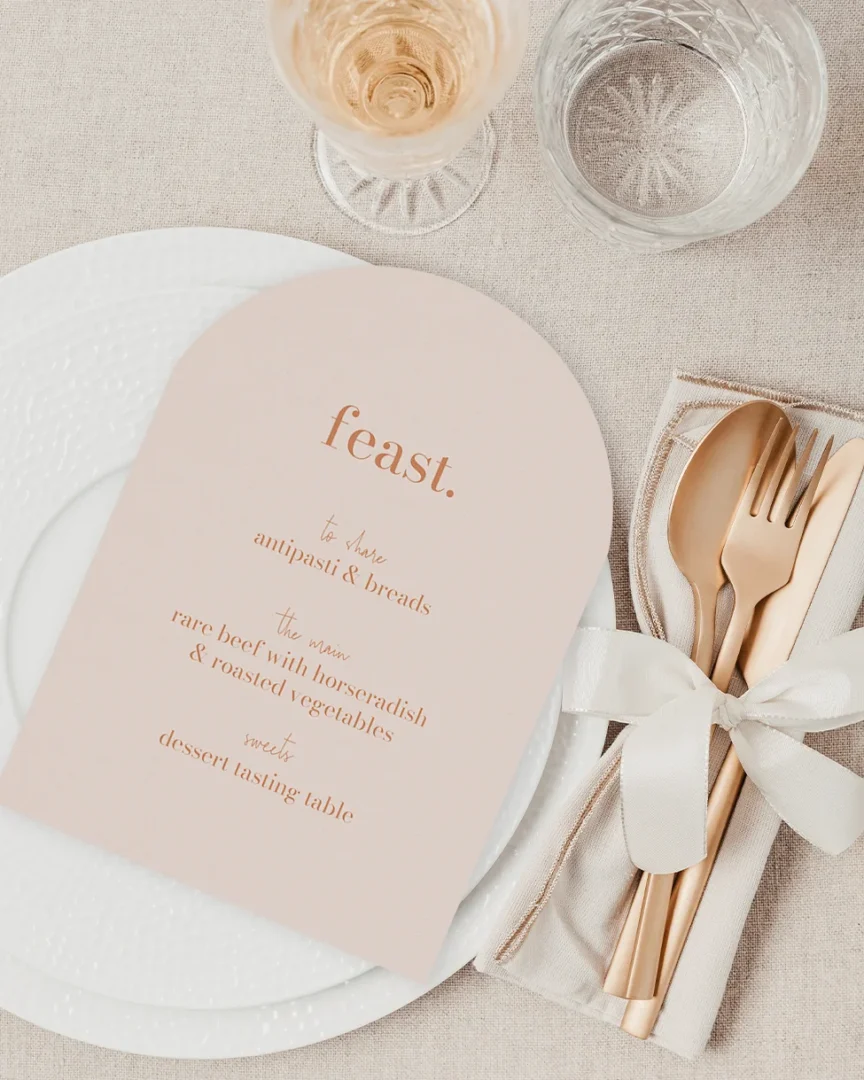
- Three required elements: course headers, dish names, allergen indicators
- Cuisine cue: match menu language to the food, Italian dishes in Italian, French in French, casual cuisine in plain English
- Length: 3-5 lines per course; descriptions sparse enough to read while plating
- Format: A6 or DL portrait, one menu per place setting (or one per couple at small tables)
- Lock copy: 3 weeks before the day, after final tasting
How to Structure Your Wedding Menu Card: Step by Step
Before choosing wording, decide what your menu card needs to include. Not every reception needs every section – use this structure as a starting point and cut what does not apply.
Step 1: The title or header
The most common approach: the couple’s names or monogram, followed by the wedding date. Some couples also include a brief welcome line. Keep this section to 2-3 lines maximum.
Examples:
- Emma and James – 14 March 2026
- E + J – March 2026
- The Wilson Wedding
- Celebrating Emma and James
- Dinner – Emma and James – 14 March 2026
Step 2: The courses
List courses in the order they will be served. Use clear headings (Appetizer, Entree, Main, Dessert) or creative alternatives:
| Standard Heading | Creative Alternatives |
|---|---|
| Appetizer / Starter | To Begin, First Bite, Something Small, Prelude |
| Entree / Second Course | Before the Main Event, The Second Act, Following |
| Main Course | The Main Event, Feast, At the Heart, The Star |
| Dessert | The Sweet Finale, Something Sweet, To Finish |
| Drinks | Raise a Glass, To Drink, The Cellar, Your Glass |
Step 3: The dish descriptions
Work directly with your caterer to describe dishes accurately. The level of description depends on your tone: formal menus describe technique and garnishes; casual menus keep it simple. Both are valid – consistency matters more than formality.
Step 4: Dietary notes
If your menu includes options or you are providing dietary labeling, add this after each dish. Use standardized symbols (V, VE, GF, N for nuts) and place a brief key at the bottom of the card.
Step 5: A closing note (optional)
A short thank-you or welcome message from the couple at the bottom of the card adds warmth and gives guests something personal to take home. One to three sentences is plenty.
Wedding Menu Wording by Cuisine Style
The best menu wording matches the food. Here are complete templates for the most common wedding cuisine styles – each ready to adapt with your caterer’s specific dishes.
Shop wedding menus
Single, double, and full-fold menu cards — letterpress, foil, embossed, and flat-print.
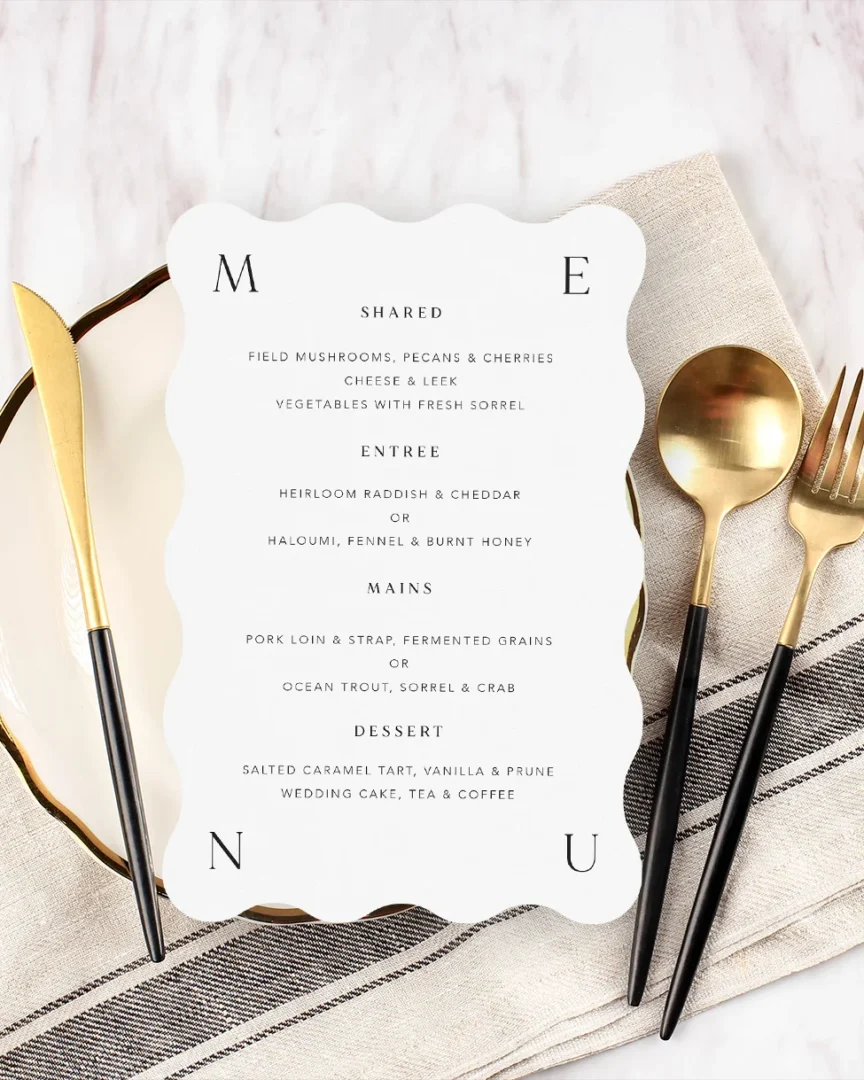
Italian and Mediterranean Wedding Menu
Emma and James
March 14, 2026
Antipasto
Burrata with heirloom tomato, torn basil, and aged balsamic
Prosciutto and melon with fresh mint
Assorted bruschetta (V)
Primo
Handmade pappardelle with slow-braised ragu
Pumpkin and sage risotto (V, GF)
Secondo
Herb-crusted lamb rack, salsa verde, roasted seasonal vegetables
or
Pan-seared sea bass, saffron butter, asparagus (GF)
Dolce
Tiramisu with espresso cream
Panna cotta with poached strawberries (V, GF)
Digestivo
Coffee, tea, and Limoncello served from the bar
Asian Fusion Wedding Menu
Lily and Chen
June 7, 2026
Small Bites to Begin
Steamed pork and chive dumplings
Vietnamese rice paper rolls with mango and mint (VE, GF)
Sesame-glazed chicken skewers
First Course
Chilled cucumber and tofu salad, ponzu dressing (VE, GF)
or
Miso-cured salmon, pickled ginger, black sesame
Main
Slow-braised short rib, jasmine rice, crispy shallots, bok choy
or
Mushroom and tofu clay pot (V, GF)
Sweet
Matcha mochi ice cream
Coconut tapioca, lychee, and passionfruit (VE, GF)
Tea and sake bar available at your request
BBQ and Southern-Style Wedding Menu
Sarah and Jake – May 10, 2026
To Start
Pulled pork sliders on brioche buns
Corn fritters with chipotle mayo (V)
Coleslaw and pickles (V, GF)
The Mains
Low-and-slow smoked brisket with house BBQ sauce (GF)
Smoked chicken thighs, lemon and herb (GF)
Loaded mac and cheese (V)
On the Side
Smoked baked beans
Cornbread
Watermelon and feta salad (V, GF)
Something Sweet
Peach cobbler with vanilla ice cream
Banana pudding
Cold beers and lemonade at the bar – help yourself
Farm-to-Table and Australian Produce Wedding Menu
Mia and Tom
October 18, 2026
From Our Garden
Sourdough with house-cultured butter and Yarra Valley smoked salmon
Heirloom tomato salad, house burrata, garden basil (V, GF)
First Course
Duck leg confit, cherry jus, seasonal greens
or
Roasted beetroot and goat cheese tart, walnut crumble (V)
From the Fire
Wood-roasted rack of lamb, mint and pea puree, charred broccolini (GF)
or
Pan-roasted snapper, cauliflower cream, herb oil (GF)
Sweet Finish
Warm apple tart tatin, creme fraiche
Chocolate and Davidson plum ganache (GF option available)
Wines selected from the Yarra Valley and Central Victoria
Cocktail and Canape-Style Wedding Menu
Nina and Rafael – September 12, 2026
Passing Through Your Evening…
On Arrival
Champagne and strawberry skewers
Mini lobster rolls
Zucchini fritters with whipped feta (V)
Through the Evening
Wagyu beef sliders with truffle aioli
Smoked salmon blini, creme fraiche, dill
Beetroot and goat cheese tartlets (V)
Chicken and leek arancini
Something Sweet
Salted caramel macarons
Mini pavlovas with seasonal berries (V, GF)
Dark chocolate truffles
Full bar available throughout the evening
Please speak with staff about any dietary requirements
Vegan and Plant-Based Wedding Menu
Jordan and River
April 5, 2026
This menu is entirely plant-based. Every dish is vegan.
To Begin
Roasted red pepper and walnut dip, warm pita
Crispy cauliflower bites, tahini and pomegranate
Heirloom tomato bruschetta, cashew ricotta
First Course
Butternut squash soup, toasted pepitas, herb oil
or
Charred broccolini, lemon dressing, toasted almonds
Main Course
Slow-braised mushroom and lentil ragu, fresh pasta
or
Roasted king oyster mushroom steak, truffle mashed potatoes, seasonal greens
Dessert
Dark chocolate and avocado mousse, raspberry coulis
Coconut panna cotta, mango and passionfruit
We believe good food and kindness go together. Thank you for celebrating with us.
Formal vs Casual Menu Wording: Side by Side
The same chicken dish can be described at least two different ways depending on your wedding’s tone. Here is a side-by-side comparison to show how wording changes with formality level.
| Course | Formal Wording | Casual Wording |
|---|---|---|
| Starter | Burrata with heirloom tomato conserve, aged balsamic reduction, and micro herbs | Fresh burrata, tomatoes, basil oil (V) |
| Main | Pan-seared Angus eye fillet, truffle pomme puree, roasted asparagus, and red wine jus | Eye fillet steak with creamy mashed potato and roasted veggies (GF) |
| Dessert | Valrhona dark chocolate fondant, Tahitian vanilla bean ice cream, raspberry coulis | Warm chocolate pudding with vanilla ice cream |
| Drinks | Meals served alongside a curated selection of Australian wines. A full beverage menu is available at the bar. | Beer, wine, and soft drinks at the bar all night – help yourself! |
| Closing note | We are deeply grateful for your presence on this joyful occasion. | Thanks for being here – now let’s eat! |
Handling Dietary Requirements on Your Menu Card
Dietary labeling on wedding menu cards is increasingly expected – and getting it right is both a guest experience issue and a safety matter. Here is how to handle it properly.
Standard dietary symbols
Use these widely recognized abbreviations consistently across your menu card:
- V – Vegetarian (contains no meat or fish; may contain dairy and eggs)
- VE – Vegan (contains no animal products)
- GF – Gluten Free (confirm with caterer that cross-contamination protocols are in place)
- DF – Dairy Free
- N – Contains nuts (or NF for nut-free)
- H – Halal
Place a small key at the bottom of the menu card: “V = vegetarian, VE = vegan, GF = gluten free.”
Important allergen warning
Never mark a dish as allergen-free unless your caterer has explicitly confirmed it meets allergen-safe protocols – not just ingredient-based. Cross-contamination during preparation can cause serious reactions. When in doubt, add: “Please speak with staff about specific allergen requirements.”
When guests pre-selected their meal
For plated dinners where guests chose their entree on the RSVP card, include a brief note on the menu so they can confirm their selection:
“Your meal choice is noted on your place card. If you need to make a change, please let your server know.”
Caterers often place a small symbol or sticker on the place card to indicate meal choice without it being visible to other guests. Coordinate this with your venue coordinator in advance.
Kids menu wording
If you are serving a separate children’s menu, a simple insert or a note at the bottom of the adult menu is the cleanest approach:
“A children’s menu has been arranged for our youngest guests. Please speak with staff.”
Or, for a separate printed kids menu card:
“Little Guest Menu
Mini margherita pizza
Chicken tenders with fries
Fruit skewers and ice cream
Menu Card Formatting Tips
Beyond wording, how you lay out your menu card affects how readable and appealing it is. These formatting principles apply regardless of which design template you choose.
Shop wedding place cards
Match place cards to your menu in the same stock and finish.
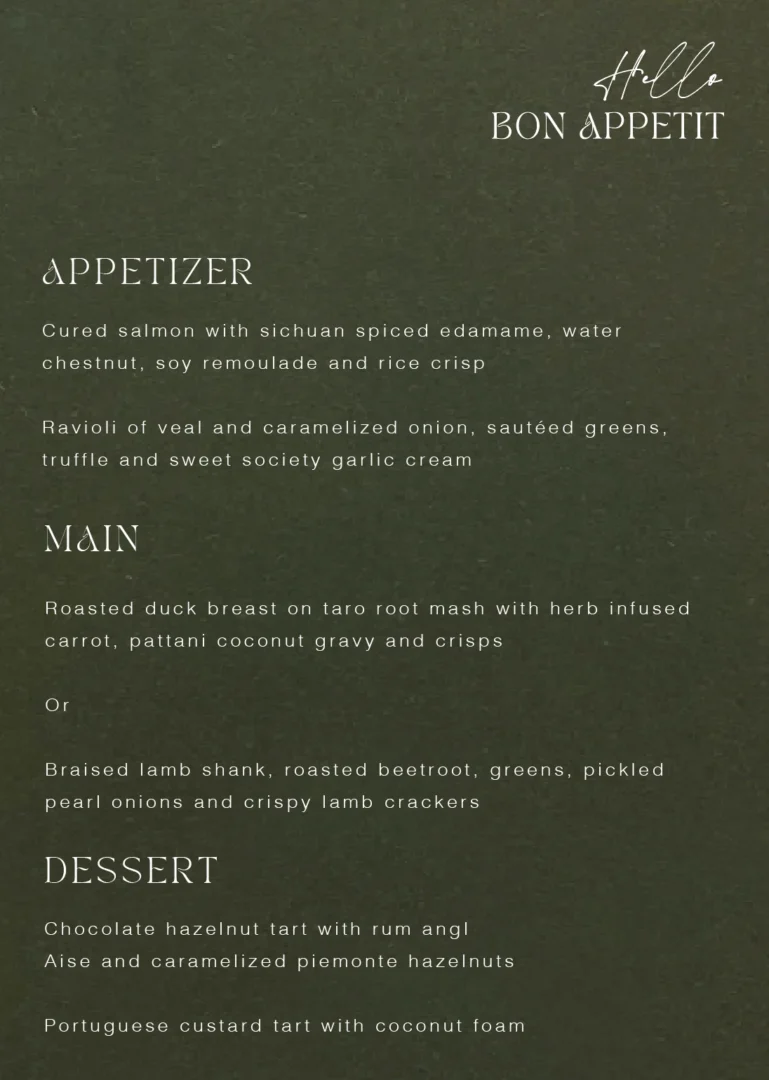
Use clear hierarchy
Course headings should be visually distinct from dish names – slightly larger, bolder, or in a different style. Dish descriptions should be smaller than the dish name. A clear hierarchy helps guests scan the card quickly without feeling overwhelmed.
White space is your friend
Overcrowded menu cards are hard to read, especially in candlelit reception venues. Use spacing between courses, not just between dishes. If your menu has six courses, consider a taller card format (DL size works well) rather than cramming everything onto a standard 5″x7″ card.
Typography guidelines
- Main text: 9-11pt is readable on a printed menu card; do not go smaller than 8pt
- Course headings: Can be 12-14pt or use a complementary script/display font at the same size
- Names and date: The top “title” section can go slightly larger (14-18pt) for emphasis
- Dietary symbols: Keep these small and consistent – ideally in a muted color or lighter weight so they do not compete with the dish name
Number of words to aim for
Standard 5″x7″ cards comfortably hold around 80-120 words of menu content. DL tall cards can hold up to 180-200 words. If your menu consistently runs long, ask your caterer to simplify descriptions for the printed card and offer fuller details verbally or on your wedding website.
Wedding Menu Card Sizes at Paperlust
Paperlust offers menu cards in four standard sizes plus custom die-cut options. Match the size to your menu’s length and your reception’s aesthetic.
| Size | Dimensions | Best for |
|---|---|---|
| Standard | 5″ x 7″ (127mm x 178mm) | Most receptions; pairs well with place card at each setting |
| DL Tall | 4.2″ x 8.3″ (107mm x 210mm) | Longer menus; stands upright in a glass beautifully |
| Round | 145mm diameter | Modern and relaxed aesthetics; table-shared format |
| Die Cut | Various custom shapes | Themed weddings; when the card shape is part of the design |
For coordinating your menu with other table stationery, browse the full wedding menu card collection at Paperlust. Many designs come as full suites, so you can match your menu to your place cards and seating chart in one cohesive design.
Thank-You Notes to Include on Your Menu Card
A brief personal note from the couple at the bottom of the menu card transforms a functional piece of paper into a genuine keepsake. Here are examples from understated to warm:
Brief and elegant:
- “With gratitude for your love and presence today.”
- “Thank you for sharing this day with us.”
- “With all our love, Emma and James.”
Warm and personal:
- “Every person at this table has played a part in our story. We are grateful beyond words.”
- “Tonight’s menu was put together with you in mind. Eat well, stay late, and dance badly.”
- “We chose each dish on this menu because it means something to us. We hope you taste the love in every bite.”
For a farm-to-table or sustainable wedding:
- “Every ingredient on this menu was sourced within 100 miles of this venue. Thank you for celebrating with us and with the land.”
For a destination wedding:
- “You flew across the world to be here. We will never forget it. Tonight’s menu was inspired by the place we first fell in love.”
How to Choose Your Wedding Menu Card Format
Menu format affects table look, printing cost, and how easy it is for guests to follow along while plating. Three trade-offs decide it.
1. Per-guest vs Shared
One menu per place setting reads luxe and gives every guest something to take home, but doubles your print quantity. Shared menus (one per 2-4 guests, propped on a small stand) cut costs ~60% and look elegant on long banquet tables.
2. Single-card vs Folded
Single A6 cards photograph cleanly and pair with most place card layouts. Folded DL or A5 cards hold longer descriptions, work for multi-page family-style menus, and let you add wine pairings inside without crowding the front.
3. Print Method by Cuisine
Foil-stamped menus suit French, Italian, and formal continental cuisines. Letterpress reads classical for traditional fare. Digital print with a botanical motif works for casual, garden, and grazing-style receptions. Browse wedding menus filtered by print finish.
When to Finalize and Order Your Wedding Menu Cards
Menu cards are one of the last pieces of stationery you order – because your final menu often is not confirmed until weeks before the wedding.
| Step | When |
|---|---|
| Confirm menu with caterer | 6-8 weeks before the wedding |
| Submit menu card order | 4-5 weeks before the wedding |
| Receive designer proof | 1-2 business days after order |
| Have caterer review proof | Same week as proof receipt |
| Approve and print | Allow 2-3 weeks production + delivery |
| Cards arrive | At least 1 week before the wedding |
For foil stamping or letterpress menu cards, allow an extra 1-2 weeks. If your caterer changes the menu after you have submitted your order, contact Paperlust’s team immediately – changes may still be possible before the proof is finalized.
Frequently Asked Questions
What should a wedding menu card say?
A wedding menu card typically includes the couple’s names and wedding date, course headings (Appetizer, Main, Dessert), dish names and brief descriptions, dietary labels (V, VE, GF), a note about drinks, and optionally a brief thank-you message from the couple. The wording should match the tone of your wedding – formal language for black-tie events, relaxed language for casual celebrations.
How many wedding menu cards should I order?
For plated sit-down meals, order one menu card per guest. For buffet or shared-style receptions, one per two guests or one per table works well. Always add a 10-15% buffer to your order. At Paperlust, digital print menus start from $2.04 per card, making per-guest ordering affordable even for larger receptions.
What size should wedding menu cards be?
The most popular sizes at Paperlust are Standard 5×7 inches (127mm x 178mm) and DL tall (107mm x 210mm). DL menus stand upright in a glass for a beautiful table effect and fit longer menus without feeling crowded. Round menu cards (145mm diameter) are popular for modern and relaxed aesthetics. The right size depends on the length of your menu and how the card will sit on the table.
When should I order wedding menu cards?
Finalize your menu with your caterer 6-8 weeks before the wedding, then submit your menu card order 3-4 weeks out. This gives time for a designer proof (1-2 business days), any revisions, and production plus delivery. For premium print methods such as foil stamping, allow an additional 1-2 weeks. Rush production options may be available – contact Paperlust’s team if you are ordering close to your event date.
Should wedding menu cards match the invitations?
Yes, for the most cohesive look, order your menu cards from the same design collection as your invitations. Most Paperlust collections include invitations, RSVP cards, place cards, and menu cards in the same design. If exact matching is not possible, match print method (for example, foil invitations with foil menus) and stay within the same color palette.
Can I put an order of events on the menu card?
Yes, and it is a practical addition guests appreciate. A brief timeline at the bottom of the menu card (for example: 6:00pm Canapes and drinks, 7:30pm Dinner, 9:00pm First dance, 10:00pm Dancing) tells guests what to expect throughout the evening. Keep it brief – four to six time points is enough. This works particularly well if you are not printing a separate order of service.