
Addressing wedding invitations feels simple until you realize you have two envelopes, a guest list full of edge cases, and a stack of etiquette questions nobody warned you about. This guide walks you through exactly what goes on each envelope, why the tradition exists, and how to handle every common addressing scenario, from married couples and families with kids to doctors, military officers, and same-sex couples.
- Outer envelope: formal full names and mailing address, exactly as the post office needs it
- Inner envelope: first names or titles only, lists everyone specifically invited (including children and plus-ones)
- Inner envelopes are traditional, not required. Many modern couples skip them
- Children’s names on the inner envelope = they’re invited; omitting them = adults only
- Spell out everything on formal outer envelopes: “Street” not “St.”, “Apartment” not “Apt.”
- A plus-one gets “and Guest” on the inner envelope, never the outer
- Both envelopes omit your return address. It goes on the outer envelope’s back flap
What Are Inner and Outer Envelopes?
Traditional formal wedding invitations come in two envelopes nested together. The outer envelope is the mailing envelope, addressed with full formal names and the complete postal address. Inside it sits the inner envelope, which holds the actual invitation suite and carries only the names of the people specifically invited to the wedding.
The outer envelope does the logistical work: it gets your invitation from your mailbox to your guest’s. The inner envelope does the social work: it tells your guest exactly who in their household is invited and sets the formality level for the event.
Why Does the Double Envelope Tradition Exist?
The double envelope dates to Victorian England and the era of white-gloved postal carriers. The outer envelope was handled by postal workers and could arrive crumpled, dirty, or smudged. A pristine inner envelope meant your guests received a crisp, untouched invitation: a sign of care and formality. Removing the outer envelope before presenting the invitation suite was part of the butler’s duties in formal households.
Today, postal handling is gentler, which is why many couples skip the inner envelope entirely. But for formal or traditional weddings, the double envelope remains a gracious choice, and the inner envelope still serves a practical purpose: it removes all ambiguity about exactly who is (and is not) invited.
What Goes on the Outer Envelope
The outer envelope follows formal postal addressing conventions. Everything is spelled out fully (no abbreviations).
Format:
2847 Elmwood Avenue
Nashville, Tennessee 37201
Key rules for outer envelopes:
- Use formal titles: Mr., Mrs., Ms., Dr., Professor
- Spell out street suffixes: Street, Avenue, Boulevard, Drive
- Spell out state names on the most formal invitations (Tennessee, not TN), though abbreviated state names are widely accepted today
- List only the adults being invited. Children are named on the inner envelope only
- Your return address goes on the back flap, not the front
- Do not use a P.O. Box as the return address if you want replies to come back to you by mail. Use your home address instead
What Goes on the Inner Envelope
The inner envelope is more personal. It uses first names, last names only, or a combination, whichever feels right for your relationship with that guest. Crucially, it lists every person in that household who is invited, including children and plus-ones.
Format (traditional):
Format (familiar):
Format (family with children invited):
Lily, Jack, and Sophie
The inner envelope does not include a mailing address. It’s a personal note of inclusion: a way of saying “these are the people we want to celebrate with us.”

Comprehensive Addressing Reference
Use the table below for quick reference. For each scenario, the outer envelope uses formal names and address; the inner envelope is shown separately. For couples using the same last name, the traditional outer format is listed first, followed by the modern equal-billing alternative.
| Guest situation | Outer envelope | Inner envelope |
|---|---|---|
| Married couple, same last name | Mr. and Mrs. David Chen | David and Michelle or Mr. and Mrs. Chen |
| Married couple, different last names | Ms. Rachel Torres and Mr. Evan Marsh | Rachel and Evan |
| Unmarried couple, living together | Ms. Priya Nair and Mr. Tom Wallace | Priya and Tom |
| Family with children invited | Mr. and Mrs. James Rivera | James and Sofia / Mia, Lucas, and Ella |
| Family, children not invited | Mr. and Mrs. James Rivera | James and Sofia (children omitted intentionally) |
| Single guest, no plus-one | Ms. Amber Cole | Amber |
| Single guest with a plus-one | Ms. Amber Cole | Amber and Guest |
| Same-sex married couple, same name | Mr. and Mr. Kevin Park or Messrs. Kevin and Daniel Park | Kevin and Daniel |
| Same-sex married couple, different names | Ms. Lauren Hart and Ms. Jenna Ford | Lauren and Jenna |
| Female doctor (uses husband’s name) | Dr. and Mr. Sandra and Paul Kim | Sandra and Paul |
| Female doctor (keeps maiden name professionally) | Dr. Sandra Reed and Mr. Paul Kim | Sandra and Paul |
| Both spouses are doctors | Drs. Sandra and Paul Kim or The Doctors Kim | Sandra and Paul |
| Judge | The Honorable Maria Santos and Mr. David Santos | Maria and David |
| Active military (commissioned officer) | Captain James Owens and Mrs. Owens | James and Lisa |
| Non-binary guest (known pronouns) | Mx. Riley Thornton or Riley Thornton (no title) | Riley |
| Widow or widower | Mrs. Margaret Hartley (retains married name by choice) | Margaret |
Addressing Children Correctly
Children under 18 are listed on the inner envelope only, below their parents’ names. They are never named on the outer envelope. The outer envelope is addressed to the adults of the household.
If children are invited:
Inner: Robert and Diana / Chloe, Ben, and Lily
If children are not invited: Address only the parents on both envelopes. Omitting children’s names from the inner envelope is a clear, graceful signal. You can reinforce this on your wedding website or reception card with a note like “Adult reception to follow.”
Children 18 and older living at home receive their own separate invitation sent to the same address. This shows they are being invited as adults in their own right, not as part of the family unit.
Single vs. Double Envelope: Do You Actually Need Both?
The inner envelope is a tradition, not a rule. A large proportion of modern couples use a single outer envelope only, and their invitations look beautiful. Here is a quick comparison to help you decide.
| Factor | Double envelope (inner + outer) | Single envelope only |
|---|---|---|
| Formality | Traditional, black-tie appropriate | Modern, casual to semi-formal |
| Guest clarity on who’s invited | Very clear (inner lists exact names) | Must address outer precisely |
| Cost | Higher (extra envelope + printing) | Lower |
| Postage | May add weight (check with USPS) | Lighter, easier to manage |
| Presentation on opening | Layered, ceremonious feel | Streamlined, clean |
| Best for | Formal, religious, or very large weddings | Most modern weddings |
If you’re torn, consider this: the inner envelope earns its place most when you have complex family situations (divorced parents, families with some children invited but not others, guests with professional titles) where the extra naming real estate prevents awkward confusion.
Tips for Formal Outer Envelope Wording
Spell everything out
Formal envelopes read better when words are written in full. “Street” not “St.” “Boulevard” not “Blvd.” “Tennessee” not “TN.” For more casual invitations, abbreviations are fine, but stay consistent.
Get the title order right
When a married couple shares a last name and the woman has not changed her name professionally, the traditional format puts the man’s name first (“Mr. and Mrs. David Chen”). The modern equal-billing alternative lists both names separately: “Ms. Lisa Chen and Mr. David Chen.” Either is correct today. Choose what fits your family dynamics.
When someone has a professional title that outranks “Mr.” or “Mrs.”
The higher title goes first, regardless of gender. A female doctor married to a man without a title is addressed “Dr. and Mr. [Surname]” (her title leads). If both hold the same title, use the plural: “Drs. Chen” or “The Doctors Chen.”
Military titles
Commissioned officers (Captain, Lieutenant, Major, Colonel, General, Admiral) use their rank on formal envelopes. Non-commissioned officers and enlisted personnel use their service-appropriate title (Sergeant, Corporal, Petty Officer) on formal correspondence too, though it is less common to abbreviate on formal invitations. Spell out ranks in full.
Addressing Invitations When You Skip the Inner Envelope
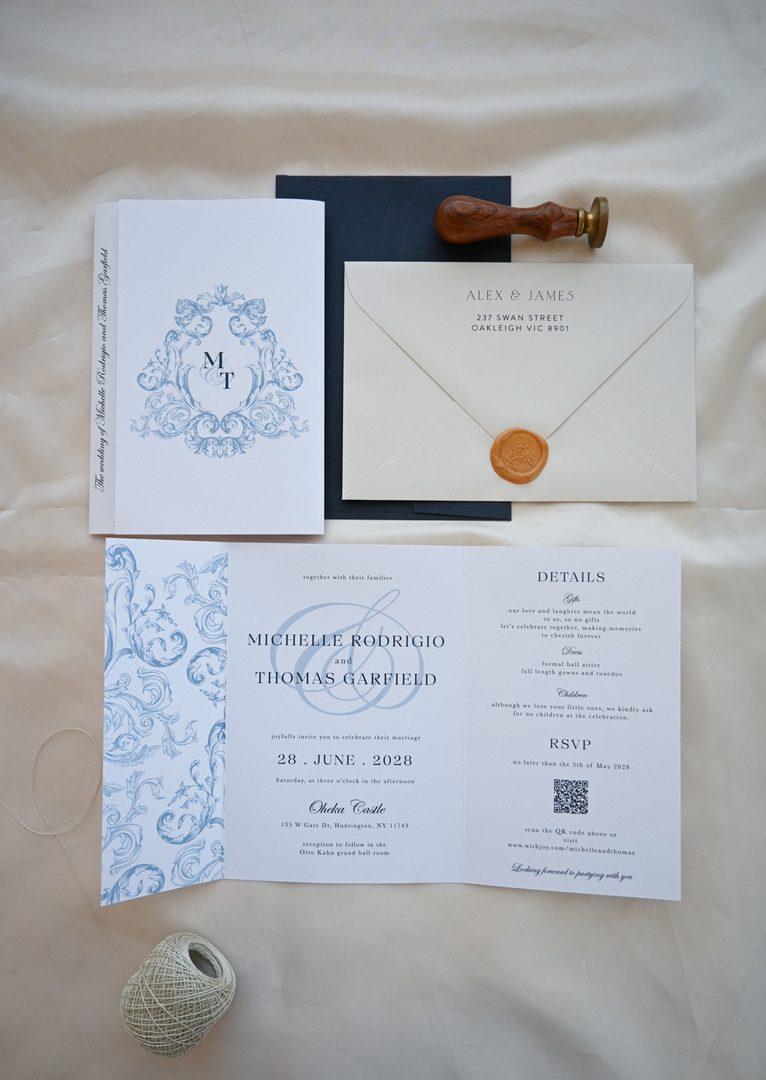
If you’re using a single outer envelope, it takes on both jobs: mailing logistics and guest clarity. List children’s names on the outer envelope line below the parents, or address it “The Rivera Family” if all household members are invited. For a single guest with a plus-one, write “Ms. Amber Cole and Guest” directly on the outer envelope.
The same formal conventions apply: spell out addresses, use full names, and include proper titles. The only difference is that your outer envelope has to do all the communicating that the inner envelope would have handled.
How to Order Wedding Envelopes From Paperlust
Every Paperlust invitation order includes free white envelopes. If you’d like colored envelopes, textured envelopes, or envelope liners to complement your invitation design, those can be added when you place your order.
If addressing 100 or more guests by hand sounds daunting, Paperlust offers envelope address printing from $0.20 per address. Your guest list can be imported via the Address Manager tool (compatible with Excel and email contact exports), printed in a font that matches your invitation style. A professional designer is assigned to every order, and your proof arrives within 1-2 business days.
Browse the full collection of wedding invitations to find a design that suits your envelope style, or explore our save the dates to start your stationery suite earlier in the planning process.
Orders over $350 USD qualify for free DHL Express shipping.
Not sure which print method suits your design? Order Paperlust’s $5 sample pack to feel the difference between digital, letterpress, flat foil, and foil stamp before you commit.
Frequently Asked Questions
Do you need an inner envelope for wedding invitations?
No. The inner envelope is a traditional formality, not a requirement. Most modern couples use a single outer envelope, which works beautifully for all invitation styles from casual to semi-formal. An inner envelope is most useful for formal or black-tie weddings where you want to be explicit about exactly who is invited within each household.
Who goes on the inner envelope?
Everyone specifically invited from that household, the couple or individual named on the outer envelope, plus any children or plus-ones who are invited. If a child is not listed on the inner envelope, that’s a clear and graceful signal that the invitation is for adults only. A single guest with a plus-one is listed as “First Name and Guest.”
How do you address children on wedding invitations?
Children under 18 are listed by first name on the inner envelope only, below their parents’ names. They are not named on the outer envelope. Children 18 and older living at home should receive their own separate invitation sent to the same address. This treats them as adults in their own right. If children are not invited, address the envelope only to the parents and omit any children’s names from both envelopes.
Do you use titles on the inner envelope?
It depends on how formal your wedding is and how well you know the guests. At the most formal end, use last names with titles: “Mr. and Mrs. Chen.” For a familiar touch, use first names only: “David and Michelle.” Both are correct. If guests have professional titles (Doctor, Judge, Captain), use those on the outer envelope; the inner envelope can drop to first names if your relationship with them is warm.
How do you address a same-sex couple’s wedding invitation?
The same principles apply: list both partners by name in whichever order you prefer (alphabetical is a safe neutral choice). If they share a last name: “Mr. and Mr. Kevin and Daniel Park” or “Ms. and Ms. Lauren and Jenna Ford.” If they have different last names, list both full names on one line. On the inner envelope, first names only works perfectly: “Kevin and Daniel.”
What is “Mx.” on a wedding invitation?
Mx. (pronounced “mix”) is a gender-neutral title for guests who do not use Mr., Mrs., Ms., or Miss. It is used most often by non-binary individuals. If a guest uses Mx., address their outer envelope as “Mx. Riley Thornton.” If you’re unsure of a guest’s preferred title, using their full name without any title at all (“Riley Thornton”) is always respectful and appropriate.
Can children be invited to the ceremony but not the reception?
Yes. If children are invited to the ceremony only, note this on the inner envelope or include a separate reception card that specifies “Adult reception to follow.” You can name the children on the inner envelope while making clear through your reception card that the dinner portion is adults-only.