
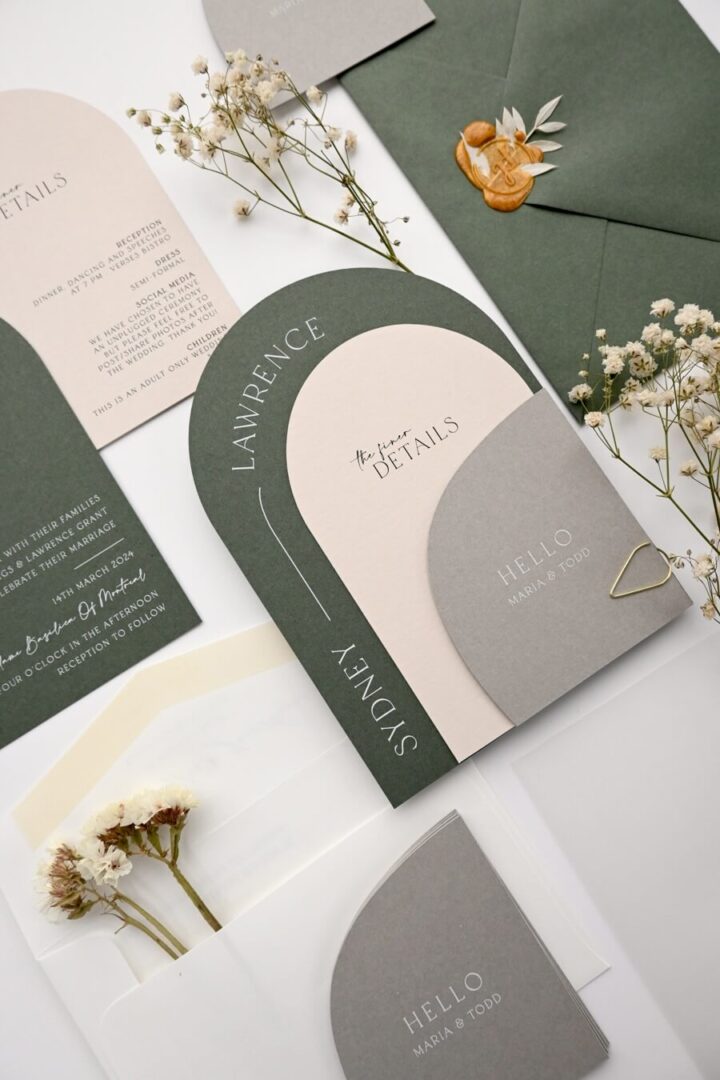
- A full wedding stationery suite has three phases: pre-wedding (save the dates, invitations), day-of (programs, menus, place cards), and post-wedding (thank you cards).
- Only four pieces are truly essential: save the dates, invitations, RSVP cards, and thank you cards. Everything else depends on your wedding format.
- Order 3+ card types together to automatically save 15%; sign up for 10% off your first purchase.
- Allow 3 to 5 business days production for digital print, white ink, and metallic; 7 to 10 business days for flat foil; 20 to 23 business days for letterpress and foil stamp; plus 2 to 4 days DHL Express transit to US addresses.
- Add 15-20% buffer to every quantity – reorders cost nearly as much as adding extra cards to the original order.
Wedding stationery touches nearly every part of your celebration – from the first notification guests receive through to the thank you card that arrives after the honeymoon. The list of pieces you could order is long; the list of pieces you actually need is much shorter. This checklist organizes everything by when it needs to be ordered, what it does, and whether it’s essential or optional for your specific wedding format.
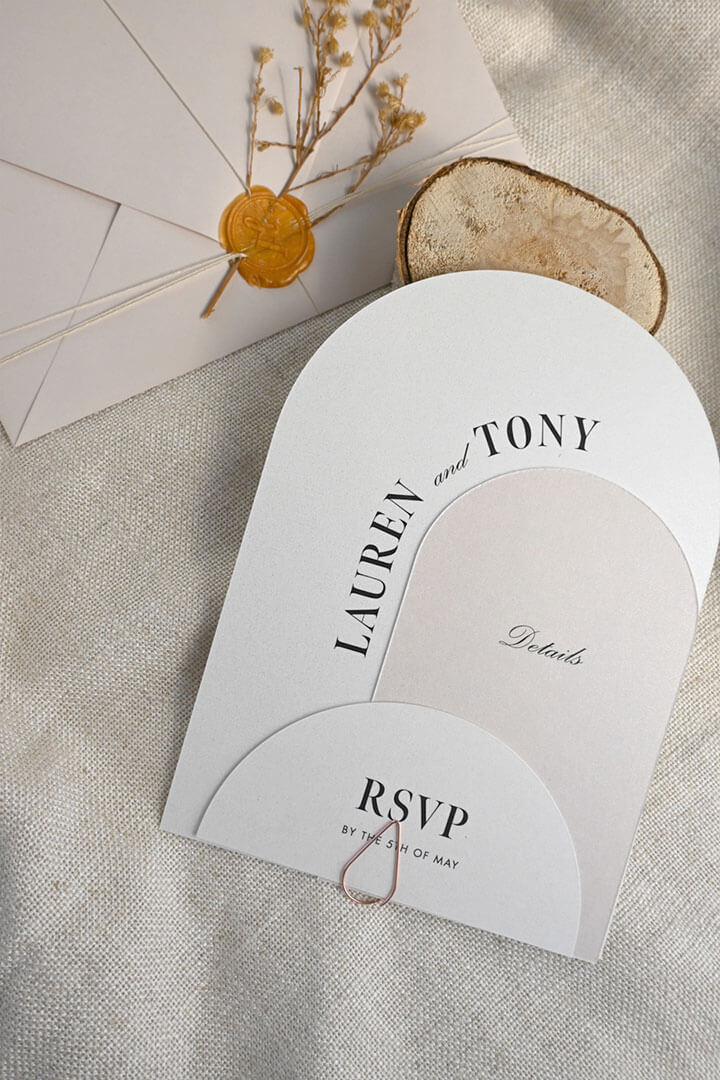

The Master Wedding Stationery Checklist
| Piece | When to Order | Essential? | Notes |
|---|---|---|---|
| Save the date cards | 6-18 months out | Recommended | Earlier for destination weddings |
| Invitation cards | 3-4 months out | Yes | The centerpiece of your suite |
| RSVP cards | With invitations | Yes | Include reply-by date; 4-6 weeks before wedding |
| Details/info cards | With invitations | Often yes | Hotel blocks, parking, dietary notes |
| Envelope address printing | Before mailing | Recommended | ~$0.20/address; saves hours of handwriting |
| Ceremony programs | 4-6 weeks before | For formal ceremonies | Order of service, readings, bridal party |
| Reception menus | 4-6 weeks before | For sit-down dinners | Confirm final menu with caterer first |
| Place cards | 2-3 weeks before | For assigned seating | Order after seating chart is final |
| Table numbers | 4-6 weeks before | For multi-table receptions | Match your invitation suite design |
| Wishing well insert | With invitations | Optional | Communicates gift preference (cash, experience) |
| Thank you cards | Order before wedding | Yes | Send within 3 months of wedding |
| Wedding signage | 4-6 weeks before | Optional but impactful | Welcome signs, seating chart, bar menu |
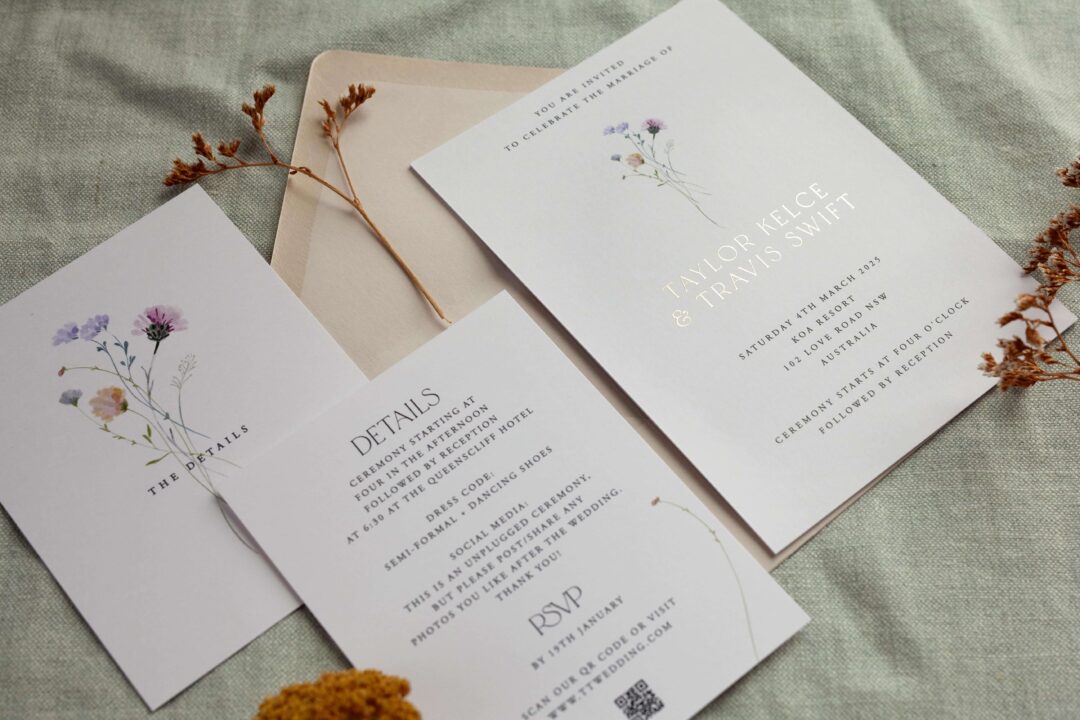
Phase 1: Pre-Wedding Stationery
Save the Dates
Save the dates serve a single purpose: claim space on your guests’ calendars before competing obligations do. They carry minimal information – your names, the date, the location city, and your wedding website URL. Everything else goes on the formal invitation.
For the full send-timing rules and a month-by-month calendar, see our companion guide on when to send save the dates.
When to order: 6-18 months before the wedding date, depending on how far guests need to travel. International and destination weddings warrant 12-18 months; standard US weddings typically send 6-8 months out.
Quantity tip: Order one per household plus 15-20% extra for damaged mail, keepsakes, and last-minute additions to your guest list.
Price: From $1 per card at Paperlust. Browse the save the date collection for designs that coordinate with your invitation suite.
Wedding Invitations
The invitation is the most important piece of stationery you’ll order. It sets the visual tone, communicates essential details, and serves as a keepsake for many guests. Choose this piece carefully – the print method, paper weight, and design should all reflect your wedding’s aesthetic.
When to order: 2 weeks for digital print, white ink, or metallic; 3 weeks for flat foil; 6 weeks for letterpress or foil stamp. Target mailing invitations 6 to 8 weeks before the wedding.
What to include: Names, ceremony date and time, ceremony venue (full address), reception venue (if different), RSVP deadline and method, and an indication of dress code if not standard.
Price: From $2.04 per card. Browse the full wedding invitations collection.
RSVP Cards
RSVP cards are the mechanism for collecting responses. They should include a clear reply-by date (typically 4-6 weeks before the wedding to give caterers and seating chart planners time to work), a way to respond (return envelope or QR code to online RSVP), and space for dietary requirements if needed.
When to order: At the same time as invitations. They’re mailed together as part of the suite.
Format tip: Online RSVP through your wedding website is increasingly common. If you go digital, your RSVP card can simply direct guests to the URL and remove the need for a return envelope. This reduces postage cost but may disadvantage older guests who are not comfortable with online forms – consider your guest list demographics.
Browse RSVP cards to find matching designs for your invitation suite.
Details and Information Cards
Details cards carry practical information that doesn’t fit on the main invitation: hotel block information, venue parking and transport directions, dress code clarification, dietary requirements form, or notes about the reception format. For destination weddings, information cards often span multiple pieces – travel information, accommodation guide, excursion options, and local recommendations each on their own card.
When to order: With the invitation suite.
Price: From approximately $25 USD per set (not per card – this is a fixed price for the set). This is notably more affordable than ordering on a per-card basis.
Wishing Well Inserts
A wishing well card communicates your gift preference – cash, experiences, or a charitable donation – without the awkwardness of a verbal conversation. It should be worded warmly and framed as “if you’d like to contribute” rather than as an expectation.
When to order: With the invitation suite, as it’s mailed inside the envelope with the invitation package. Browse the wishing well cards collection for options.
Phase 2: Day-Of Stationery
Day-of stationery creates the on-site experience for your guests. These pieces set the visual tone of your venue, guide guests through the event, and add detail that photographs remember. They are ordered later than your invitation suite because the content (final seating chart, confirmed menu, finalized bridal party order) isn’t known until closer to the wedding.
Ceremony Programs
Programs help guests follow the ceremony: the order of service, readings and who delivers them, music selections, bridal party names and their relationships to the couple, and any ceremonial traditions guests may be unfamiliar with (unity candle, cultural traditions, etc.). For weddings under 30 guests where most attendees know the couple well, programs are often skipped. For larger or more formal ceremonies, they’re worth the cost.
When to order: 4-6 weeks before the wedding, once the ceremony order is confirmed with your officiant.
Quantity: One per guest, not per couple – people like to keep programs. Browse wedding programs for design options.
Reception Menus
Menus serve dual purposes: they inform guests about the meal and they dress the table visually. For plated dinners, menus are nearly always used. For buffet receptions, large printed menu signs often replace individual cards. For cocktail receptions, individual menus are usually skipped.
When to order: 4-6 weeks before the wedding, once the final menu is confirmed with your caterer. Do not order before the caterer signs off on the menu – last-minute changes are expensive to reprint.
Quantity: One per place setting (not per couple). Browse wedding menus for matching designs.
Place Cards
Place cards direct each guest to their assigned seat. They can be as simple as a name on a card tent or as detailed as a named card with the menu choice pre-noted. For weddings with assigned seating (most formal receptions), place cards are essential.
When to order: 2-3 weeks before the wedding, after the seating chart is finalized. This is typically the last stationery item ordered.
Practical note: Order 10-15 extra to account for last-minute seating changes and damaged cards. At this late stage, a reorder of 10 cards takes 1-2 weeks that you may not have. Browse wedding place cards for options.
Table Numbers
Table numbers identify each reception table so guests can find their seats. They should match or complement the overall stationery aesthetic. Paperlust offers printed table number cards; many couples also opt for framed prints or standing acrylic frames – but verify material options directly for your preferred format.
When to order: 4-6 weeks before the wedding, once the final floor plan is confirmed with your venue.
Wedding Signage
Signage at the venue creates cohesion between your stationery and the physical space. Common pieces include a welcome sign at the ceremony entrance, a seating chart display at the reception entrance, a bar menu, a gift table sign, and a photo booth instruction sign. These are optional but significantly improve the visual consistency of the venue for photography.
Paperlust prints wedding signs on fabric, printed PVC board, and acrylic panels. For outdoor venues, printed PVC board is the more weather-resistant choice; for indoor receptions, fabric signs have a softer, more editorial quality that photographs beautifully.
Phase 3: Post-Wedding Stationery
Thank You Cards
Thank you cards are the final piece of the wedding stationery story and one of the most important for your relationships. Etiquette calls for sending within three months of the wedding; two months is better. Order before the wedding so the cards are ready when you return from your honeymoon.
Quantity: One per household gift, not per guest. If 80 households attended and gave gifts, order 80-90 cards.
When to order: 4-6 weeks before the wedding, alongside or just after your day-of stationery. Browse wedding thank you cards for designs that complete your suite.
The 15% Bundle Saving: How to Plan Your Order Sequence
Paperlust automatically applies a 15% discount when you order three or more different card types in a single order. Planning your order sequence around this discount can save a meaningful amount:
- Order 1 (6-8 months out): Save the dates + anything else you have content for
- Order 2 (3-4 months out): Invitations + RSVP cards + info cards + wishing well cards + thank you cards – this is your biggest order and the one most likely to hit the 15% threshold easily
- Order 3 (4-6 weeks out): Programs + menus + table numbers – group these to hit the 3-type threshold again if possible
- Order 4 (2-3 weeks out): Place cards (content not known earlier)
The first-order 10% discount applies once per account. Use it on your largest order (usually Order 2 above) for maximum effect.
How Many to Order: The Buffer Rule
The universal advice from experienced event planners: always order more than you think you need. Here’s the standard buffer recommendation by piece type:
| Piece | Buffer to Add | Why |
|---|---|---|
| Save the dates | +15-20% | Address changes, keepsakes, list additions |
| Invitations | +10-15% | Damaged in transit, keepsakes, late additions |
| RSVP cards | Match invitation quantity | One per invitation, plus a few extras |
| Programs | +10-15% | One per guest (not per couple); guests keep them |
| Menus | +5-10% | Damaged during setup, extra seating |
| Place cards | +15 flat cards | Last-minute seating changes |
| Thank you cards | +10% | Writing errors, late gifts received |
Production and Delivery Timeline by Print Method
Every order starts with a designer proof delivered within 1-2 business days of placing the order. You have two rounds of edits included at no extra charge. Production begins after proof approval.
| Print Method | Production Time | US Shipping (DHL Express) | Total Lead Time (estimate) |
|---|---|---|---|
| Digital print | 3-5 business days | 2-4 business days | ~5-9 business days |
| Flat foil | 7-10 business days | 2-4 business days | ~9-14 business days |
| Metallic print | 3-5 business days | 2-4 business days | ~5-9 business days |
| White ink | 3-5 business days | 2-4 business days | ~5-9 business days |
| Letterpress | 20-23 business days | 2-4 business days | ~24-26 business days |
| Foil stamp | 20-23 business days | 2-4 business days | ~24-26 business days |
DHL Express shipping is free on orders over $350 USD. For smaller orders, shipping is calculated at checkout.
What You Can Skip (and When)
Not every wedding needs every piece. Here’s a realistic guide to what you can skip based on wedding format:
| Wedding Type | Can Skip | Should Not Skip |
|---|---|---|
| Intimate (under 30 guests) | Programs, individual menus, table numbers | Invitations, thank you cards |
| Cocktail reception (no sit-down dinner) | Individual menus, place cards | Invitations, RSVP cards, thank you cards |
| Backyard or informal venue | Formal programs, individual menus | Invitations, RSVP cards, thank you cards |
| Destination wedding | Nothing – guests need more info, not less | Everything; especially info cards and signage |
| Large formal reception (100+ guests) | Nothing sensible to skip | Full suite including programs and signage |
About This Guide
This checklist was compiled by the Paperlust content team using production data and customer service records from over a decade of wedding stationery production. Order timing recommendations reflect actual production windows as of 2026, including current DHL Express transit performance to US addresses. The “can skip” guidance reflects real patterns from customer orders across different wedding formats, not theoretical advice.
Sources: Paperlust production team; customer service consultation; wedding etiquette standards (2026).
Frequently Asked Questions
What stationery do I absolutely need for a wedding?
The non-negotiables are: invitations, RSVP cards, and thank you cards. Save the dates are strongly recommended but not technically required for local weddings with short notice. Everything else – programs, menus, place cards, signage – depends on your wedding format and is genuinely optional for many couples.
When should I order my wedding invitations?
Order 2 weeks before your target mail date for digital print, white ink, or metallic. Add a week for flat foil (7 to 10 business days in production), and several weeks more for letterpress or foil stamp, which take 20 to 23 business days. Target mailing invitations 6 to 8 weeks before the wedding so guests have time to respond before your RSVP deadline.
How do I save money on a full stationery suite?
Order three or more card types in a single order to trigger the 15% automatic discount. Group your invitation, RSVP cards, info cards, and thank you cards into one order. Use the 10% first-purchase discount on that largest order. Choose digital print for enclosures and save premium print methods for the invitation card only.
Should I order programs if my ceremony is short?
For ceremonies under 30 minutes with a simple structure and guests who all know the couple well, programs are often skipped. For ceremonies with cultural traditions, multiple readings, or guests who may be unfamiliar with the religious format, programs significantly improve the guest experience.
Do place cards and menus have to match the invitation design?
They don’t have to, but matching creates a more polished impression. Many couples use the same design family with minor variations (matching color palette and typeface even if the motif is slightly different). Paperlust’s suite approach means many designs are available across multiple card types.
What is a details card and do I need one?
A details card (also called an information card or enclosure card) carries practical information that doesn’t fit on the invitation: hotel block details, parking, transportation, dietary RSVP notes. For weddings where guests need logistical information, it’s recommended. For simple local weddings where everything is covered on the wedding website, it can be skipped in favor of a website link on the invitation.
How long after the wedding should I send thank you cards?
Within three months of the wedding. Two months is better. Pre-ordering before the wedding so the cards are ready when you return from your honeymoon makes this deadline much easier to meet. Write them in batches of 10-15 per day rather than all at once.
Shop Wedding Menus at Paperlust
Custom wedding menu designs to match your suite, customizable online with an online proof.