
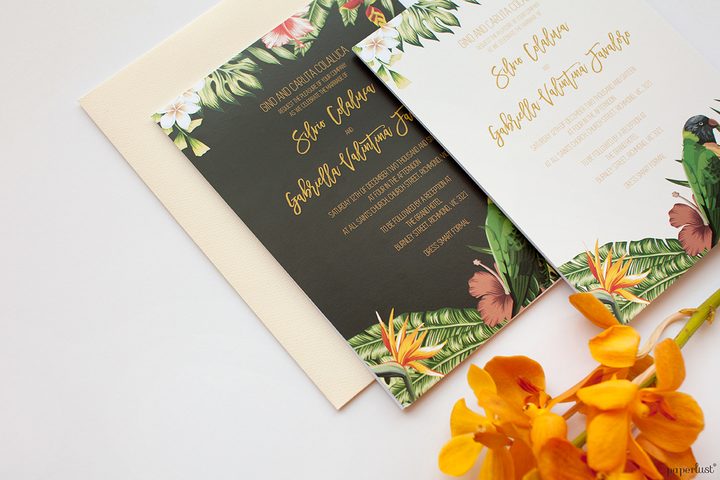
- Formal invitations use third-person, full-name phrasing with no abbreviations and spelled-out dates and times.
- The hosting line names whoever is paying for the wedding, traditionally the bride’s parents, but modern versions list both families or the couple themselves.
- Traditional order: hosting line, request line, couple’s names, date, time, venue, city.
- Religious ceremonies use “the honour of your presence”; secular receptions use “the pleasure of your company.”
- All numbers, date, year, time, are spelled out in full on formal invitations (no numerals).
- Browse Paperlust’s formal wedding invitations including letterpress and foil stamp designs.
- For casual, semi-formal, and all other wording styles, see our complete wedding invitation wording guide with 80+ examples.
Formal wedding invitation wording follows centuries of etiquette tradition, and while you do not have to follow every rule, understanding the conventions helps you make deliberate choices about which ones to keep and which to adapt. This guide covers 40+ copy-ready templates for traditional, religious, military, and multi-family scenarios, with plain-English explanations of what every line means and why it is there.
This guide covers formal wording only. For casual, relaxed, and semi-formal styles, see our complete wedding invitation wording guide with 80+ examples across every style and tone. Browse Paperlust’s wedding invitation designs to see how formal wording looks in real layouts.
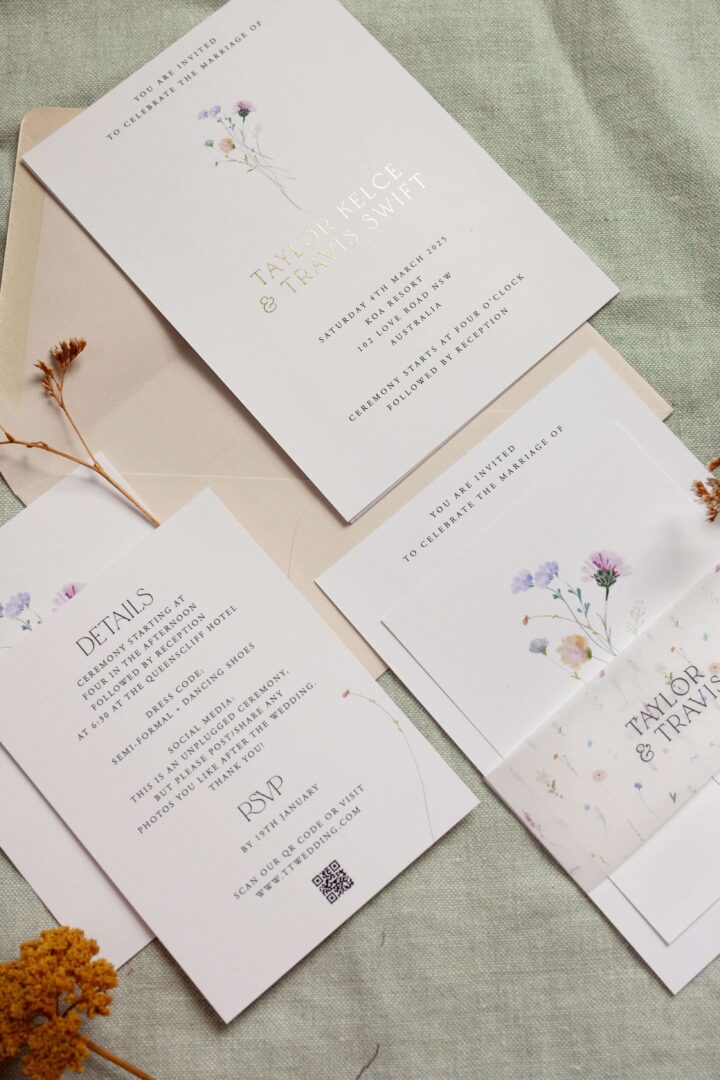

| Line | Purpose | Example |
|---|---|---|
| Hosting line | Names who is hosting (paying) | Mr. and Mrs. James Whitmore |
| Request line | The formal invite phrase | request the honour of your presence |
| Couple’s names | Who is getting married | Eleanor Grace Whitmore and James Edward Hollis |
| Date line | Day and date, spelled out | Saturday, the eighteenth of October |
| Year line | Year, spelled out | two thousand and twenty-six |
| Time line | Ceremony start time | at half past four in the afternoon |
| Venue name | Full name of the venue | The Grand Ballroom |
| City and state | Location | Charleston, South Carolina |
The formal invitation request line: honour vs. pleasure
The two most common formal request phrases are not interchangeable:
- “Request the honour of your presence”: traditionally used for religious ceremonies. The British spelling “honour” (rather than “honor”) is conventional on formal American invitations and is an exception to the general US English rule. Both spellings are accepted.
- “Request the pleasure of your company”: used for secular ceremonies and receptions. If you are having a civil ceremony at a venue rather than a house of worship, this is the more accurate phrase.
Both phrases signal formality, the distinction is about venue type, not about which sounds better. Many couples today use either interchangeably without issue.
Standard formal wedding invitation templates
Traditional, bride’s parents hosting
The most classic American formal invitation, where the bride’s family is named as host.
request the honour of your presence
at the marriage of their daughter
Eleanor Grace
to
James Edward Hollis
son of Mr. and Mrs. Thomas Hollis
Saturday, the eighteenth of October
two thousand and twenty-six
at half past four in the afternoon
The Grand Ballroom
Charleston, South Carolina
Reception to follow
Traditional, groom’s parents hosting
request the honour of your presence
at the marriage of
James Edward Hollis
to
Eleanor Grace Whitmore
Saturday, the eighteenth of October
two thousand and twenty-six
at half past four in the afternoon
The Grand Ballroom
Charleston, South Carolina
Reception to follow
Both families hosting (joint host)
and
Mr. and Mrs. Thomas William Hollis
request the honour of your presence
at the marriage of their children
Eleanor Grace Whitmore
and
James Edward Hollis
Saturday, the eighteenth of October
two thousand and twenty-six
at half past four in the afternoon
The Grand Ballroom
Charleston, South Carolina
Reception to follow
Couple hosting (no parental hosting line)
Eleanor Grace Whitmore
and
James Edward Hollis
request the honour of your presence
at their marriage
Saturday, the eighteenth of October
two thousand and twenty-six
at half past four in the afternoon
The Grand Ballroom
Charleston, South Carolina
Reception to follow
Formal wedding invitation designs →

Good SpringDigital printing
Modern ModeDigital printing

Half MoonColour Stock + Foil

Fifth AvenueDigital printing
Formal wording for divorced and remarried parents
When parents are divorced, each parent is listed on a separate line. If a parent has remarried, include the stepparent’s name. The bride’s mother traditionally appears first.
Bride’s divorced parents hosting (mother remarried)
and
Mr. Robert Whitmore
request the honour of your presence
at the marriage of their daughter
Eleanor Grace Whitmore
to
James Edward Hollis
Saturday, the eighteenth of October
two thousand and twenty-six
at half past four in the afternoon
The Grand Ballroom
Charleston, South Carolina
Bride’s divorced parents, neither remarried
and
Mr. James Robert Whitmore
request the honour of your presence
at the marriage of their daughter
Eleanor Grace
to
James Edward Hollis
Saturday, the eighteenth of October
two thousand and twenty-six
at half past four in the afternoon
The Grand Ballroom
Charleston, South Carolina
One parent deceased
requests the honour of your presence
at the marriage of her daughter
Eleanor Grace Whitmore
daughter of the late Mr. James Robert Whitmore
to
James Edward Hollis
Saturday, the eighteenth of October
two thousand and twenty-six
at half past four in the afternoon
The Grand Ballroom
Charleston, South Carolina
Religious formal invitation wording
Religious ceremonies often include an additional line naming the officiant or the specific rite. Catholic, Jewish, and Protestant traditions each have standard phrasing conventions.
Catholic ceremony
request the honour of your presence
at the Nuptial Mass uniting their daughter
Eleanor Grace
with
James Edward Hollis
Saturday, the eighteenth of October
two thousand and twenty-six
at eleven o’clock in the morning
Saint Mary’s Cathedral
Charleston, South Carolina
Reception immediately following
Jewish ceremony
and
Mr. and Mrs. David Schwartz
joyfully invite you to share in the celebration
of the marriage of their children
Rachel Miriam Goldstein
and
Benjamin Noah Schwartz
Saturday, the eighteenth of October
two thousand and twenty-six
at five o’clock in the evening
Temple Beth Israel
Atlanta, Georgia
Dinner and dancing to follow
Protestant/general Christian ceremony
request the honour of your presence
at the marriage of their daughter
Eleanor Grace
to
James Edward Hollis
before God and their families
Saturday, the eighteenth of October
two thousand and twenty-six
at three o’clock in the afternoon
First Presbyterian Church
Charleston, South Carolina
Reception to follow
Same-sex formal invitation wording
For same-sex couples, traditional etiquette places names in alphabetical order when neither partner is the designated “bride.” Both partners use their full names without honorific-linked order conventions.
Two grooms, parents hosting
and
Mr. and Mrs. Robert Andrew Clarke
request the honour of your presence
at the marriage of their sons
Alexander Thomas Clarke
and
James Edward Hollis
Saturday, the eighteenth of October
two thousand and twenty-six
at half past four in the afternoon
The Grand Ballroom
Charleston, South Carolina
Two brides, couple hosting
Catherine Anne Fairbanks
and
Rachel Miriam Goldstein
request the honour of your presence
at their marriage
Saturday, the eighteenth of October
two thousand and twenty-six
at five o’clock in the evening
The Rosewood Estate
Savannah, Georgia
Military formal invitation wording
Active military personnel use their rank on wedding invitations. The convention: if the rank is junior officer or above (Captain and above for Army/Air Force/Marines; Lieutenant and above for Navy/Coast Guard), the rank precedes the name. Junior enlisted members list their branch below their name.
Army officer (bride is military)
request the honour of your presence
at the marriage of their daughter
Captain Eleanor Grace Whitmore
United States Army
to
James Edward Hollis
Saturday, the eighteenth of October
two thousand and twenty-six
at half past four in the afternoon
Fort Hamilton Chapel
Brooklyn, New York
Navy officer (groom is military)
request the honour of your presence
at the marriage of their daughter
Eleanor Grace Whitmore
to
Lieutenant Commander James Edward Hollis
United States Navy
Saturday, the eighteenth of October
two thousand and twenty-six
at half past four in the afternoon
Naval Station Chapel
Norfolk, Virginia
Honorifics, titles, and professional designations
Formal invitations use full honorifics throughout. The standard system is straightforward for most situations, but there are edge cases worth knowing before you print.
Standard honorific use
| Title | Used for | Example on invitation |
|---|---|---|
| Mr. | Adult men (married or unmarried) | Mr. James Robert Whitmore |
| Mrs. | Married women (traditionally takes husband’s surname) | Mrs. Thomas William Hollis |
| Ms. | Women regardless of marital status; preferred by many | Ms. Eleanor Grace Whitmore |
| Dr. | Medical doctors and PhDs; listed before the name | Doctor Eleanor Whitmore and Mr. James Hollis |
| The Reverend | Ordained clergy | The Reverend and Mrs. James Whitmore |
| The Honorable | Judges and certain elected officials | The Honorable James Whitmore |
When both partners hold a title
List both titles in full: “Doctor Sarah Gilbert and Doctor David Cannon.” If one partner holds a title and the other does not, list them together: “Doctor Sarah Gilbert and Mr. David Cannon.” Do not use “Drs.” as a plural abbreviation on a formal invitation.
Divorced or widowed parents
A divorced woman who has not remarried uses “Mrs.” with her own first and last name, not her ex-husband’s first name: “Mrs. Margaret Whitmore” is correct; “Mrs. James Whitmore” is not. A widow traditionally keeps the married form, but “Mrs. Margaret Whitmore” is increasingly preferred. When in doubt, ask the parent directly how they prefer to be listed.
Dropping titles for the couple’s own names
The couple’s names on a formal invitation do not carry honorifics. It is “Eleanor Grace Whitmore” not “Miss Eleanor Grace Whitmore.” This applies across all formal invitation styles, the names stand alone.
Professional designations after the name
Academic or professional suffixes (PhD, MD, Esq.) are not typically used on formal wedding invitations. The title before the name (“Doctor Eleanor Whitmore”) is the standard form. If both partners are physicians, “Doctor Eleanor Whitmore and Doctor James Hollis” is correct and clear.
Formal time phrasing reference
On a formal invitation, times are spelled out in full. Here is a complete reference:
| Clock time | Formal phrasing |
|---|---|
| 11:00 AM | at eleven o’clock in the morning |
| 12:00 PM | at noon |
| 1:00 PM | at one o’clock in the afternoon |
| 2:30 PM | at half past two in the afternoon |
| 4:00 PM | at four o’clock in the afternoon |
| 4:30 PM | at half past four in the afternoon |
| 5:00 PM | at five o’clock in the evening |
| 6:30 PM | at half past six in the evening |
| 7:00 PM | at seven o’clock in the evening |
Formal attire and reception line
The reception line at the bottom of a formal invitation signals what follows the ceremony. Common options:
- Reception immediately following: ceremony and reception at the same venue
- Reception to follow: reception at a different venue (include a separate details card)
- Dinner and dancing to follow: signals a full reception with dinner service
- Cocktails and dancing to follow: signals a cocktail-format reception, no seated dinner
Dress code on a formal invitation is optional but helpful. If you include it, list it in the lower right corner of the card or on a separate details card: “Black tie preferred,” “Black tie optional,” or “Formal attire.”
Pair your formal invitation with formal RSVP cards from the same suite. See wording templates for formal reply cards in the section below.
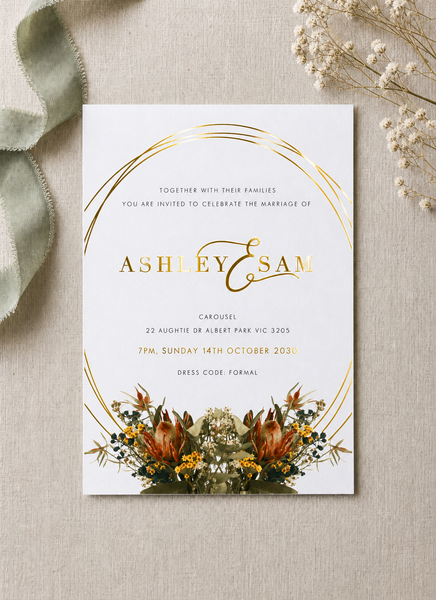
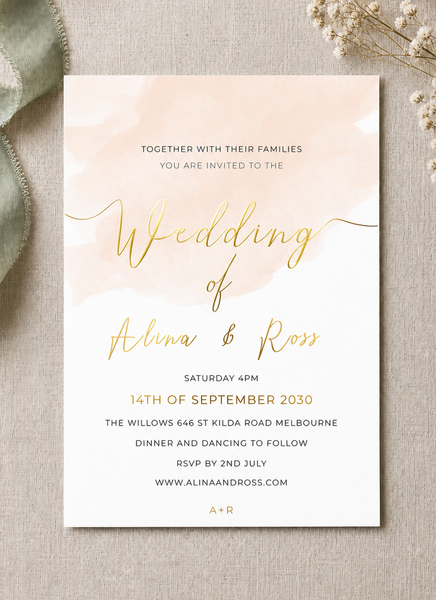
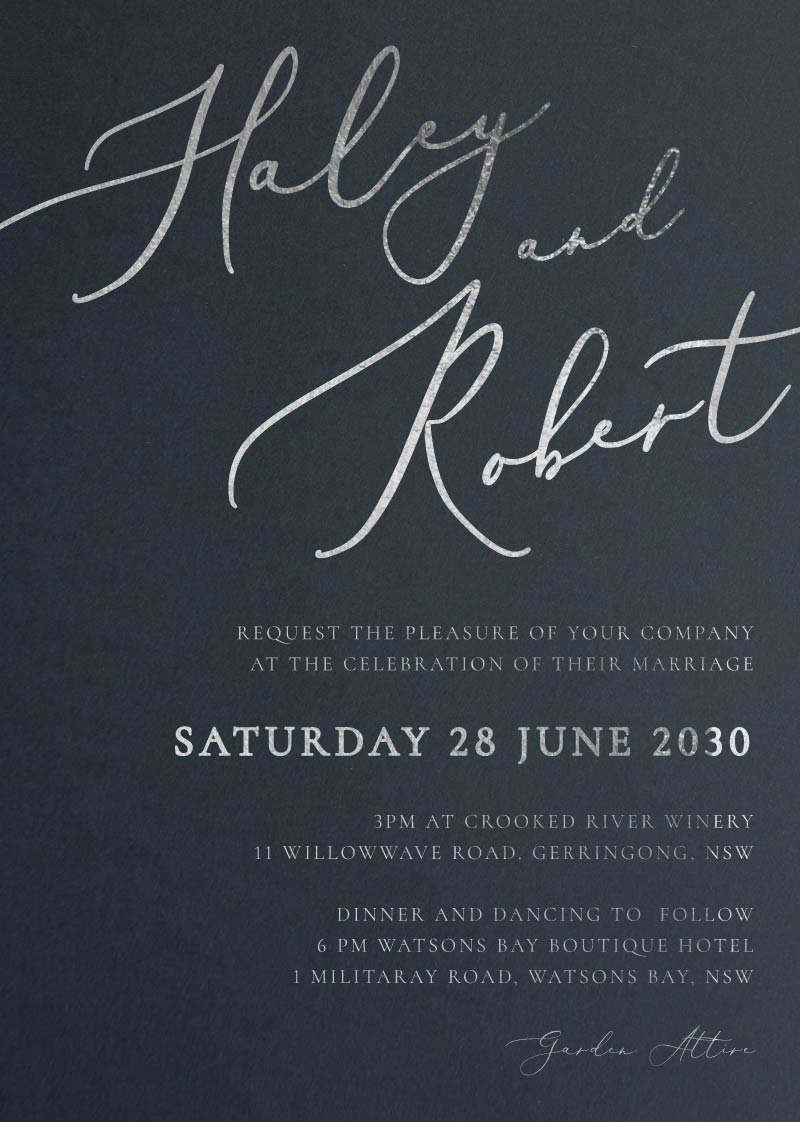
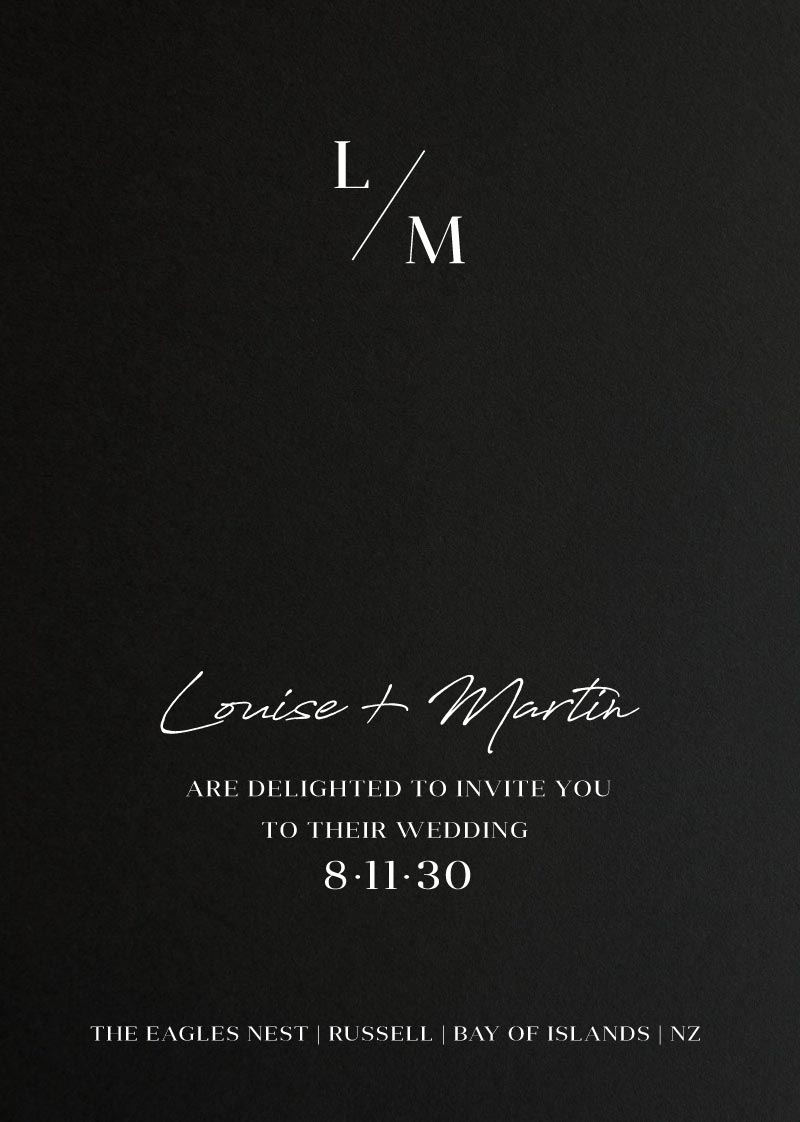
Formal weddings traditionally call for engraved or letterpress invitations, the pressed, tactile impression conveys the same weight and seriousness as the wording. At Paperlust, letterpress is printed on 300gsm or 600gsm Wild Cotton paper and creates a genuine deboss impression. Foil stamp adds a mirror-bright metallic finish with the same deboss effect. Browse formal wedding invitations, explore letterpress designs, and coordinate with matching RSVP cards from the same suite.
Formal RSVP card wording
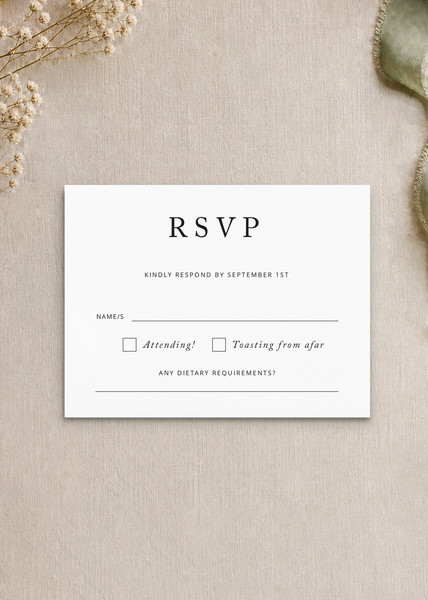
A formal invitation deserves a formal reply card. The same conventions apply: spelled-out language, no casual abbreviations, and a clear response deadline. Browse formal RSVP card designs at Paperlust that coordinate with your invitation suite.
Traditional formal RSVP
___ accepts with pleasure
___ declines with regrets
With meal selection
M _______________________________
[ ] Accepts with pleasure
[ ] Declines with regrets
Meal preference:
[ ] Chicken [ ] Fish [ ] Vegetarian
Number of guests attending
Kindly reply by May first
The “M” line is a traditional shorthand: guests write their title and name (Mr., Mrs., Ms., Dr.) as their response signature. It dates to an era of handwritten RSVPs and is still common on formal reply cards today. It is optional, many couples omit it and use “Name:” instead.
Black and WhiteDigital printing

EucalyptusDigital printing

Forest WalkFlat foil

Stylistically GreenFlat foil
Common formal wording mistakes
| Mistake | Correction |
|---|---|
| Using numerals (Oct. 18, 2026) | Spell out: the eighteenth of October, two thousand and twenty-six |
| “4:30 PM” | “at half past four in the afternoon” |
| Using ampersand (&) in the host line | Spell out “and” in the hosting and couple lines |
| “Mr. & Mrs.” | “Mr. and Mrs.” (no ampersand) |
| Using a comma after the venue city | No punctuation after venue city on formal invitations |
| Listing a street address | Formal invitations show only venue name and city, the address goes on the outer envelope or info card |
Created by the Paperlust stationery and design team. Since 2014, Paperlust has worked with thousands of couples to design custom wedding invitations, from formal letterpress suites to modern digital designs. Every order comes with a dedicated designer and a 100% happiness guarantee.
Frequently asked questions
Should I use “honour” or “honor” on a formal wedding invitation?
Both are acceptable on American formal invitations. “Honour” (British spelling) is the traditional convention for this specific phrase and is widely used even in American contexts. “Honor” is equally correct. Choose based on personal preference, neither is wrong.
Do formal wedding invitations need to be third-person?
Yes. Traditional formal invitations use third-person phrasing throughout: “request the honour of your presence at the marriage of their daughter Eleanor” rather than “invite you to our wedding.” If you want to write in first person, that is a semi-formal or casual choice, not a formal one.
How do I list a divorced mother on a formal invitation?
A divorced woman who has not remarried uses “Mrs. [First Name] [Last Name]” (her own last name, not the ex-husband’s). If she has reverted to her maiden name, use that. Each divorced parent appears on a separate line, with the mother listed first.
Can I abbreviate “Doctor” on a formal invitation?
No. Formal invitations spell out all titles and honorifics. However, “Dr.” is actually an abbreviation that is universally accepted on formal invitations as an exception to the no-abbreviations rule. Both “Doctor” and “Dr.” are correct in formal contexts.
What is the correct order for listing names when both partners are women?
Traditional etiquette used to place the bride’s name first. For same-sex couples, contemporary etiquette places names in alphabetical order by first name when there is no traditional “bride” designation. Alternatively, go by whatever order sounds or looks better on the card, your guests will not be checking alphabetization.
Where does the dress code go on a formal invitation?
Dress code is typically listed in the lower right corner of the invitation card, or on a separate details card. It is never listed on the face of the invitation in the main wording block. Common phrasing: “Black tie,” “Black tie preferred,” “Black tie optional,” or “Formal attire.”
Do I need to include “Reception to follow” on the invitation?
Yes, if you are hosting a reception. Guests need to know what follows the ceremony. “Reception immediately following” signals everything is at the same venue. “Reception to follow” signals a separate venue, include the details on an enclosure card.
Should formal invitations include a street address for the venue?
Traditionally, no. A formal invitation includes only the venue name and the city, the street address is reserved for the inner or outer envelope, or a separate details/directions card. This is a style convention rather than a practical one, so many modern couples include the address for convenience.
Browse Paperlust’s formal wedding invitations including letterpress and foil stamp designs, all fully customizable with your wording. Order the $5 sample pack to feel paper stock and print finish before you commit.
Browse Formal InvitationsLetterpress DesignsOrder $5 Sample Pack